






Within today’s increasingly hybrid cultural landscape, the line between design and art appears not so much blurred as it is seemingly in a state of constant re-drawing. London-based visual artist Wenbin Sun stands at what might be characterised as this shifting boundary. Initially trained as a graphic designer and now working across installation, publication, and object-led research, Sun’s work seems to embody a practice that largely resists simple categorisation. What seems to emerge from his work is an understanding of visual grammar ostensibly born from branding systems, but it steadily unfolds into what appears to be a tactile, critical language that tends to explore materiality, space, and cultural perception.
Rather than discarding his graphic roots, Sun appears to push them into new terrain, transforming the two-dimensional logic of grids, typography, and identity into sculptural, participatory, and conceptual explorations. What this appears to suggest is that this shift from graphic grammar to tactile thinking is not only material, but also intellectual and cross-cultural. Given the multifaceted nature of this evidence, at a moment when global design languages increasingly trend toward a certain homogeneity, Sun’s work seems to lend support to what may represent complexity, hybridity, and resistance.
Born in China and currently based in the UK, Wenbin s artistic trajectory appears to mirror the layered, transnational qualities of his practice. His early design education in Shanghai introduced him to the technical foundations of graphic design, typography, layout, packaging, bookbinding, but also awakened a curiosity for conceptual experimentation. He was typically interested in the grey zones where design becomes illegible, or where function collapses into something more speculative.
It was during his BA studies in Graphic Branding and Identity at the London College of Communication (UAL) that Sun began to critically reflect on the systems behind visual culture. What appears to follow from this analysis is that Sun began creating works that resemble diagrams but operate more like sculptures. He translated type into what seems to constitute sculptural modules, expanded layouts into spatial environments, and reimagined visual systems as engagement. Considering the nuanced nature of these findings, his projects increasingly took the form of printed installations, participatory publications, and small-scale objects that tend to blur the lines between media.
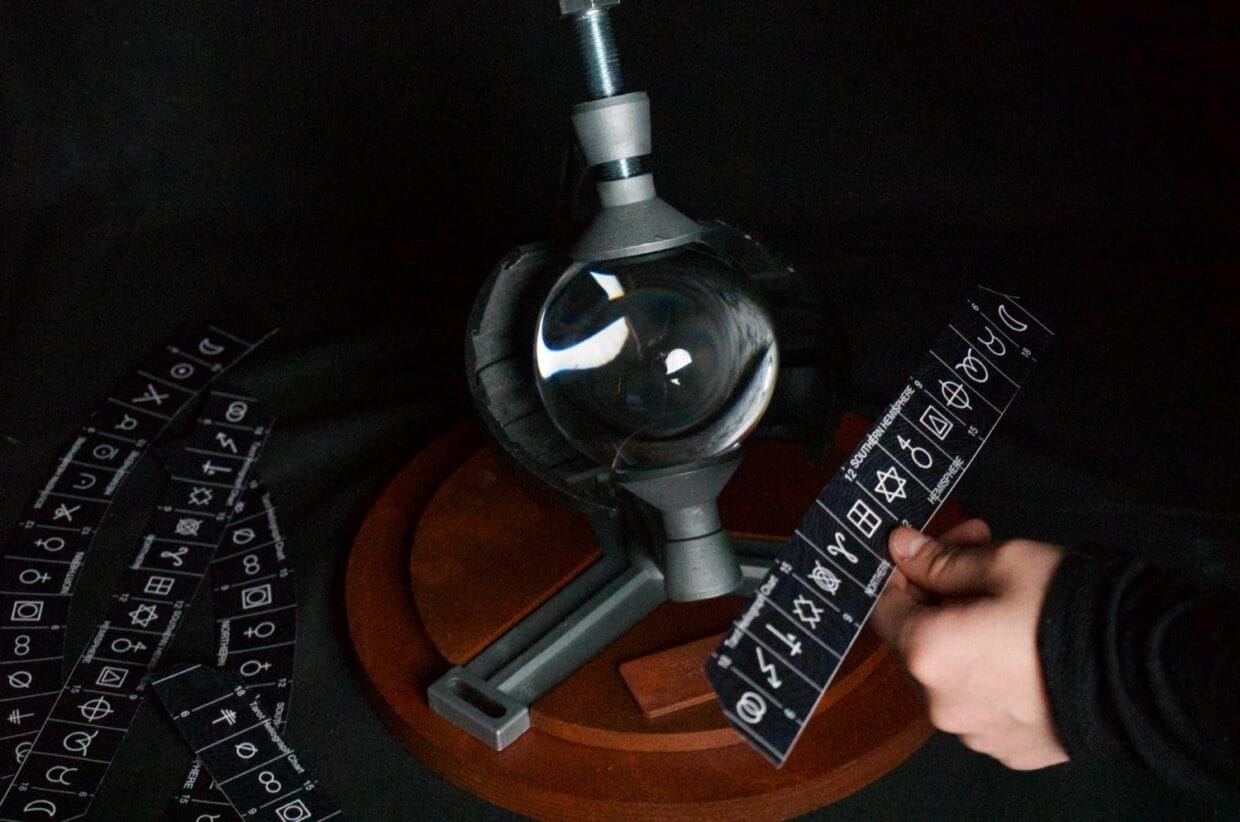
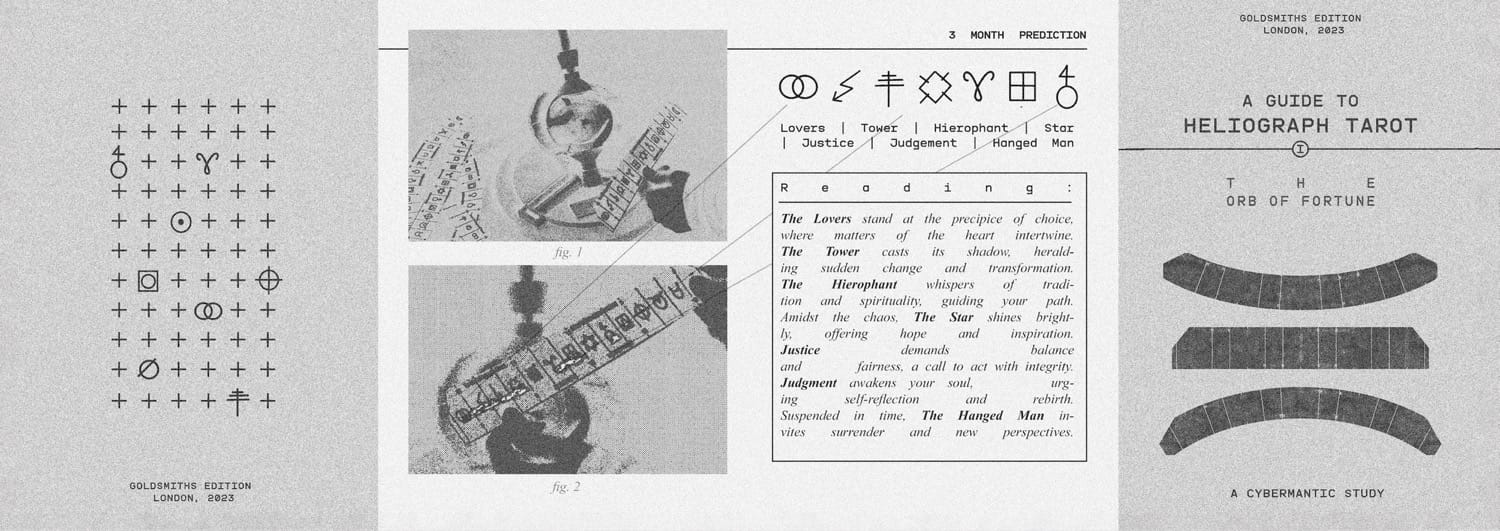
His work The Orb of Fortune serves as a representative example. In this piece, he seeks to extract the cultural traces, value systems, and power mechanisms embedded within the structural attributes of objects. The work centres on a constructed spherical installation that uses a metallic framework, rotating components, and multiple layers of transparent materials. Standing before it, the viewer is not merely a passive observer but becomes an active participant, both a player and a decoder, guided by the work’s visual and structural mechanisms. The surface design resembles that of a divination device or a museum artefact display, while the embedded graphics, symbols, and linguistic fragments within constantly point toward uncertainty and the disintegration of meaning. This is a deliberate process of construction and deconstruction.
In his practice, Wenbin Sun consistently emphasises the relationship between the discursiveness of objects and the plasticity of ideas. In Urban Green Gap, language is reshaped into a terrain. The 3D-printed letters, scattered like urban relics, host tiny plants sprouting through their fissures. The work explores the intersection of technology and ecology, where cracks appear in systems of control and new forms of faith and life begin to take root.
Given the complexity of these theoretical relationships, as design continues to globalise and visual languages become increasingly homogenised, voices like Sun’s appear to offer a necessary counterpoint. What his work appears to do is invite us to feel what we typically only see, and to think about what we often take for granted. What this tends to indicate, therefore, is that from graphic grammar to tactile thinking, Wenbin Sun’s expanded visual language seems to constitute not merely a method, but a message in itself.
Author: Ming Liu