




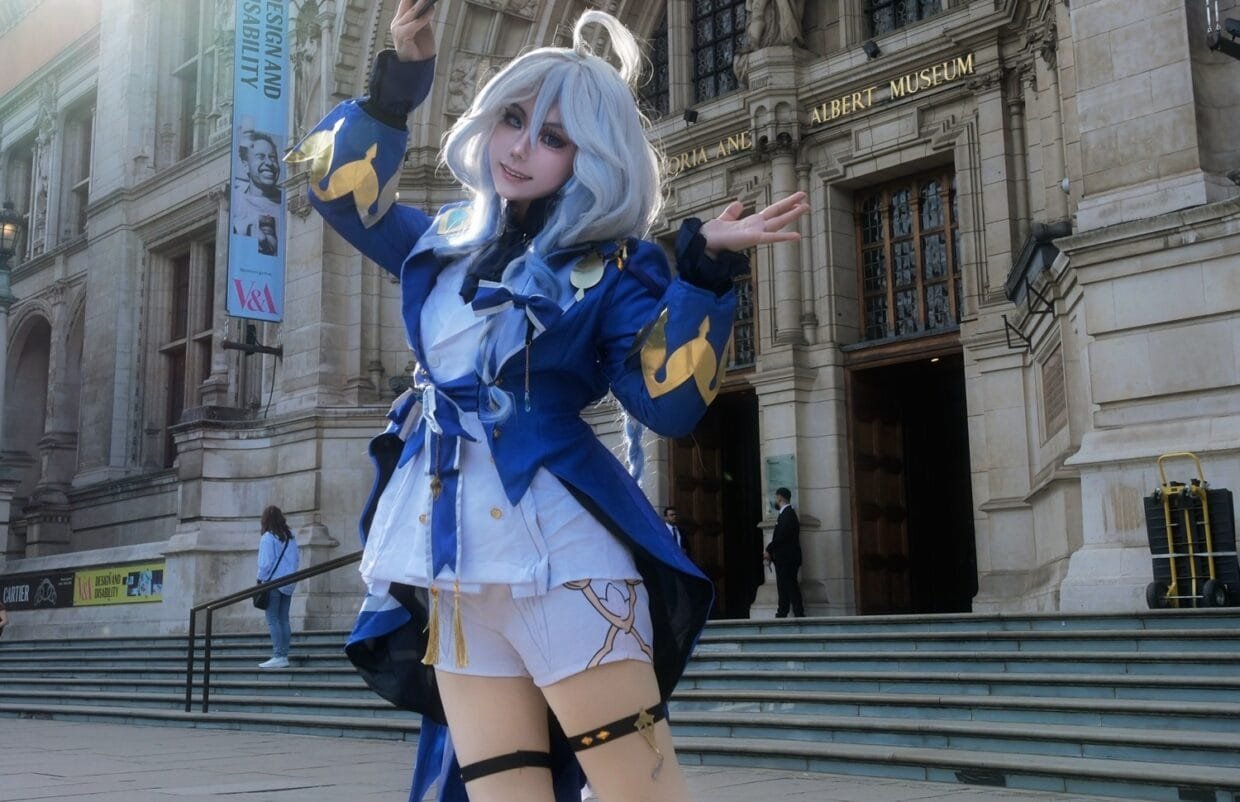
In front of the V&A Museum in London, a unique performance captured the attention of visitors from around the world. Fanli Meng stood on the steps leading to the main plaza, dressed in the magnificent costume of Furina from Genshin Impact. With her captivating voice and profound emotional commitment, she infused every note with life and soul. The melody of “Light Ripples” (La vaguelette)flowed like silk, resonating in the air and guiding the audience through a world where the virtual and real worlds intertwined. Fanli Meng was not just portraying a character; her performance gave Furina a new life, breaking the boundaries of artistic forms and creating a fusion of sound and the virtual world.
We delve into a conversation with Fanli Meng, exploring her creative philosophy as a sound artist, how she promotes cultural exchange through the integration of various art forms, and her unique influence in the global sound art field.
The recent re-interpretation of “La vaguelette” by you has garnered widespread attention. What inspired you to choose this piece as a breakthrough for your creative work?
Fanli Meng: This song captivates me not only because of the refined musical aesthetics but also for how it integrates traditional vocal structures with a dramatic world-building approach. Produced by HoYoverse, this piece symbolizes how contemporary game companies are redefining music as a narrative tool. HoYoverse has held over 20 orchestral concerts worldwide, from Shanghai to London, Paris, and Los Angeles, specifically inviting leading musical theatre artists from around the world, who contributed not just vocally but also to the artistic shaping of the piece’s vocal dimension. This serious approach to drama truly resonates with me.

So from your perspective, was this more than just a musical decision—perhaps a conceptual one too? How effective do you think the overall execution turned out?
Fanli Meng: Certainly, what fascinates me the most is how this song blurs the boundaries between the virtual world and live performance. Although it is sung by the game character Furina from Genshin Impact, the song requires the precise control of an experienced dramatic soprano. From March to June 2025, thanks to the collaboration between Beijing Universal Resort and Genshin Impact‘s fixed scene, this work broke through the virtual world and entered the physical space, bringing an unprecedented immersive experience. The audience’s strong emotional responses clearly indicate that this is no longer “just” game music, but a completely new form of artistic expression, merging elements of the virtual and real worlds, as well as game and drama, to create a deeply immersive narrative experience.
During this process, I also received extremely valuable feedback.One of the most valuable pieces of feedback came from Professor Sun, a vocal specialist at the Central Conservatory of Music who has performed at leading international venues. She has offered me guidance before. She pointed out that my French diction—especially the articulation at the end of certain phrases—needed improvement, particularly in shaping final consonants and controlling lip movements during vocal release. Her feedback was honest and insightful, helping me focus on specific technical refinements in phrasing and pronunciation.
Your sound art works cover various forms, from audiodrama to virtual character portrayals and immersive audio storytelling. Could you specifically share the artistic techniques and expressive forms used in these creations?
Fanli Meng: I believe that sound art itself has infinite expressive power. It is a pure way of conveying emotions, which is exactly what I emphasize in my creations. In audiodramas and voice acting projects, I often use tone, speech speed, rhythm, and sound effects to convey emotional layers in different contexts. For example, when voicing an epic mythological story, I adopt a deep and powerful tone, combined with background music and environmental sound effects, to create a grand and immersive atmosphere. On the other hand, in children’s stories, I use a softer and more approachable tone to cater to the emotional needs of children as they perceive and connect with the story.
In virtual character portrayal, the artistic techniques become more complex. I not only shape the character through voice but also combine costume, performance, and background sound effects to create a multi-sensory experience. For instance, in the performance at the V&A Museum, I wasn’t merely transmitting sound; I used changes in tone, breath, and volume to deepen Furina’s emotional expression, transforming her from a virtual game character into an artistic figure with humanity and emotion. This type of character development through sound often becomes a profound artistic dialogue between the virtual and the real.
Apart from the multiple expressions of sound in your works, have you also incorporated other art forms to enhance the immersive experience of your works?
Fanli Meng: Yes, sound’s expressiveness is endless, but I tend to integrate other art forms into my works to enhance the layers and depth. For example, in an immersive audio storytelling project, I don’t rely solely on voice. I also incorporate scene design, spatial sound effects, and interactive elements. Every change in sound resonates differently in space, stimulating the audience’s sensory experience.
Take one of the projects I led, where I voiced a multilingual theatrical project. In addition to focusing on precise language expression, I combined scene changes, and audience interaction opportunities, so that listeners could experience a dual stimulation of both sound and visual effects. This cross-media integration allowed the audience to not only “hear” a story but to “immerse” themselves in it.
You mentioned the role of immersive audio and cross-media storytelling techniques in cultural exchange. Could you elaborate on how you use these creative techniques to promote the exchange and understanding of different cultures?
Fanli Meng: Absolutely. Sound has always felt like a borderless language to me. In late 2022, I took part in a local music exchange forum that focused on the intersection of traditional performing arts and youth culture. I also performed selected vocal works that aligned with my ongoing exploration of traditional timbres and storytelling. However, one moment that left a lasting impression was encountering the music of the band Second Hand Rose, whose aesthetic boldness and cultural hybridity astonished me. Their ability to blend traditional northeastern Chinese opera vocal techniques with rock music and achieved surprising international popularity with such a distinctively local sound. This experience prompted me rethink how traditional culture can be reimagined for new audiences.
Then, this encounter led to my involvement in a community-based audio project aimed at preserving the disappearing sonic heritage of an old town. I began recording local lullabies, stream sounds, and street ambience—not just as documentation, but as living material that could be transformed into new forms. I plan to experiment with these textures in future electronic music compositions, using immersive audio techniques to reconstruct environments that invite emotional and cultural resonance.
Through such approaches, I aim to tell stories that travel across cultural borders—not by flattening differences, but by deepening the listener’s engagement with unfamiliar sounds and rhythms. It’s a kind of narrative built not just on language or visuals, but on affective and spatial listening.
Your artistic achievements have earned you numerous awards and honors. What do these accomplishments mean to you?
Fanli Meng: Each award is an acknowledgment of my years of artistic exploration, but more importantly, they show me that sound art is not only a tool for personal expression; it is a power that can influence others and promote cultural exchange. Especially when I received the “World Masters Open Music Competition Gold Award,” I felt that this was not just recognition of my personal creations but also of sound art as a cross-cultural art form. This has strengthened my determination to continue exploring sound art and to use my works to bring more cross-cultural understanding and communication to the world.

What are your artistic plans and goals for the future?
Fanli Meng: In the future, we are committed to adapting “Light Ripples”(La vaguelette) into an English version to expand its international influence. At the same time, we plan to enhance the work’s appeal by incorporating more visually striking effects and creative storytelling methods, particularly in a way that resonates with the aesthetic and emotional needs of younger audiences. This is not only an innovative attempt at artistic expression but also an effort to deepen the cultural significance and emotional resonance of the work in the process.