






In the creative chaos of London, where the future of tech often feels more dystopian than utopian, Identity 2.0 is rewriting the narrative—playfully, provocatively, and with purpose. Founded by long-time collaborators Arda Awais and Savena Surana, the studio fuses art, research, and activism to reshape how we engage with technology. Now part of Somerset House’s Talent 25 programme, they’re expanding their work on digital memories and legacies, curating global roundtables and crafting cheeky AI-resistance zines. We caught up with Arda and Savena to talk tech ethics, creative community, and how Identity 2.0 is imagining better digital futures—one provocation at a time.
What inspired the creation of Identity 2.0, and how has your vision for it evolved since its founding?
We never intended to build a creative studio! We’ve been friends since 2014 (ahhh) when we lived together in uni halls. We quickly became friends, bonding over sticky dancefloors and Gossip Girl.
In 2018, we launched Identity 2.0 with a real focus on the data that builds our identities up. We created a manifesto and even spoke about how we would want to be paid for our data. But since then, we’ve become more interested in the social relationships we have with tech, and how it’s shaping ideas and the concept of identity, rather than focusing solely on data and privacy. It definitely was a starting point for us, but we’ve since branched out and thought beyond an extractive data exchange and more holistically about the role of technology.
You’re exploring identity in a digital world—what personal experiences shaped your interest in this theme?
We both had a shared frustration about how we exist online. Identity 2.0 was created late 2018, at the time both of us were working in tech startups. Arda was designing services and thinking about how audiences would interact with digital platforms. The constant reinforcement of hyper personalisation made her feel uncomfortable. Savena was working on how to implement GDPR in her company. We both had ways we wanted our interactions online to be different, we were just having a conversation over dinner about our thoughts and it led into a mini rant about how we don’t have access to shape our digital identities. We don’t have a say in how we use digital tools. So, we decided to focus on art as a tool of communicating our frustrations and future visions.
As one of Somerset House’s Talent 25 Innovators, what does this opportunity mean for your collaborative work and future projects?
It’s given us a chance to meet some of the amazing people based at Somerset House. Meeting the other artists and hearing about their work has been a definite highlight.
Having the support of Talent25 means we’ll be able to knock on a few doors that we didn’t previously have access to.
It’s also the first time we’ve had R&D funding! Since late 2023, we’ve been exploring topics around digital memories and digital legacy, and been part of a lot of interesting conversations. But now, with this funding we’ve been able to facilitate structured conversations with artists & researchers globally! So we have been able to host roundtables with thought leaders from Argentina, Mexico City, New York, Berlin and Canada to name a few.
There is an urgent need to talk about the future of our digital platforms and our presence on them; with growing environmental concerns around the construction of data centres, vampiric AI taking more and more of our data and an ageing population that is very online.
Your backgrounds span UX design, creative tech, producing, and strategy. How do your different disciplines influence how you build together?
Our respective disciplines allow us to arrive at projects with different perspectives, and create something unique to us. We lean into our different expertise, as it results in really interesting ideas for projects and ways to work with clients.
Some of our favourite ideas we’ve found outside of our sector – whilst we find ourselves in a lot of tech spaces, fun ideas have come from mycelium, CAPTCHA and school games.
As we both operate in different spaces, it also challenges us to look beyond our own knowledge biases and seek inspiration in new research and beyond. It’s surprising how many ideas we can have at a tech conference! We always start with research!
It’s also important that we build with care. We couldn’t do it without one another, and when someone is low energy, going through something or is just overwhelmed, we work through it together. We care about what we build and how we make it!
How do you see technology helping—or complicating—the way people express identity today?
Technology has always changed the way we relate to one another, as it’s such a broad stroke. Technology can be drugs that change your hormones or a locomotive that has changed the way we are able to physically be with one another.
One of, if not the most important inventions for expression of identity is the camera. It has defined what is the truth, what is worthy of expressing and how to share your life with others. Now, we see those photos being in circulation in a way that were never considered at the invention of the camera.
What has been your most impactful or unexpected audience response to Identity 2.0’s work so far?
Three pieces come to mind:
Processed by Automated by Design (an exhibition for Stop Killer Robots)
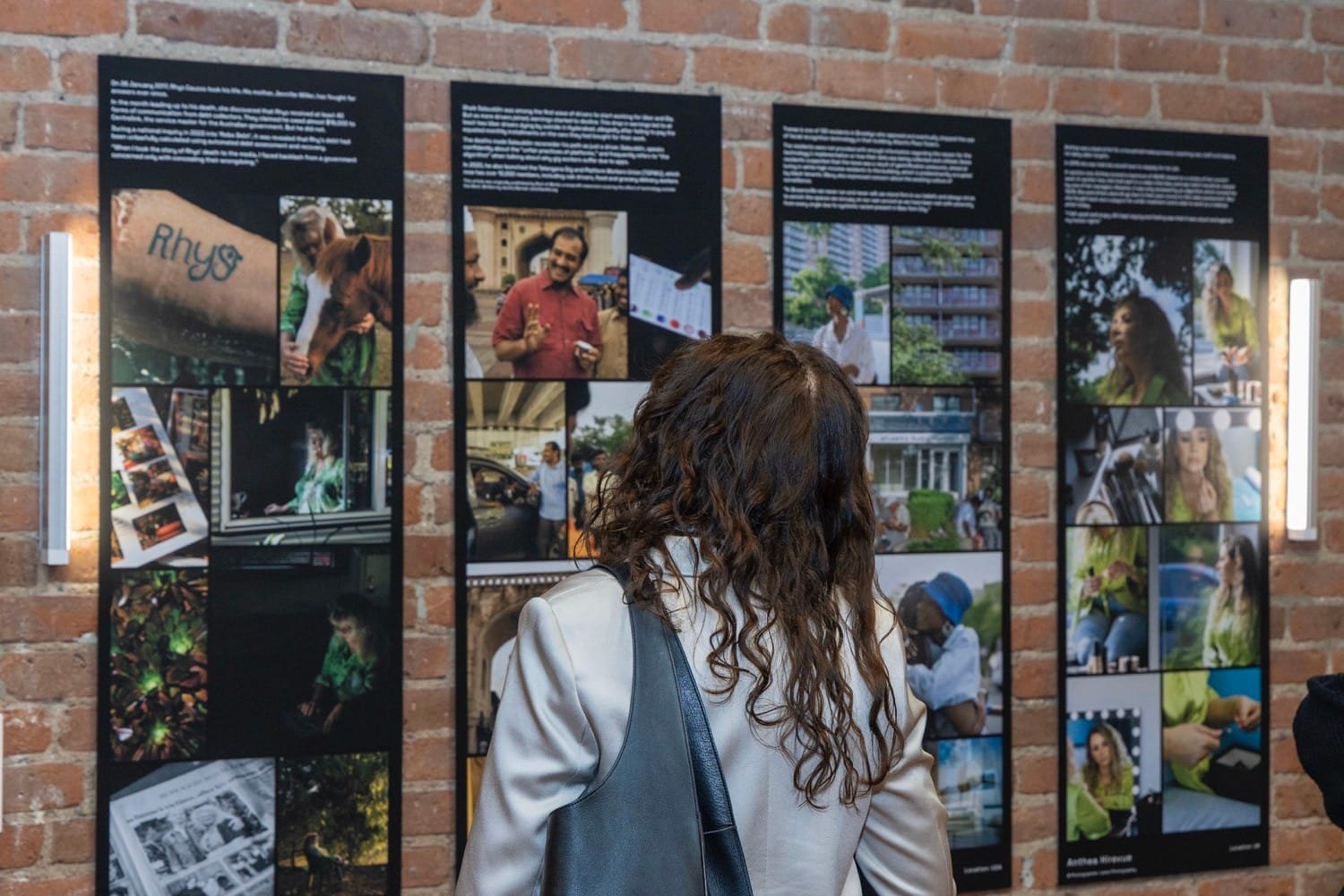
We created four photo essays, based on the stories of four people who have faced digital dehumanisation. These included Tranae (USA) grassroots activists resisting the use of facial recognition technology in Black and Brown neighbourhoods in NYC. Shaik (India) a union leader fighting for platform workers rights in India; Jennifer (Australia) a woman who is fighting for justice for her son after he took his own life following an automated debt collection service which wrongly accused him of fraud; and Athena (UK) who was wrongfully let go from her job after an algorithm was unfairly used during a rehiring process.
The final essays were shown in an exhibition curated by Identity 2.0, in October 2023, presented to members of the United Nations General Assembly. We found that it really showed how the harms of technology are not from the future, but are happening today!
Whiteboard at our Pilot Exhibition
In our first exhibition, we created a piece which demonstrates how long things can last online. As it was a private event, we researched everyone who was coming along and found things they had shared online. We then wrote this on a whiteboard in permanent marker, so as people walked around the space they noticed their own name making up part of the space. We provided a whiteboard rubber so people could try to remove their information but found they couldn’t. It represents the permanence of when something is posted online.
Chatbot from CTRL + U
In our first digital exhibition, in 2020, we created a chatbot that tells you the truth. It was a personal assistant that maybe was a bit too cheeky and people were shocked to see the way different data points can be drawn together.
You’re both deeply engaged in storytelling for social impact. How do you ensure those stories remain inclusive, ethical, and challenging?
As we’re so interested in these topics we are constantly learning from others (we go to talks, read books, listen to podcasts about marginalised stories in tech) and have friends in the space. We work hard to make sure we challenge ourselves, and find stories that have an intersectional lens with them and view them through our values. News outlets such as 404 Media, Rest of World and podcasts such as Tech Can’t Save Us and Computer Says Maybe have been really great for this.
Whilst we come from diverse backgrounds, we know we will have our blindspots. So part of telling stories is being open to making mistakes.
There are important pillars to all our work: we always pay people we work with, we bring the snacks, we tell people’s stories with them, we are open about how we’re feeling with people so they know who they’re working with.
Looking forward, what kinds of digital tools, collaborations, or provocations are you excited to explore next through Identity 2.0?
We’re looking forward to continuing our work around digital memories and furthering conversations about digital legacy. From more public workshops, to diving into more written research around it, we want to continue to push our work and find more opportunities to develop this work.
We’re also currently working on a zine about resisting generative AI (AI-Z) which launches at Inspace Edinburgh as part of a BRAID research project: https://inspace.ed.ac.uk/tipping-point/
There are a few existing projects we’d love to build on, including our previous exhibition This Machine is Black which explored race and technology.