






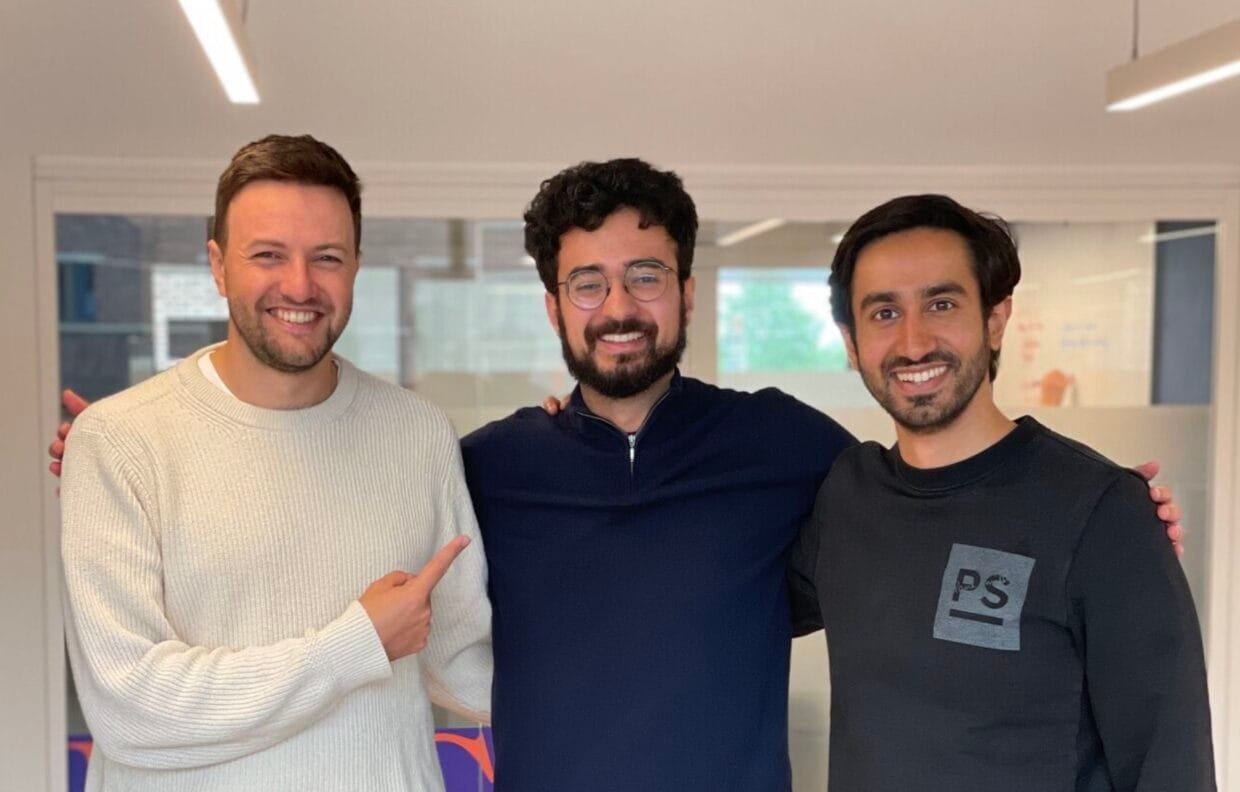
In a job market saturated with noise, Matt Wilson and Saaras Mehan set out to do something radically different. Their AI startup, Jack & Jill, uses conversational AI to strip away the stress and anonymity of hiring, putting real human nuance back into the process. By focusing on empathy, trust, and genuine dialogue, the co-founders are reimagining what recruitment can be in the age of AI. To dive deeper into their vision and the journey so far, we caught up with Matt Wilson and Saaras Mehan for an interview.
Tell us about the moment the idea for Jack & Jill was born—what problem were you both trying to solve?
The idea was born from lived pain. At my last company, Omnipresent, we scaled at an unbelievable pace, hiring hundreds of people in just a couple of years. I spent my days in the trenches of the talent market, and it was clear to me that the system is fundamentally broken. It’s a low-signal, high-anxiety process for everyone. Candidates feel like a number, and companies are buried in a sea of irrelevant applications.
The real “aha” moment came when generative AI started exploding. We saw a fork in the road. AI could either make this problem 100 times worse by flooding the market with AI-generated spam, or it could be used to rebuild the entire process from first principles. We chose the second path. We didn’t want to just stick a thin layer of AI on top of a broken system; we wanted to create a new one, built around genuine, nuanced understanding. That’s Jack & Jill.
Jack & Jill uses voice to help people find jobs—why was voice such an important medium to build around?
The current model tries to reduce people to a set of keywords, with hiring managers or application portals making quite and generalised judgements on applicants. That’s where the signal gets lost. You can’t capture ambition, cultural fit, or the nuance of a non-linear career path in a form.
A conversation is the most natural, high-bandwidth interface for understanding another person. It’s how we build trust and rapport in the real world. That’s why interviews have always been central to hiring — they’re not just tradition, they’re effective.
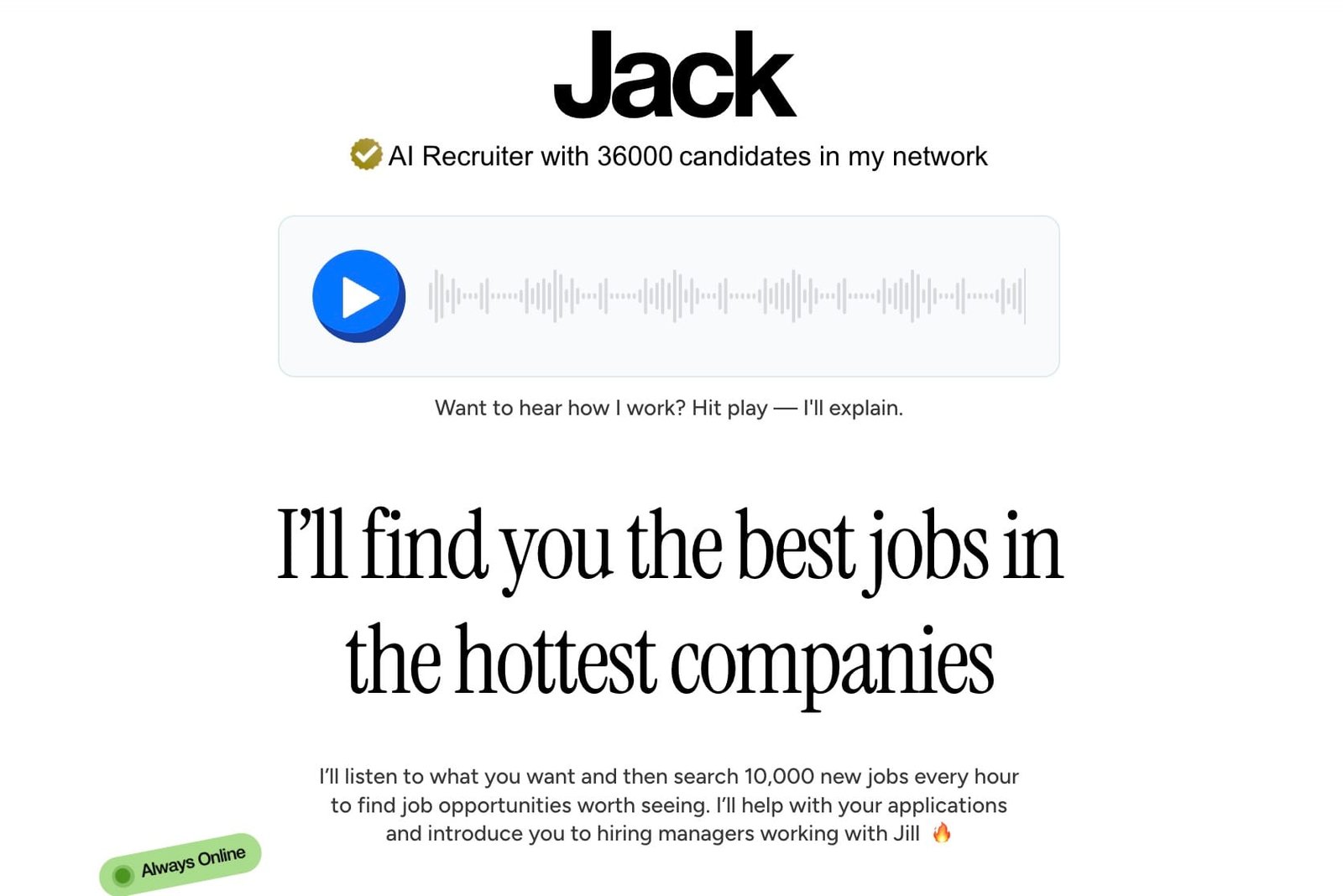
Jack builds on that. By using voice, Jack doesn’t just collect data — he has a dialogue that feels more like a session with a career coach than a stuffy interview. It means we can go beyond the CV and uncover what someone really wants, and what a company truly needs.
For hiring managers, Jack provides a phase 1 interview — a smart, scalable screener that replaces tedious early calls while still surfacing the kind of insight you only get from a real conversation. It’s the difference between a black-and-white photo and a full-colour movie.
You’ve both built companies in complex industries. How did those past experiences shape how you approached launching Jack & Jill?
Previous experiences have impacted our approach immensely.. This isn’t our first time tackling problems of this scale. My experience at Omnipresent taught me about the acute pain points in HR tech and the mechanics of hyper-growth. Saaras (our CTO) is a YC alum who knows how to build and scale a product from zero to millions in revenue at incredible speed. But it’s not just about us as co-founders, we’re fortunate to be able to draw from an amazing set of experience across the entire founding team. Our founding engineer, Sam, was building the world’s first neural voice agents years ago—he brings that deep, foundational AI expertise. Franky our CMO has done the 0 -> $xxM ARR journey a bunch of times, and most recently built the growth engine behind the fastest growing company in the UK. This collective experience gives us pattern recognition, networks and and lots of mistakes that we can avoid this time around!
The job hunt can be brutal. How does Jack & Jill shift the emotional experience for candidates compared to traditional platforms?
This is at the heart of what we do. The job hunt today can be a soul-crushing experience of sending applications into a void. We wanted to change that completely. One of our users put it best: “It’s like a recruiter, but because it’s not a human, it doesn’t suck.”
What they meant was that Jack is 100% on your side. He’s not trying to hit a quota. He’s an empathetic partner who listens without judgment, remembers your preferences, and works 24/7 to find opportunities that align with your real ambitions. Users have told us the conversations feel “therapeutic” because Jack asks questions that help them understand what they actually want. We’re shifting the experience from a transactional, often demoralising chore to a supportive, empowering partnership.
Let’s talk AI. Everyone’s throwing it around, but how do you make sure Jack & Jill’s use of AI stays human-centric and hype-free?
That’s the key question. Our core thesis is that a thin layer of AI on top of a broken process just accelerates the chaos. You’re already seeing it—AI tools making it easier to spam applications and, soon, for recruiters to spam candidates. That’s not our game.
For us, AI isn’t a feature; it’s the foundation. We’re not using it to replace human connection, but to make it count. Jill’s AI does the heavy lifting—understanding the deep context of a role, evaluating candidates holistically, and making intelligent matches—so that by the time a hiring manager speaks to someone, it’s the right conversation with the right person.
It’s not just about enabling interaction, it’s about fostering the right environment for success, both for hirers and applicants. The goal is to remove the noise, surface true alignment, and create space for high-signal, human-to-human dialogue. Because the best hiring still happens when the right people connect.
What’s one surprising thing you’ve learned from how users interact with Jack & Jill during conversations?
The level of vulnerability and honesty people show. We expected users to find it efficient, but we were surprised by the depth of the emotional connection. People tell Jack things they might not tell a human recruiter—their real career anxieties, their non-negotiables for work-life balance, or why a previous role was a bad cultural fit.
There’s a sense of a “safe space” because the AI is non-judgmental. It doesn’t have a bad day and it listens deeply. One user said, “I didn’t want the conversation to end,” which is just not something you ever hear about a job application process. This raw honesty is not just a fascinating human insight; it’s the fuel for our matching engine. It allows us to make connections based on deep alignment, not just surface-level skills.
Jack & Jill isn’t just a clever chatbot. What’s the tech stack behind it—and how does it enable such personalised matchmaking?
You’re right, it’s much more than a chatbot wrapper. We’ve built an AI-native architecture from the ground up. You can think of it in three layers.
First, there’s the Conversational Engine, which is what users interact with. It’s designed to have empathetic, probing dialogues that capture unstructured context. Second, that feeds a Knowledge Engine. It doesn’t just hear “I was a CTO at Company X”; it enriches that with data on what Company X does, its size, its industry, and its trajectory. It builds a deep, contextual understanding of both people and companies.
Finally, our Matching Engine sits on top. It moves beyond keywords to leverage the entirety of that rich context—the conversations, the enriched data, the user feedback—to find connections based on deep, nuanced alignment. And the whole system is designed to learn, so it gets smarter and more accurate with every single interaction.
Jack & Jill has a sense of playfulness in a high-stakes space. How intentional is that tone—and why does it matter?
It’s very intentional. The name itself—Jack & Jill—is disarmingly playful. We wanted to move away from the cold, corporate, and often intimidating feel of traditional HR and recruitment tech. Finding a job or building a team is one of the most important things you can do, but the process is often filled with anxiety.
The playful, accessible tone is designed to put users at ease quickly, encouraging open, honest responses — and ideally, helping them enjoy both the conversation and the overall experience of using the tool.. It makes the technology feel less like a rigid machine and more like a helpful, approachable partner. We believe that when people feel more comfortable, they are more open and honest. That honesty is what allows us to deliver the “magic” of a perfect match.
What’s more, we’re confident that if people have a great time speaking to Jack and love the experience, they’re far more likely to talk about the tool and spread the word. So it feels like a win-win, both for us and our users.
Where do you see job discovery heading in the next five years, and how does Jack & Jill fit into that future?
It will be a shift from active, transactional job hunting to continuous, passive career management. You’ll have an AI co-pilot like Jack working for you in the background, 24/7. It will understand your evolving skills and ambitions, suggest personalised learning paths, and proactively surface incredible opportunities you might never have found on your own.
This opens up a new channel of top-tier, off-market talent—people who aren’t actively looking, but are open to the right opportunity. Jack builds long-term relationships with these candidates, quietly learning what truly matters to them: what they’re missing in their current role, what their ideal job looks like, and what could genuinely excite them enough to make a move.
For companies, this means access to exceptional, often untouchable talent—people who are highly aligned not just on skills, but on motivation, values, and long-term potential. For candidates, it means being considered for roles that feel tailor-made—opportunities that actually fit, not just match.
Jack & Jill is built to be the platform that powers this future. We aim to be the new standard—the intelligent layer that connects talent and opportunity in a seamless, personalised, and fundamentally more human way.
Finally, for anyone building in the AI space right now, what’s one principle you’ve stuck to that’s served you well?
Don’t use AI to accelerate a broken process. It’s a simple idea, but it’s everything. There’s a temptation to see a clunky, inefficient workflow and just say, “Let’s make it faster with AI.”
Our guiding principle is to always go back to first principles. Ask, “What is the fundamental human problem we are trying to solve?” Then, design your AI system from the ground up to solve that. For us, the problem wasn’t that applying for jobs was too slow; it was that the process lacked understanding. So we built our entire company around solving for nuance and signal, not just speed and volume.