





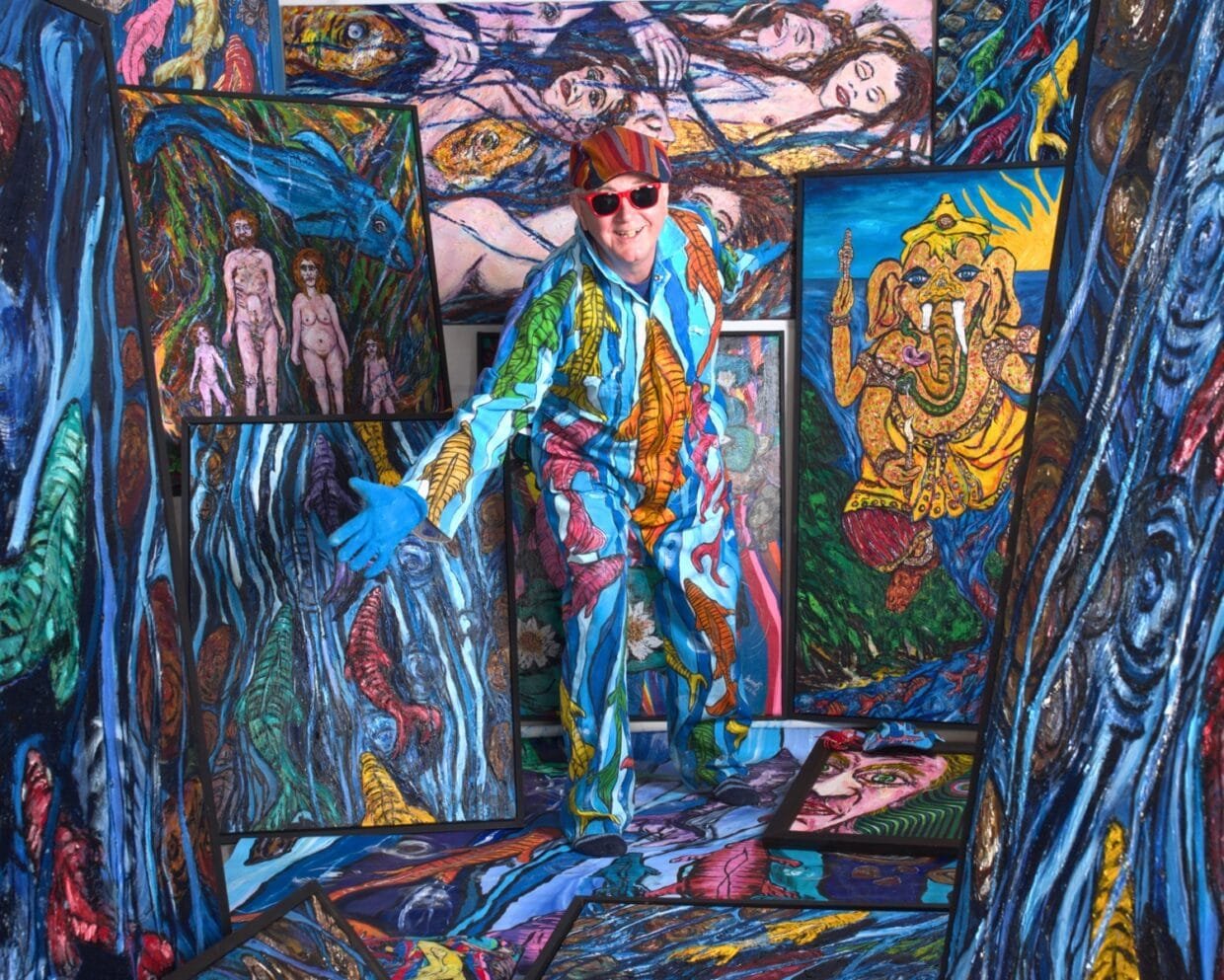
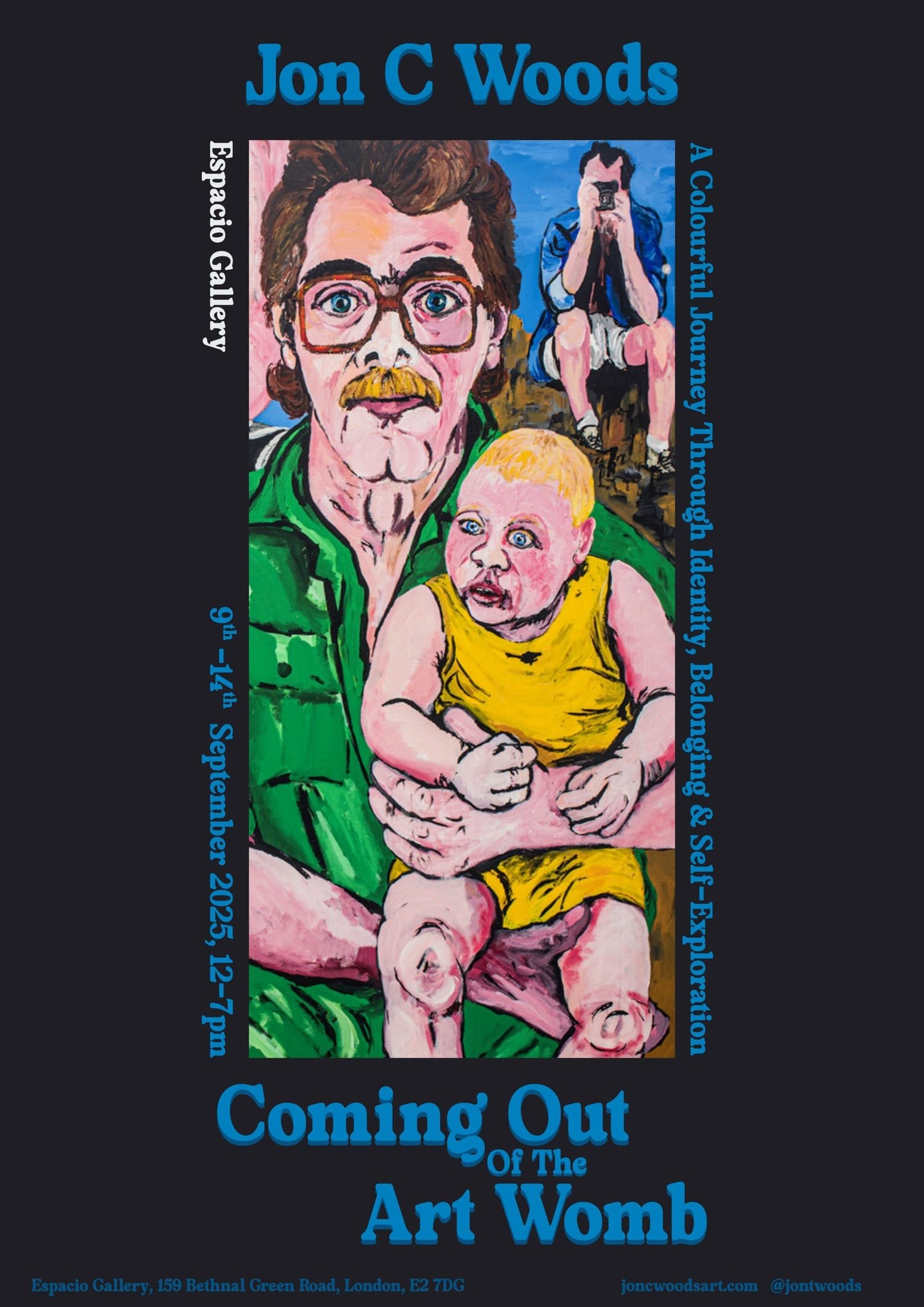
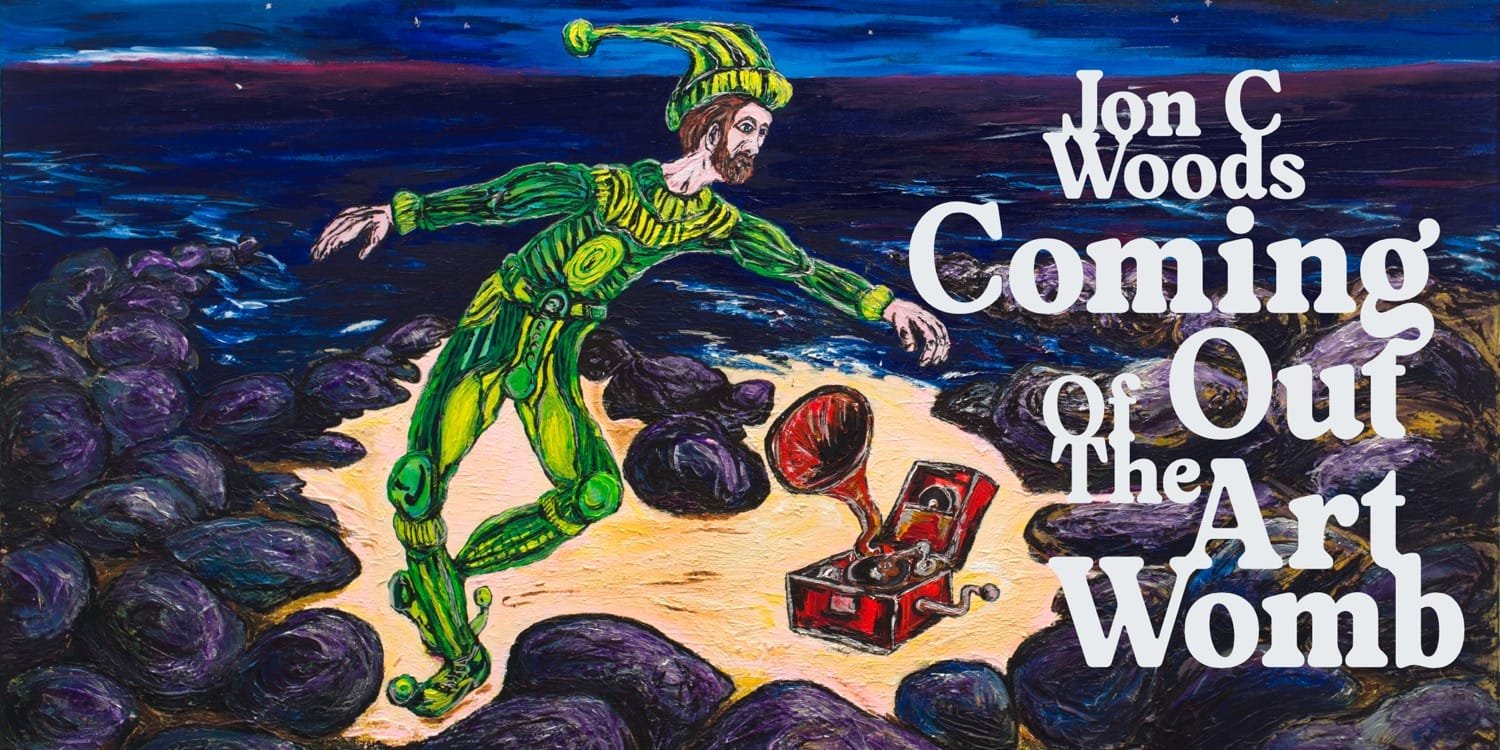
After nearly forty years away from the public eye, Jon C Woods is returning with a striking retrospective, Coming Out of the Art Womb, at Espacio Gallery in Shoreditch. His work, marked by bold colour, vivid symbolism, and radical vulnerability, reflects a life of queerness, belonging, and self-expression. Produced by his children as a long-overdue celebration, the exhibition brings private art into the light for the first time in decades. To learn more about his extraordinary journey, we caught up with Jon C Woods for an interview.
→ Curious about East London’s creative hub? Don’t miss our take on Shoreditch things to do.
After nearly forty years of artistic silence, you’re returning with Coming Out of the Art Womb. How does it feel to finally share these works publicly?
Looking back over my years of artistic endeavors, I felt the paintings in my degree show at Brighton Art College were genuinely expressive, raw, and uninhibited images. Getting back to that exhilarating high has been subdued by life’s events, work, family, responsibilities, etcetera. But sharing my art, I feel, is a privilege yet a necessity to warrant the title Artist. I am stressed, anxious, yet so excited to be exhibiting.
You describe the exhibition as one of radical vulnerability. What gave you the courage to reveal such deeply personal explorations now?
Life has doors and some you open, but most remain shut. Mystery and fantasy slips by and one is left with regret. Time, becoming an old-age pensioner, retiring and now facing my 70’s gave me a more focused approach to my life and the realisation that from a child all I wanted was to express myself with an honesty and truthfulness to myself.
Obviously society has its censorships, but questioning social norms is, I feel, the way forward for society. To share oneself is exposing a vulnerability, but doing so gives the spectator clarity of their own life and challenges them to view their own perspectives of “who am I”.
The courage comes from becoming a sagacious septuagenarian – hah! Yes, I’m learning even now at 70 words that describe how I feel.
Your paintings are populated with striking motifs—fish, nymphs, jesters, conductors. How do these recurring symbols help you process identity and memory?
My identity from an early age has been multifaceted. As an example to this, during my teenage years, I was the combination of all these gangs – I was a rocker, a skinhead, a mod and a hippie, who owned a Honda 250 Superdream, wore a black army surplus store parka, with two bright stripes down the back, and a full black real fox fur stitched round the hood.
This is to say, regarding symbols and motifs, all you need to know is the cultural artefacts of one’s tribe are handed down in stories, art, music, objects and memorabilia; as described in the wisdom of Carl Jung’s Man and His Symbols. I look to my paintings, to the stuff that I produce within them, as being my life story. And I can look back to stuff that I did as a teenager and appreciate what it was about, and how it affected me, and how it moved me through life. That’s how I remember, that’s how I maintain an identity, and memory. That’s a bit worrying, memory, but you’ve got to keep at it, you’ve got to keep yourself on your toes.
For years you felt pressure from what you call the “Cornish Art Mafia” to paint more acceptable work. How did resisting that influence shape your artistic voice?
We settled in a place known as being the end of the line, but it offered facilities often hard to find in Cornwall, and the prospect of a well-known artistic community. However, the tourist trade is the big money-earner, and standard subject matter reflects what the tourist buyers want – sea, cliffs, seagulls, fish, boats, sun, sand – at a small scale, easy to take home on the train or in the bus or in the car. Finding an outlet for anything different is difficult in Cornwall and there are many artists who never exhibit or sell there because they want to do their own artwork. Their joy is actually creating for themselves – what they want to paint, what they want to sculpt.
For me to fit in there would have been detrimental to my determination to create energies of self belief, with an honesty and truthfulness. I am expressionist – if you want a photorealistic painting or such-like, that’s not me. I’m not a production line painter. I increasingly find myself reflected back – often bouncing back – from the painting in front of me that I’m creating. Oozing my feelings, thoughts, and emotions – that’s what I want. That’s what is reinforced in me, what my paintings are about. That’s what’s giving me a visual voice, an identity of my own, that isn’t replicated. My original artwork.
You’ve spent three decades as an art psychotherapist in the NHS. How has that therapeutic lens informed both the content and process of your art?
I had always used art as a communicator with the people I worked with, but when family life became a factor I realised that I needed a professional qualification to progress further. So I took on board the training that was required and within that, one had to do personal therapy and group therapy on top of the therapeutic knowledge and applications and theory.
My journey through this therapy focus was intense but self-rewarding in opening my mind, thoughts, feelings, and emotions to a much greater self-awareness. Throughout the study we maintained our art practice, both in studios and within the analytic Art Therapy groups. Within this I evolved a much clearer understanding of the Art Therapy process, the subject matter, projections, transference, etcetera but also of my own process and my own understanding to such an extent I felt comfortable in freeing up once again upon my own expressionistic creative process and not to be limited or to adhere to the expectational society standards of “what is art, art should be this, it should be that – no. It gave me a freedom to spontaneity, and to feel that freedom of expressionism in painting.
I am creating something unique, like a baby, that will enter the world, Out of the Art Womb, and fend for itself. My artwork and my process is a creative process that is very similar to what happens when a child is born, it develops, it is nurtured, it grows into becoming itself. The painting becomes a painting in its own right, and it may have my DNA in it, literally, but it stands on its own in the world.
Bold colour, piercing gazes, and the uneasy tension between viewer and viewed are central to your work. What do you hope audiences feel when confronted with these pieces?
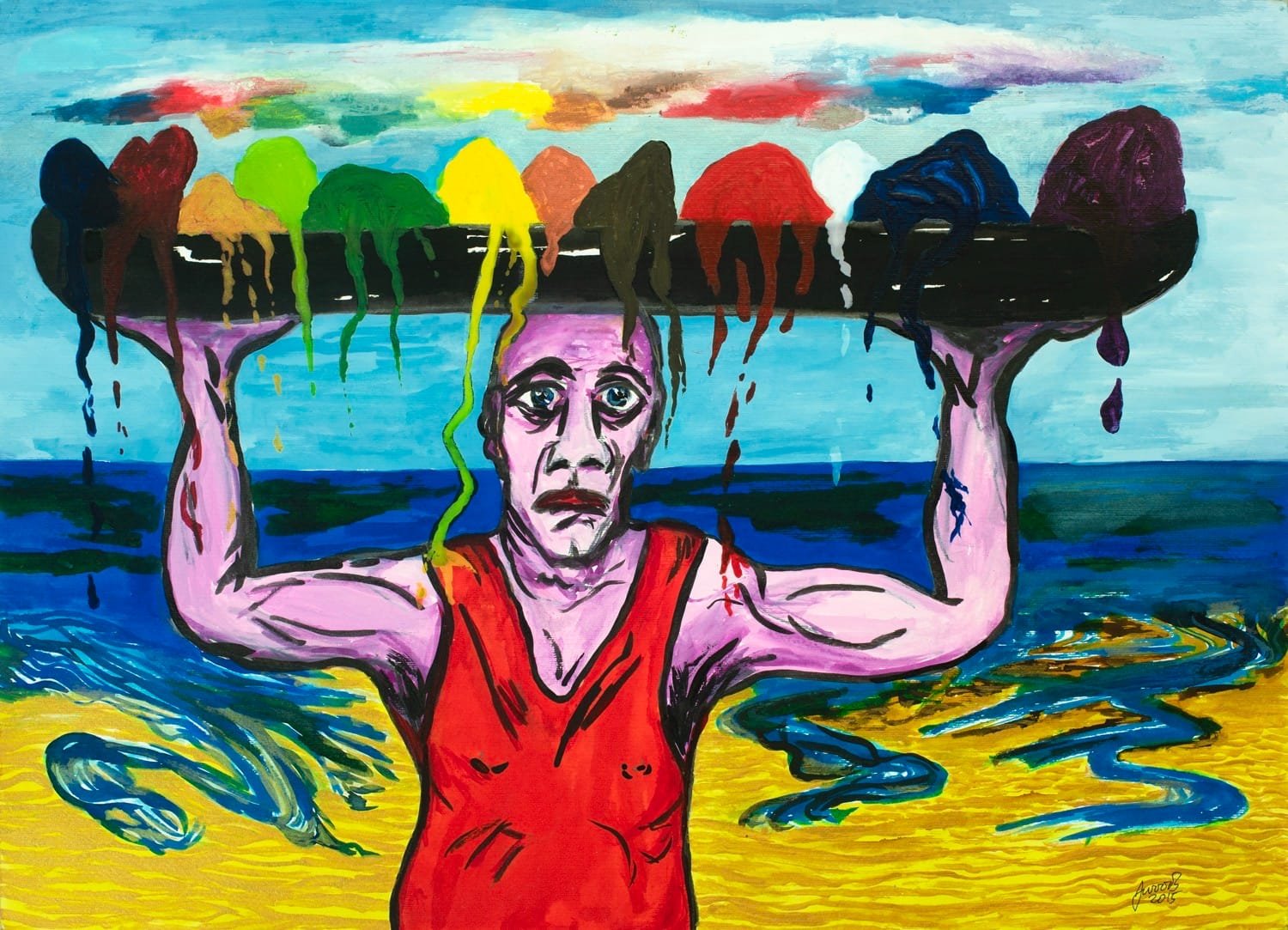
Following on from creation of the painting in the security and confines of the Art Womb studio, there is always a fear of what’s beyond, like in Khalil Gibran’s poem “Fear”, in which the River journeys to the sea and fears entering the ocean. You actually become that ocean. It’s my hope that my artwork, likewise, will become as one with the viewer, the audiences, and their appreciation of the meaning, message, and artistic impact that gives the spectator a lasting association of the painting’s message within their own thoughts, feelings, and awareness to the subject matter. Of course, like one’s own child, once out in society the paintings will evoke many meanings and interpretations that go far beyond the artist’s original inspirations. For instance, my painting The Balancing Act of the NHS Art Therapist has been described many times with different titles, and people’s interpretations have at times been humorous, connotations such as “the ice cream seller’s struggle on the beach in the sun”, but the concept of the painting, the massages of the painting, are still there.
I hope my paintings do inspire people’s own reflection and thoughts and get them to question stuff within their own lives and within society.
Your daughter Amelia has been instrumental in producing this exhibition. How does it feel to see your family championing your art after so long in private?
I really do feel very privileged in being given this opportunity to exhibit at the wonderful Espacio Gallery in Shoreditch especially as it is a retrospective whilst I shall be celebrating my 70th birthday. My family have orchestrated this in such a way that I feel so proud of them, it’s an awesome, awesome thing to do.
My family have lived with my artwork from them being youngsters and throughout they have always called me foremost an artist, and valued my paintings in such a way that has never been judgmental nor seen as an embarrassment, but just that they are our Dad’s paintings. Which has always given me a sense of self-worth and encouragement to pursue in hope that one day that door will open for me. They have given me the key and I feel honoured to step out of the Art Womb with their respect and support of me as an Artist, whose paintings are, well, individually different, and at times explicit in content whilst challenging the norm. I thank my family, all members of my family, immensely for this opportunity.
Looking back across this retrospective, what does this body of work say about your own journey with belonging, queerness, and self-expression?
Looking back over the retrospective exhibit it is evident that my life is on display within the paintings and in particular the drawings within the portfolios, encompassing a wide variety of experiences within the concept of non-hetero, non-normative, and non-binary defined relationships in my early years and that of the heterosexual binary-defined partnerships since parenthood. I do not feel, however, the categorisation is that simple to attribute to any one label either for myself and my artwork other than it is a self expression of my thoughts feelings and emotions toward the subject matter of my art and the choice of person whom I wish to be with.
The journey has been played out through my creativity in what has been described as being a form of therapy using art as a catalyst for resolution, understanding, and exploration of oneself – at times cathartic, playful, often intense but always with a wish for truthful honest self-expression. The Art Womb has been a safe place to create, give birth, nurture and develop my form of self-expressiveness. Now those paintings have a life of their own to live and inspire others to discover themselves. I am an artist, I am a proud father of children who as adults have discovered their own sense of self being. That is my journey to date.
As a footnote, I’d like to say that my son has sent me a quote, allegedly from Sigmund Freud, and it talks about the journey especially for males. I think it is most appropriate. “You wanted to kill your father in order to be your father yourself. Now you are your father, but a dead father.” I just think that that’s a lovely. quote. And it’s all about finding oneself.