



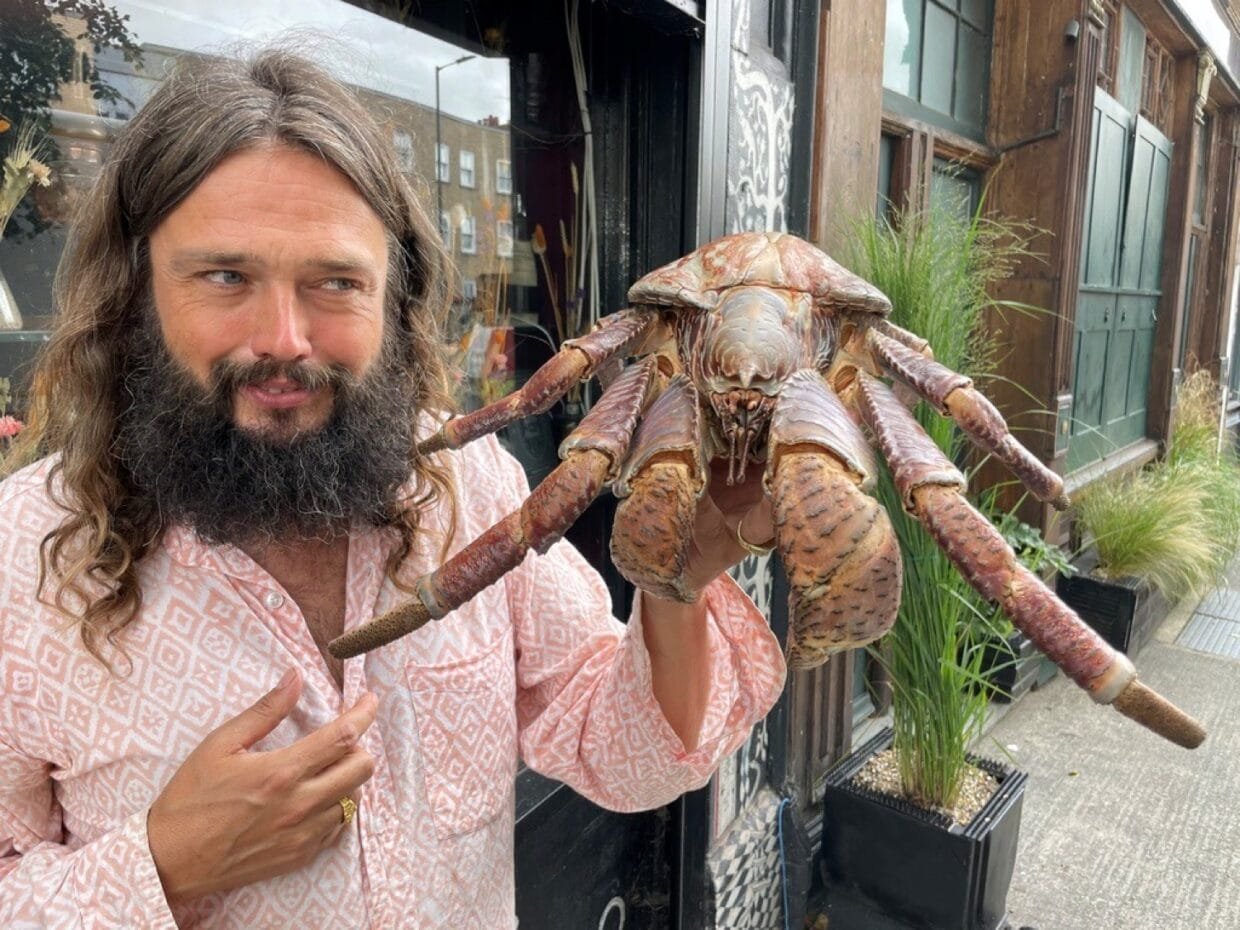
From cursed cocktails to mummified mermaids, Viktor Wynd has long been a master of the strange in East London. As the mind behind the Museum of Curiosities and the newly released book Dark Fairy Tales, his work blends folklore, art, and the beautifully grotesque into unforgettable experiences. With stories gathered from Papua New Guinea to the Black Forest, he turns myth into something hauntingly alive. To dive deeper into his wyrd world, we caught up with Viktor Wynd for an interview.
You’ve called Shoreditch home to mummified mermaids and cursed cocktails — what do you think draws people to the weird and wonderful in the heart of East London?
I would turn that question round and say that East London is one of the few places that weird and wonderful can feel at home, it is a magnet that attracts more and more of us – my museum is home for the strange and by the strange – almost everyone hates it, and they stay away, but for those of us who wish to drink absinthe and worship the dead please come on in.
From Papua New Guinea to the Black Forest, you’ve collected tales and trinkets in equal measure — do you see yourself more as a folklorist or a fabulist?
I have always been interested in stories, I did for a time dress it up as an academic interest, however at the end of the day I am a storyteller, I believe stories to be living things with their own agency – so to some degree I’m a just an empty vessel filled with stories I’ve heard all over the world that escape whenever i open my mouth. I don’t think I’d call myself a fabulist but I will take it as a compliment.
Dark Fairy Tales is definitely not for children — what’s the appeal of retelling old myths with a more grotesque, unapologetically adult twist?
Well we have to say it’s definitely not for children, otherwise we’d have to leave out things like bestiality, but I don’t see why you shouldn’t read it to children, though sometimes you might have to paraphrase a paragraph as ‘and then she had a nice cuddle with the polar bear’ or ‘and then the prince was nice to her’ or ‘and then the warlock did some horrible things to her’ – or not depending on how sensitive the tender ears are. I suspect country children of another age brought up surrounded by copulating animals, sharing a room with their parents and helping them butcher the animals would not have been offended. The way I see it I’m just telling the stories as they are – or rather I’m letting the stories tell themselves, it can be a nasty, brutal, beautiful world out there – at least so it seems to me.

Your stories are often introduced with personal travel notes — how important is it for readers to feel your presence in these tales, rather than just the folklore?
One of the points I’m trying to make is that these stories are alive – they don’t just exist in the pages of books, people tell them, and have always told them and always will tell them, every storyteller tells a different story, though of course all stories are the same. These stories are part of me so I hope that by grounding them in where i first heard them people will listen a little more acutely.
The Museum of Curiosities is a Hackney institution — do you think East London is more open to the odd than other parts of the capital?
I moved to Hackney in the early noughties because it was the cheapest place in the whole of London. The museum is very much not for everyone so I think it needs to be somewhere slightly off the beaten track so that only people who really want to visit visit – even if by accident, or if chance lures them in. I love Hackney, it’s incredibly diverse no one looks at anyone twice whatever we are. Increasingly I feel Hackney is home to an abnormally high population of supernatural beings – I see them all the time on Mare Street – far more than elsewhere (though I did see a family of Trolls on Southwold beach eating ice cream yesterday) – so yes we live in an odd place.
Luciana Nedelea’s illustrations are beautifully eerie — how did the collaboration come about, and how do visuals deepen the impact of these strange tales?
I have been enormous fan of her work for years – I could hardly believe it when she agreed to illustrate the book – and the drawings she did are just incredible – we will be showing the originals in the museum this winter.
Your collection features baby-eating pigs, witches, shapeshifters and doomed wanderers — do any stories still haunt you, or feel strangely… familiar?
I’ve heard many hundreds of stories, many are in my mind somewhere, the ones that haunt me the most I’ve written down in this book – well that’s not true – when I wrote the book the stories that haunted me then poured out, I’d write different stories down now. Certainly some stories are more real than others – I’ve never heard a better explanation for why there are mosquitos than the one in the book.
Between book writing, museum curating and bizarre expeditions — what’s next on your winding, wyrd path of creation? Any new curiosities brewing?
I have a new studio and it is full of projects on the go – todays is trying to make the world’s smallest unicorn – I’m going to offer a prize of $100 to the first person who actually sees the atom balancing on the end of its horn.
xxx
Dark Fairy Tales by Viktor Wynd, illustrated by Luciana Nedelea, is published by Prestel on 9th September. You can buy your copy here.