




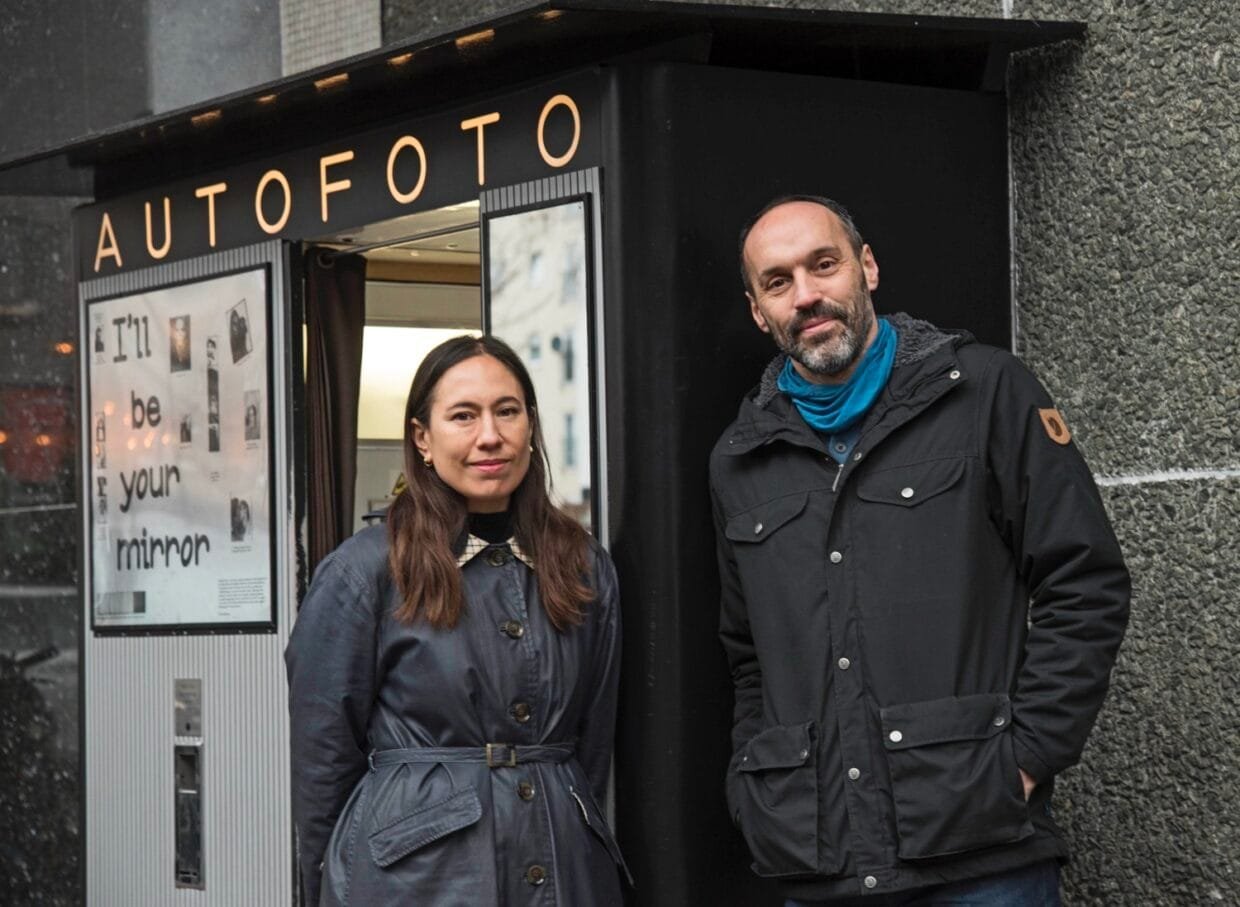
The analogue photobooth has just turned 100, but thanks to Rafael Hortala Vallve & Corinne Quin, its future looks brighter than ever. Through AUTOFOTO, the duo has spent more than a decade rescuing, restoring, and celebrating these machines across Shoreditch, Berlin, New York, and beyond. Their work is both mechanical and cultural, keeping alive a century-old technology while inviting artists and communities to reimagine its creative potential. To explore their journey and the enduring appeal of the photobooth, we caught up with Rafael Hortala Vallve & Corinne Quin for an interview.
The analogue photobooth is turning 100 this year. What does this milestone mean to you personally, after more than a decade restoring these machines?
R: We always had this idea of wanting to preserve this technology for future generations. It was obsolete in the 2000’s and there was little interest in it… the community of operators was really small – so it’s been really beautiful to see how this has turned around over the last years. Of course the recognition that your passion / obsession / hobby has become celebrated by a wider audience feels great. It’s funny as we’ve been saying for a long time the photobooth is almost 100 years old and now we can say it’s over 100 years old.
C: We’ve had booths in Shoreditch since the very beginning. Our first was at Pizza East in 2009, and since 2012, our second booth has been at The Hoxton Hotel, making it our longest-running machine in London. It’s a special one for us—we took our wedding invitation photos in it and the first baby photos of our daughters. So many people have come back to that one over the years, and we love that.
AUTOFOTO has grown from a small obsession into a global network. What first drew you to rescuing photobooths, and what keeps that passion alive today?
R: I was first drawn to rescuing photobooths out of curiosity, and I loved what photobooths represented in terms of the opportunity for people to take pictures in a spontaneous and private way. It also joined two of my passions, photography and mechanics. Seeing the happiness it brings to people, that they can create an image they can cherish afterwards.
I also haven’t yet reached the point where I fully know how the machine works – there’s still a lot ot learn. For instance, we still need to better understand the chemical process and how that can better develop the strips. We are trying to preserve the old technology whilst also improving it, making sure everyone looks good in the photograph.
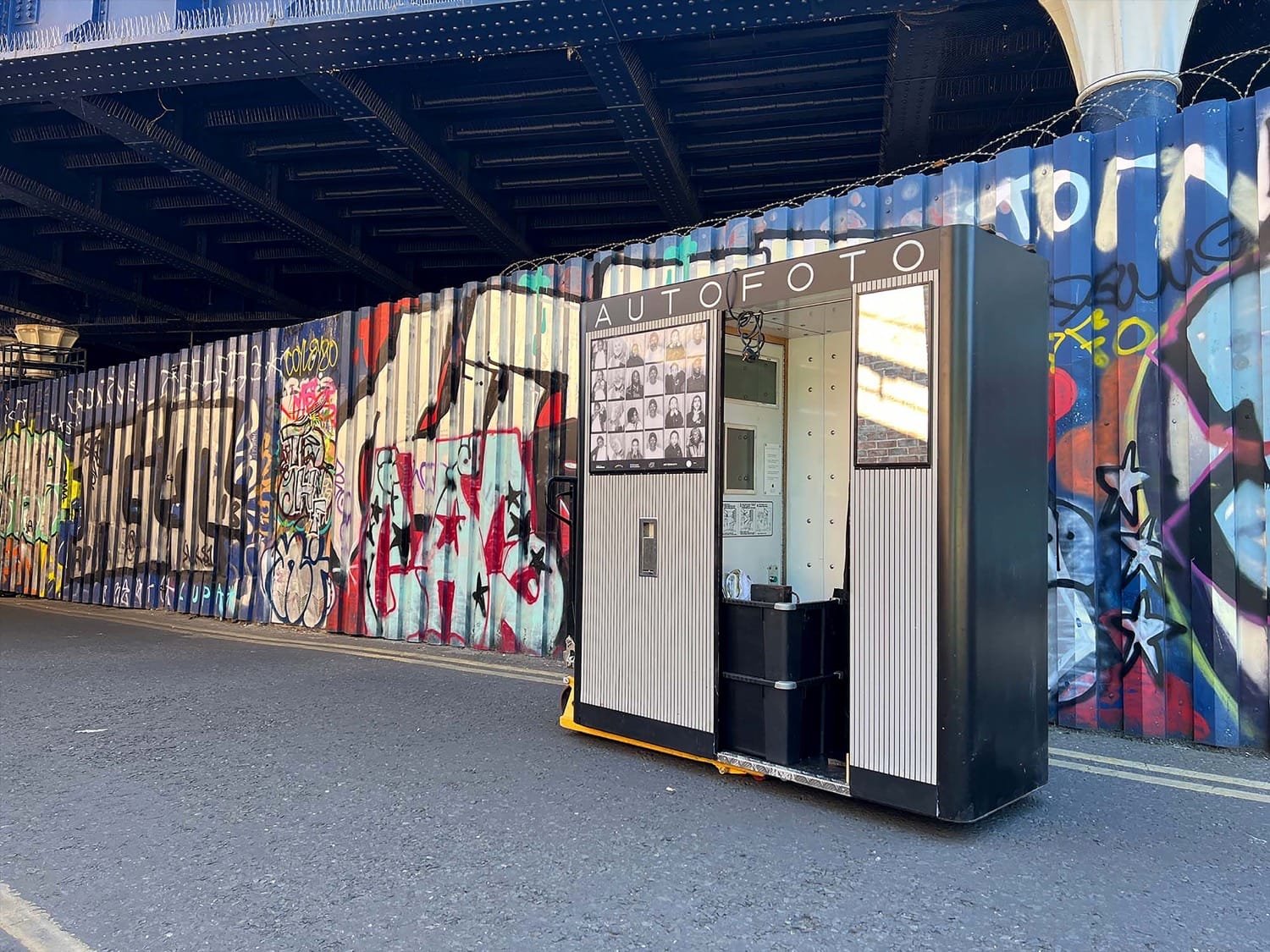
From New York’s International Photobooth Convention to Shoreditch Design Triangle and The Photographers’ Gallery, you’re marking the anniversary across continents. How did you shape such an ambitious programme?
C: Analogue processes are really having a moment, and the photobooth is one of the most immediate ways to experience this firsthand. Thanks to social media, it’s easier than ever for people to connect and share information about where to find these machines and experiment with image-making. I think this cultural interest is evident in all sorts of places. For example, there was a beautiful show at the RMIT gallery in Australia showcasing the photobooth test strips of technician Alan Adler, and a new documentary is being made about the analogue photobooth community with the support of the inventor’s granddaughter. We’re proud to be a small part of this bigger community that’s finding creative ways to celebrate these machines, and we love seeing their appeal across fields like photography, design, art, fashion, writing, and education.
The photobooth is often seen as nostalgic, but you argue it’s still a vital creative tool. How do you see it functioning in today’s digital image-saturated culture?
C: Images are so often remixed and reposted, it’s so hard to trace something back to its original source. There’s something to be said for the fact that each photostrip is original, every frame is an exposure direct to paper. There are no copies – unless you photograph or scan your strip. Of course the format is fixed, which makes it strangely familiar and archetypal at the same time. The selfie has made us so painfully aware of our own image, so to inhabit this box, to test, experiment and play in complete privacy gives space for something unexpected to come out.
R: There’s something so liberating about a machine taking your picture instead of a person. You’re free from the pressure of endless digital retakes, where you’re constantly trying to achieve perfection. With the photobooth, you just get to let go and be in the moment. The photographs themselves often have tiny imperfections from the development process, and people find these flaws to be a big part of the charm.
C: Every photo is an experiment, with an element of uncertainty. You can’t just delete the unexpected things in the same way you do with bad digital photos—they exist. You come away with something physical and real that becomes part of your world. The fact that you can then fold it, cut it out, or pin it up makes it something you can work with, arrange, and reflect upon.
Collaborations are central to AUTOFOTO’s work, from Michael Marriott’s pegboard portraits to Jenny Lewis’ autoimmune family series. What excites you about inviting artists into the booth?
R: The reason we got the photobooth in the first place was to use it for our own personal projects. In 2009 I wanted to capture different communities and people in markets in London but then I got bogged down with actually trying to get the machine to work. After so many years that phase is done and now we can not only do our own projects but make the booth available to other creatives. So with the excuse of the centenary, we’re reaching out to our friends and people whose work we love to offer them the booth to experiment with.
C: I love that everyone brings a different perspective to the machine. Particularly people from different creative practices – there’s always a question we haven’t been asked or a different way of looking at something that we wouldn’t usually see. It’s a real pleasure to work with people to see the machine anew, through their interests.
R: It’s also an excuse to work with people we admire! It was beautiful to see how Michael interprets the booth, through the idea of the tool. He’s so careful and coherent about how he approached his series – the beauty of the tool (in homage to Walker Evans) where he photographed the tools we use to fix the booth on a pegboard in the booth. He’s helped us a lot over the years, lent us tools, given advice on details, formica, metal profiles, so it’s been a pleasure to see him use the machine as a camera. We have long admired the work of Jenny Lewis, but we hadn’t had the chance to meet her before. It was a privilege to give her the freedom to explore such a personal subject with our machines. What we were most curious about was seeing how a portrait photographer would capture a portrait when they are the one in front of the camera, not behind it.
You’ve described restoration as both mechanical and cultural work. What’s the most challenging part of keeping these machines alive for new generations?
C: For a long time the mechanical work was the most difficult as Rafa struggled to understand all the things that went wrong. It was really by learning through failure that he got to know how to fix the machines and keep them running. Culturally, even though analogue has been enjoying a resurgence, many companies and manufacturers went out of business in the early 2000s and the material and knowledge was lost with them.
R: When that comes to things like paper it can be a big problem. The last factory that produced the best photobooth paper was in Russia, but the product is now unavailable due to sanctions. We’ve moved to a different paper manufactured by Ilford, but this does not capture the same range of tones, which can impact the nuance in very light or very dark skintones. We are currently working to fix this by experimenting with the intensity of the flash, though we wish there were more products on the market that could achieve the same results. We are pushing for this as it’s an important issue.
Photobooths capture private, playful moments behind a curtain. Why do you think that intimacy and spontaneity continues to resonate so strongly after 100 years?
C: There’s a lovely quote from the surrealists that answers this.
“Photomaton, I’ve been seen, you’ve seen me, I’ve often seen myself. There are fanatics who collect hundreds of their ‘expressions’. It is a system of psychoanalysis via image. The first strip surprises you as you struggle to find the individual you always believed yourself to be. After the second strip, and throughout all the many strips that follow, while you may do your best to play the superior individual, the original type, the dark fascinating one, or the monkey, none of the resulting visions will fully correspond to what you want to see in yourself.”
December 15, 1928 issue of Variétés: Revue mensuelle illustrée de l’esprit contemporain. source: https://jilltxt.net/automatic-portraits-and-selfies/
Looking beyond the centenary, how do you imagine the role of analogue photobooths evolving over the next decade—culturally, artistically, and technologically?
R: Our hope is that we can keep bringing these booths to new audiences and that these strips will continue to be meaningful markers in people’s lives. We’re really committed to the chemical, material, and technological work needed to develop and sustain the materials that create the best-looking portraits.
C: Artistically, we aim to collaborate with more creative practitioners – giving them a chance to experiment with our machines in order to share new perspectives and discover new possibilities together.