


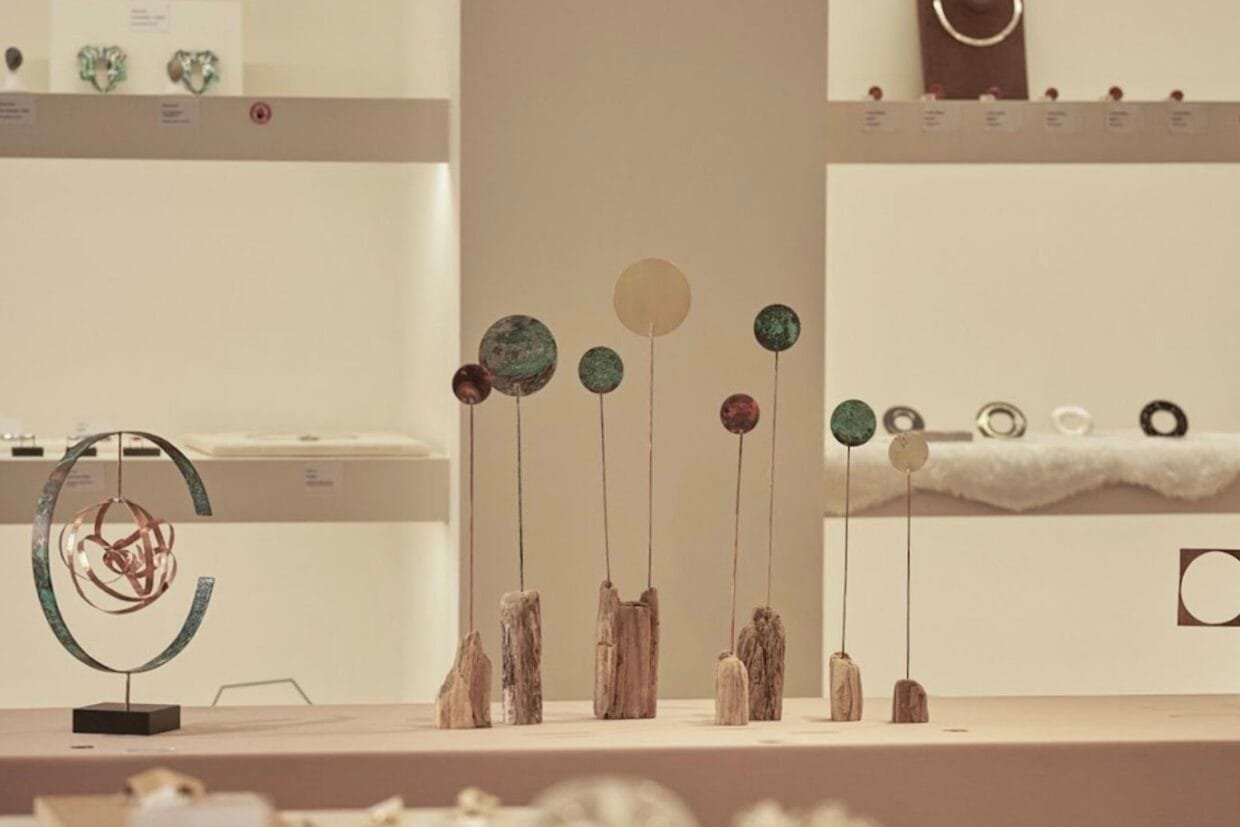
By now, we are accustomed to expecting from design shows that they assert something, that they solve a problem, reference a theme or engage with a social issue. But at a modest independent space in East London during the 2023 London Design Festival, curator Yanru Hu decided to do the opposite. Her exhibition, Infinite Dimensions, quietly rejected size and scope. Instead, it invited a slower, more tender question: how do we engage with a work of art?
At a time when making in design is often defined by spectacle and clarity of story, curator Yanru Hu took a quieter path during the 2023 London Design Festival, presenting an exhibition that invites us to reconsider our relationship with scale, viewing and intimacy.
Presented at Alsolike Gallery, which has typically showcased contemporary craft and cross-disciplinary practice, Infinite Dimensions took miniature scale as its curatorial basis. Featuring artists from London and across Europe, the show brought together pieces that were small in scale and in density. Some were no larger than the palm of a hand, others were without labels, existing solely on the material pull to draw one in. They were not pieces that demanded interpretation; they were waiting, patiently, to be seen.
“Small does not mean slight,” Yanru writes in her curatorial text. “Often it is a form of compressed time.” For her, miniaturisation is not a visual effect but a curatorial shift in how attention is placed. Working with tactile materials, hand-made marks and minutiae, she invites us to slow down and return to embodied perception. In terms of spatial positioning, she compresses circulation paths, inviting audiences to lean in, crouch down, sidestep and generally work hard to engage. The act of viewing is physical, and in that process, something slower and deeper begins to occur. Pieces presented without fanfare or textual interruption. Rather than being overlooked within grand group shows, these works were valued for their intricate materiality, hand-made quality and quiet potency.
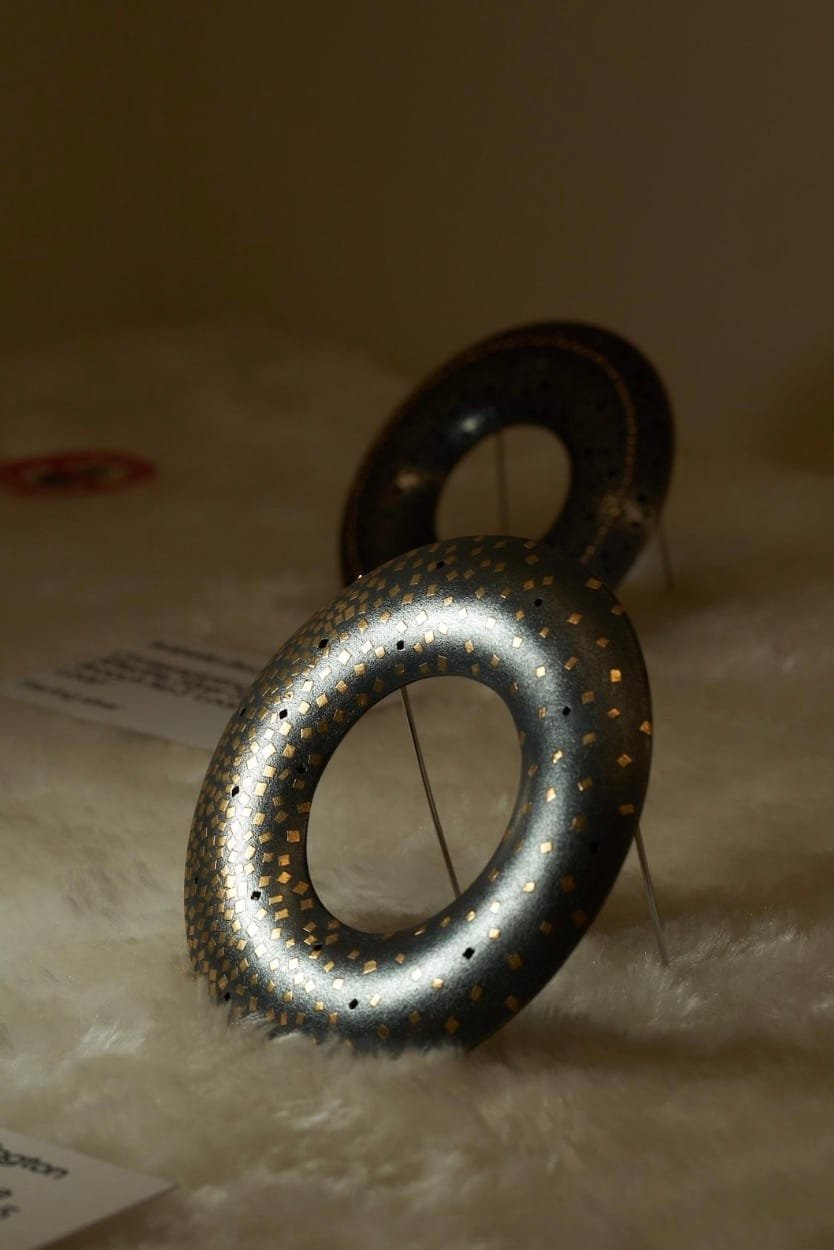
Crucially, the works on show were not united by medium or message. Ceramics, silverware, textiles and mixed media sat alongside each other, united only by their haptic intensity. This, in fact, reflects Yanru’s approach throughout: she doesn’t curate thematically, but rhythmically. Her exhibitions are not thesis statements; they are composed spaces, in which she is mindful of pacing, spacing and perception. With a background in dance and choreography, she approaches making and exhibiting with an embodied mindset; the gallery is not just a space, it is a choreographed environment, in which movement and stillness hold significance.
As part of a curated environment, Infinite Dimensions deliberately didn’t create visual noise. No explanatory panels took centre stage; instead, the pieces whispered. They functioned as micro-architectures, with their own material narratives and sensory pull, a space where texture, touch and scale became the medium.
Yanru also positioned the exhibition within an educational context. Working with tutors at art colleges, she introduced the exhibition to art student cohorts, positioning the show as a teaching tool for questions of scale, material thinking and slow design. This reflects her long-standing position that curation is not only a form of display, but also a form of learning.
“Internally put in,” Yanru told us in an interview, “we have been consuming so much. We need to retrain our capacity to devote this kind of attention.” Her project was not a sign of her withdrawal from relevance, but a reassertion of sensitive perception as a matter of importance. It required the audience to ‘re-train’ their capacity to devote this quality of attention. We still hear her words ringing true, “so through this exhibition we would like to celebrate the infinite creativity, care and devotion, and transformative power that miniatures can bring”.
In some ways, this exhibition was not about miniatures at all; it was about magnifying the act of looking itself. Yanru thinks that the dimension of a work is not a question of scale, but how it reorganises our attention. The smallness was merely the start point; what came from this was a subtle reordering of our relationship to the world, to what we notice, how we feel, and how we attend. This presentation was not a side note; it was a quiet manifesto. It required the viewer to look again at the smallest scale, to think about the capacity of this scale as a powerful realm of experience. In Yanru’s curatorial building plan, miniaturisation is a device to suspend pace and refine perception to re-engage with the haptic quality of the everyday.