





For over two decades, Nick Brandt has created hauntingly beautiful images that merge art, activism, and environmental urgency. His work has shifted from portraits of African wildlife to documenting the human impact of climate change across continents. With his ongoing series The Day May Break, Brandt continues to provoke reflection on our shared vulnerability in a rapidly deteriorating world. To explore his vision and latest chapter The Echo of Our Voices, we caught up with Nick Brandt for an interview.
Your latest chapter of The Day May Break, The Echo of Our Voices, focuses on climate-affected communities in Jordan. What did you want to highlight with this series?
Art its most basic, I wanted to highlight connection, resilience (an overused word these days, I know) in the face of trauma. These families, who fled the war in Syria, are people who lost their homes, their way of life, their communities, their land, everything. Now all they really have is each other. It seems to have given them a strength and togetherness in the face of such adversity.
In the previous chapters, I had shown everyone mainly in isolation, separated even from each other. I wanted this chapter to be very different in tone, both visually and emotionally: that in the face of adversity, when all else is lost, you still have each other.
The reason for this difference? As things seem to grow darker with each passing year, I myself felt the emotional need for a change of energy within the series.

In Sink / Rise you photographed South Pacific Islanders underwater. How did that concept evolve, and what did you want audiences to feel?
It felt a natural progression to make a series about the impact of climate change from rising sea levels. I am usually not conscious of how a concept originates, it’s just something troubling that is especially on my mind at a moment in time (although everything is these days).
In terms of what I want the audience to feel, I think I just want them to feel the way I do. I mean, don’t we all want everyone to feel the same way that we do? But perhaps to share a sense of outrage at environmental injustice, but also, through a greater empathy, be more cognoscent of how we choose to live our lives, the postive impact that we can have.
You often pair humans and animals in your images. What does placing them together in the same frame reveal about our shared vulnerability?
Good question although you have in one sense already answered the question for me – a sense of shared vulnerability, a shared sense of loss.
For me, we – us and non-human animals – are sentient beings not so different from one another, and sharing the same frame, connected yet disconnected – helps convey this shared fate with the destruciton of the natural world around us.
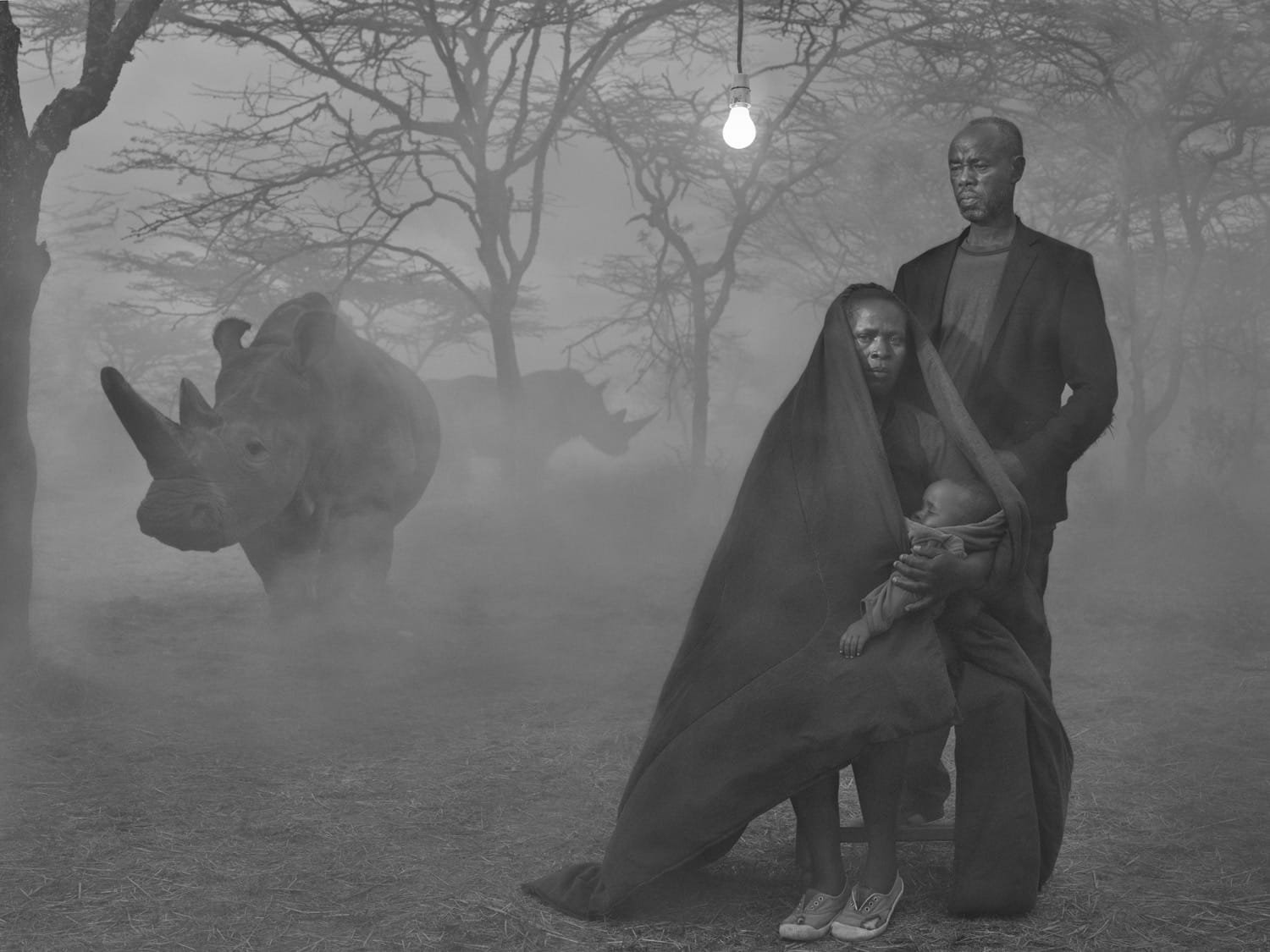
Your earlier trilogy in East Africa portrayed animals as sentient beings. How has your approach to capturing environmental loss shifted since those first works?
That early work didn’t address my growing concerns about the destruction enough. Yes there was a sense of melancholy, a sense of an elegy for a disappearing natural world, but I wanted to address the issues in more direct terms, how it also degrades human life, and even more so degrades human life once also talking about climate change.
Photography historian Philip Prodger called your work “a portrait of us all.” Do you see your projects as documentation, activism, or something in between?
It’s a good question, but I’m wary of pigeonholing and labels. I create what obsesses me, emotionally and intellectually, and hope that people will in turn be affected, moved, and pause to think about the people, and animals, whose lives are much less fortunate than their own. But I like that quote of Philip’s a lot. I would hope that people see that it is, effectively, indeed a portrait of us all.
You co-founded Big Life Foundation to protect wildlife in Kenya and Tanzania. How do your conservation efforts inform your photography and vice versa?
Less so now, because I am only photographing people, but in earlier years, the two were linked emotionally (I keep using that word), but it wasn’t a conscious thing, just a way of hoping to enlighten and raise awareness. I will say this, however: I have no idea whether my work has influenced the way people view the world. I do however know that the actions of Big Life have had a tangible, concrete positive impact for life in the area where Big Life operates, and that’s something to feel positive about.

The Day May Break has been exhibited worldwide. Have reactions differed between audiences in Europe, Africa, and the Americas?
It’s actually the reactions of the people I have photographed that has meant the most to me. At the end of each shoot, we interview some of the people photographed. Invariably, we hear the same very moving thing: “Thank you for seeing us. Thank you for hearing us.”
For people living in Europe and North America, I would hope that they see how fortunate we are, how comfortable our lives are, compared to those whose lives have been so disrupted, and with no social safety net that we might be more accustomed to.
Looking ahead, what stories or locations do you feel most urgently compelled to capture in your next body of work?
I would want to photograph in Gaza. Or the tragedy of what remains of it. But of course that is far too dangerous.
I mean, everywhere one turns, there is some compelling drama. For me any issue is how to find a way of visually expressing my feelings in a way that I hope has not been done before.
Right now, at this moment, I am thinking less about specific locations, and more about the universal condition of sadness and alarm that so many of us currently feel. However, I don’t want to end on a downer, because the point is this:
We may experience pessimism of the intellect, but we all need to exercise optimism of the will. We need to consciously make efforts to improve life while we are here. We need to learn to be good ancestors, to be better ancestors for those billions not yet born.