






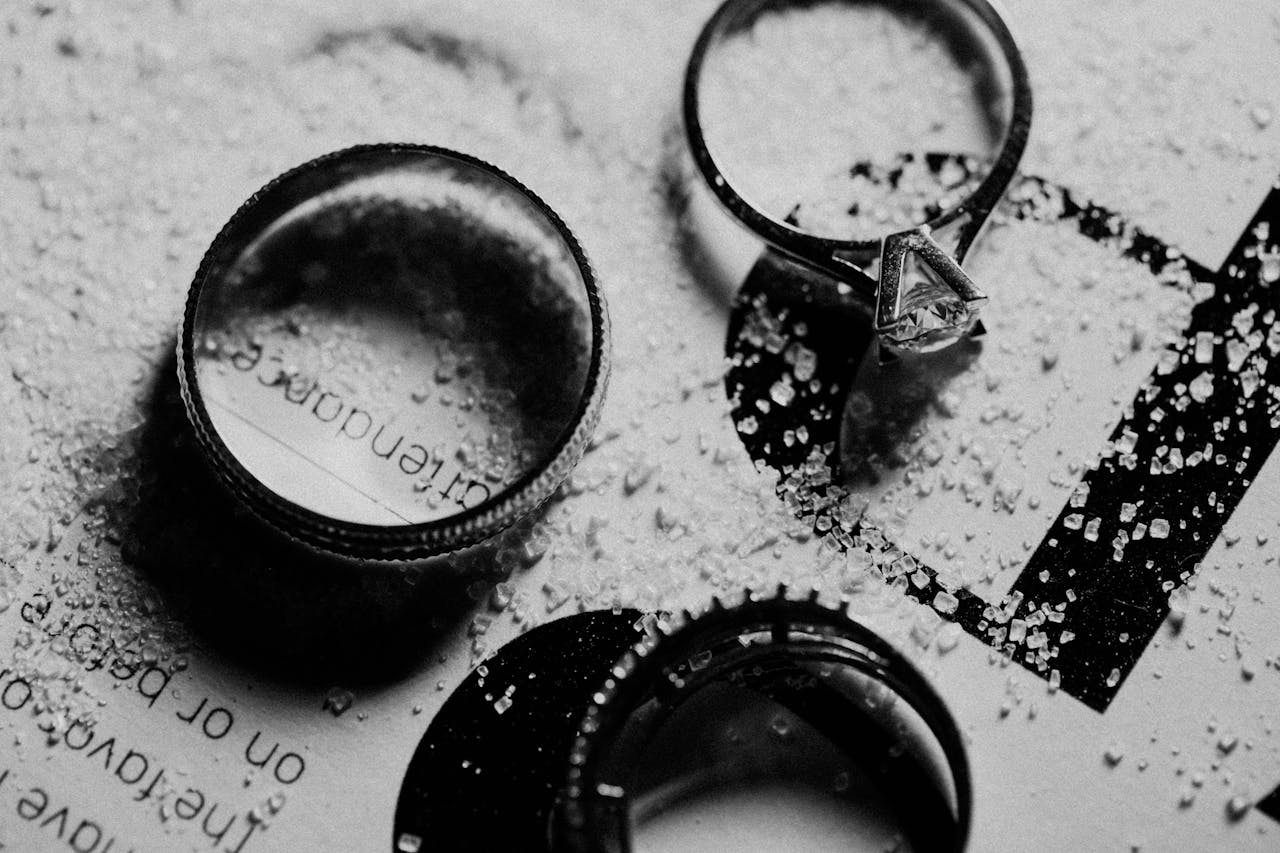
Every marriage is unique. Thus, it might make sense for you to choose a diamond engagement ring that suits your specific preferences. While many couples might gravitate toward the timeless charm of a solitaire design, others might prefer something a little more unusual.
Of course, it’s worth thinking about ring design, even if the ring you’re picking isn’t going to be an engagement ring. Let’s take a look at the options, and how they differ from one another.
Understanding Ring Settings
The ‘setting’ of a ring describes the way that it’s joined to the metal band. Over the years, many different ways of doing this have been developed by jewellers around the world. A few of these methods have become incredibly popular.
For some, the vintage appeal of a certain kind of setting might provide an appealing link to the past, particularly if a family member, or a series of family members, have chosen a particular kind of ring. On the other hand, you might seek to break from tradition with the help of a more modern and striking design.
Whatever your preferences, your choice will be to some extent subordinate to your choice of stone. You might pick a stone that matches your preferred setting, or vice versa. What matters is that you consider the ring as a whole, rather than just a small part of it.
Types of Unique Ring Settings
There are a number of different settings to choose from.
A bezel setting is sleek and minimalistic, comprising a continuous band of metal that encircles the central stone. For a more modern look, you might prefer a tension setting, which creates a floating effect. Here, the stone is held in place via the tension of the elements on either side of it.
A split-shank setting sees the band itself split into parts, framing the stone as it passes around it. Then there are custom settings which incorporate and combine many of the features we’ve looked at, and others, to create something that’s entirely new and unique.
The Craftsmanship Behind Unique Settings
Creating an entirely original ring will, of course, inflate the cost of the item. Certain more popular settings can be produced in bulk with the help of specialised machinery, while others require a skilled craftsperson, armed with a handful of more generalised tools.
The malleability of the metal involved will make a difference to the cost, too, with gold, platinum, silver, and titanium all requiring subtly different approaches. If you have your heart set on a ring of a particular kind, however, then it’s worth exploring your options thoroughly – it might be that there’s something out there that matches your precise tastes.