






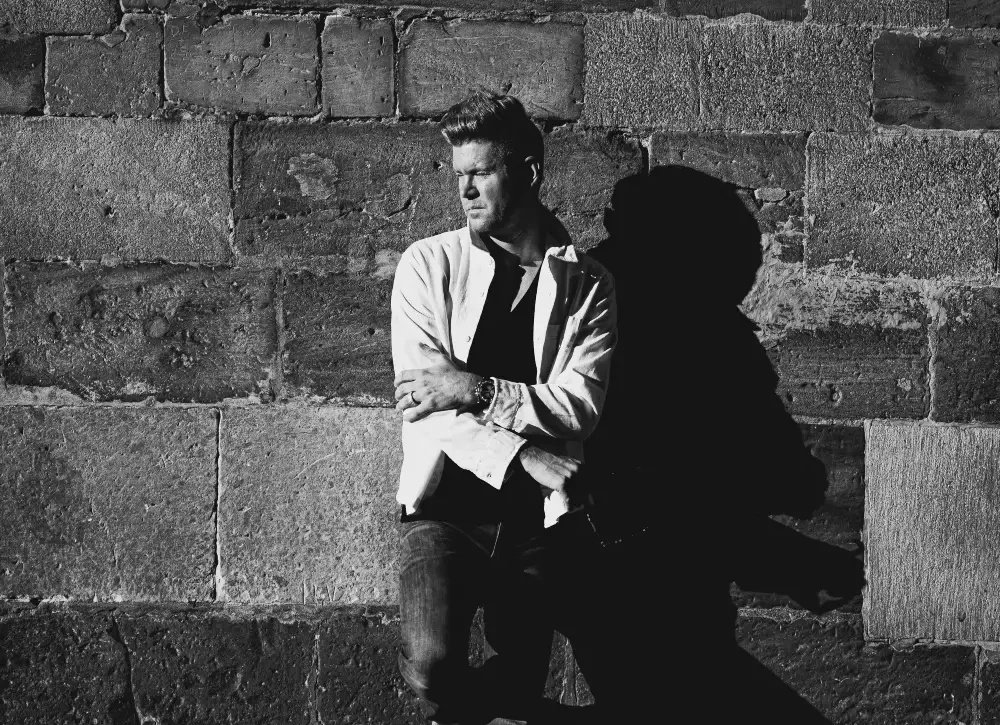
We caught up with multimodal artist Jairic whose making waves with his single ‘Don’t Let Me Put A Track On You’.
With nearly 2 million streams across platforms, Jairic’s work is entirely self-written, self-produced, and self-performed with a distinct fusion of modern luxury and underground grit.
Based in Cannes, France, Jairic’s roots are in Detroit, Michigan, where he was immersed in music from an early age. Starting out as a hip-hop producer for Detroit artists, he eventually developed a fiercely independent sound of his own. Influenced by legends like Nas, the Wu-Tang Clan and Detroit’s underground scene, Jairic crafts a sound that defies boundaries.
Tell us about you, how long have you been making music? What inspired you to start?
I’ve been making music for most of my life — at this point it’s closer to three decades than two. What first pulled me in, and what still keeps me here, is joy. Creating music has always felt like solving a puzzle: anyone can make noise, but shaping those sounds into something that flows, something unique, is a challenge I love. It’s equal parts problem-solving, self-expression, and pure energy, and that’s what inspired me to start and keeps me pushing forward.
The music industry is super competitive these days, was there a moment in your life that you wanted to give up on music? How did you manage to stay focused and achieve what you want?
I did take a pause from music at one point, not because I stopped loving it, but because life called me in other directions — building businesses, leading teams, and being present for my family. Those parts of my life give me purpose and pride, but without music, something still felt unfinished. My wife was the one who pushed me to “get back on the saddle.” She reminded me that music wasn’t just what I did, it was who I am.
Since then, I’ve leaned into a principle I live by in every lane: you can either suffer the pain of discipline, or the pain of disappointment. I chose discipline. I show up, I create, I put in the work — not obsessing over where every track will land, but trusting the process. That commitment keeps me focused and fuels everything else I do.
How would you describe your creative processes? Are the music and lyrics written in conjunction, or separately?
For me, the music always comes first. The beat, the rhythm — that’s the foundation, the pulse that sets the mood. Once I lock into that groove, the words start chasing it down. The lyrics don’t feel forced; they ignite naturally, like throwing gasoline on a fire. The sound tells me where to go, and I just follow it until the song reveals itself.
Where did the inspiration come from?
The inspiration came from living — the wins, the losses, the late nights where your mind won’t shut off, and the mornings where you’ve got to show up anyway. Some of it comes from my journey as a CEO, making calls that affect entire families. Some of it comes from being a husband and a father of four, where the stakes are even higher because it’s your legacy, your bloodline. And a lot of it comes from just being in the world — traveling, seeing different cultures, absorbing energy, and turning those frequencies into sound.
Music is how I process it all. It’s my way of translating life’s chaos into something that connects, something that can spark people to feel, to move, to fight, to dream. That mix of discipline, love, and raw experience — that’s the fuel behind everything I write.
What’s next for you?
n=40 lit the fuse — that was just the beginning. From there, the stage gets wider: a fall and winter tour through Europe, then down into the Caribbean — St. John, St. Thomas, the Bahamas — bringing the sound to the water and the islands. I’m also stepping deeper into fashion with a capsule collection — luxury CEO streetwear — set to debut in Mumbai next March through a runway-meets-performance show.
Then comes L’Americain in Spring 2026 — not just an album, but a full world of its own, heavy with vision and weight. I’m planning to perform during the Cannes Film Festival in May. And behind the scenes, I’m building a cinematic project scored with more than twenty original tracks — a complex love story told through rhythm and light, a soundtrack that becomes its own film.
For me, it’s all connected: music, fashion, film, and legacy. What’s next isn’t just the release — it’s leaving something that lasts.