





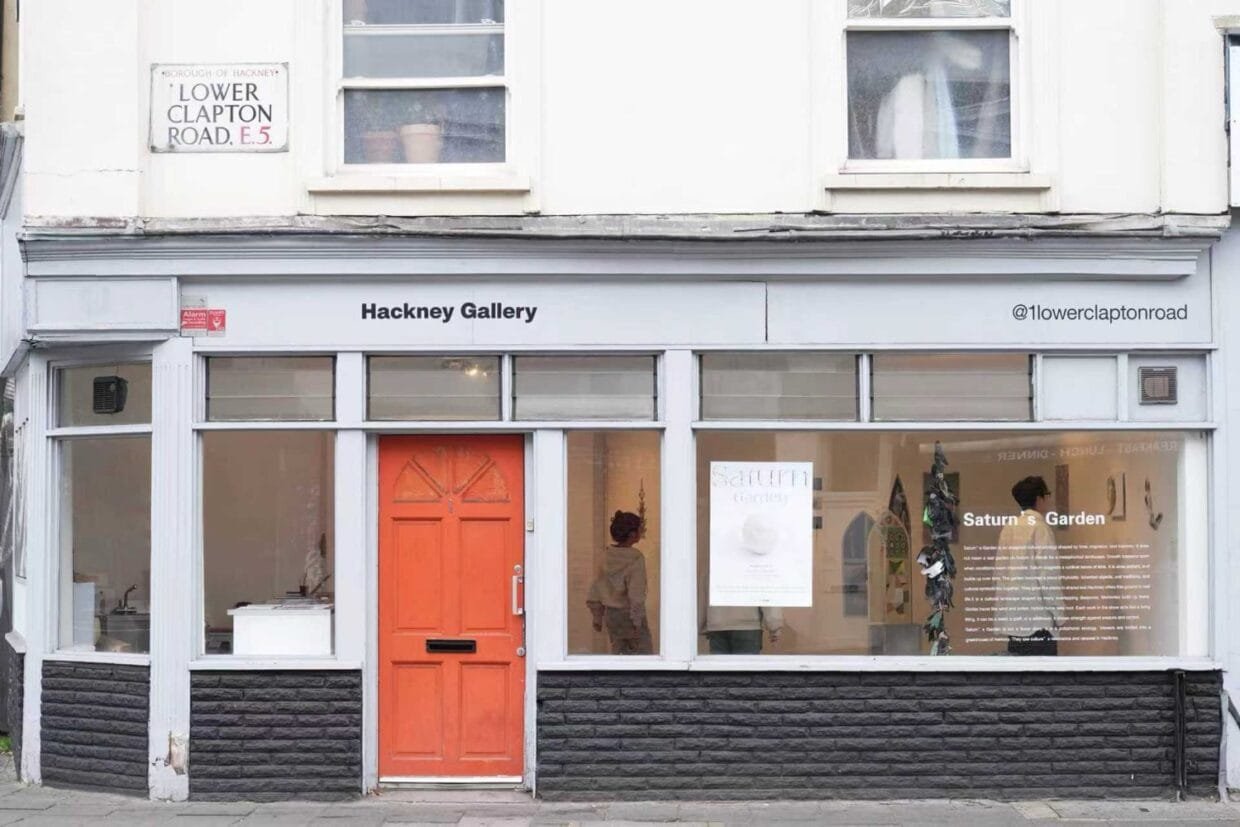
Hackney is no stranger to cultural metamorphosis. Waves of migration have long reshaped its streets and communities, layering traditions and languages into a living palimpsest. It is here, at Hackney Gallery – a locally managed cooperative at 1 Lower Clapton Road, recognised by the Mayor of London’s office as a culturally significant space – that Saturn’s Garden takes root. Since its founding in 2020, the gallery has provided studios, exhibitions, and a platform for underrepresented voices. It is thus fertile ground for this exhibition by K:art Studio, which positions migration not as rupture but as cultivation; a garden grown against the odds.
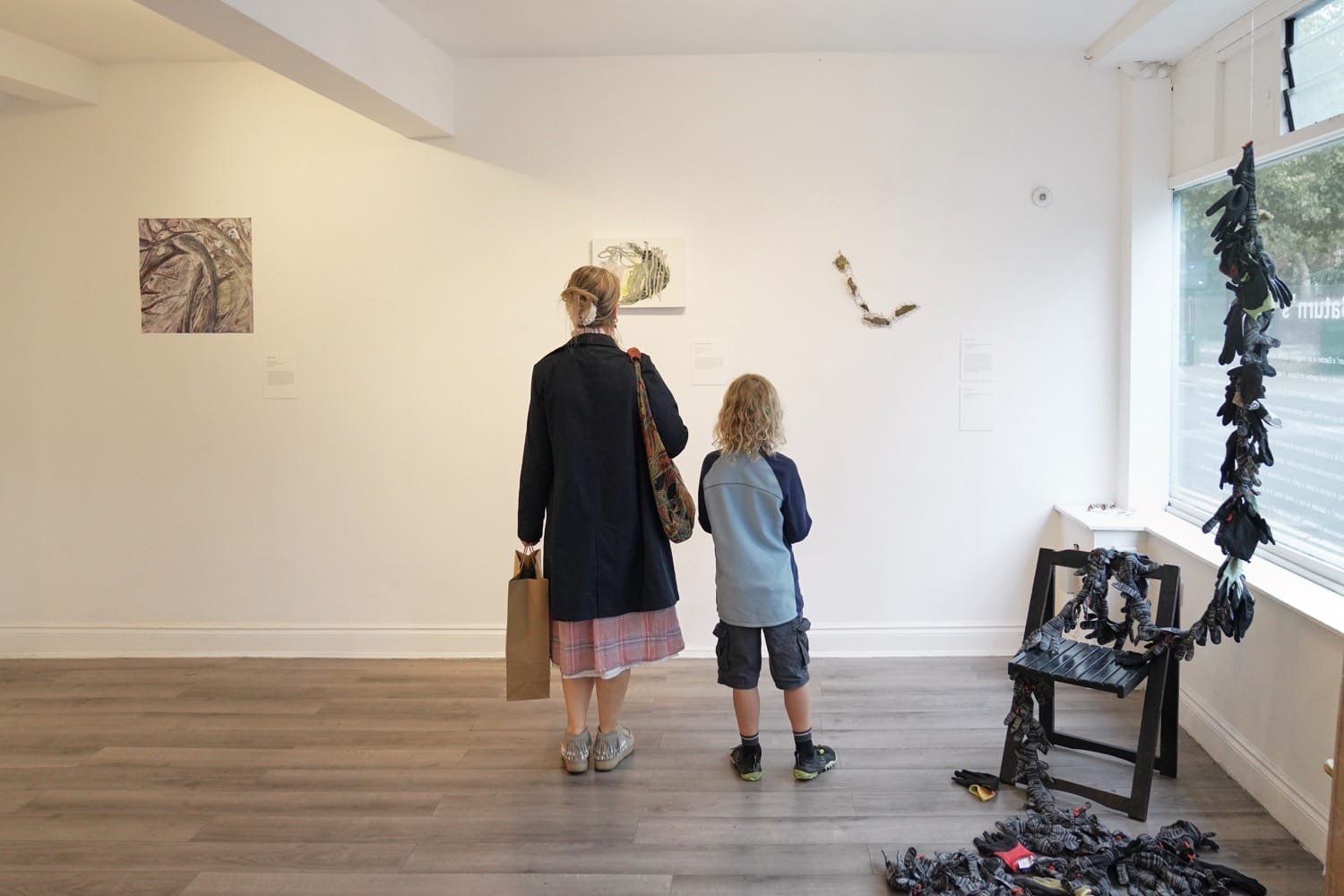
The curatorial premise is deceptively simple: Saturn, planet of cycles and slowness, lends its temporal logic to the condition of migration. As curator Angel Qin’s statement reminds us, culture in movement is neither preserved nor erased. Instead, it undergoes what Qin calls “generation within impossibility,” sedimenting into new forms, hybridising through contact, resonating across distance. The exhibition, structured as a circular ecology, places the visitor within this cycle.
→ For the ultimate East London experience, check out Things to Do in Shoreditch – Your Essential Guide.
At the core is Yifan Jing’s Clover, described as “trunk and mother-body.” With its concrete base and triptych form, it anchors the show physically and symbolically. Built on coexistence, Clover reflects the cross-cultural narratives within the garden. Its centrality is not ornamental but cartographic. From here, works unfold like diaspora itself – dispersed yet interconnected. Clover becomes a gravitational force around which memory gathers, structuring the visitor’s passage as a circular ecology. Rejecting linearity, the exhibition stages migration as an unfinished process rather than a resolved narrative.
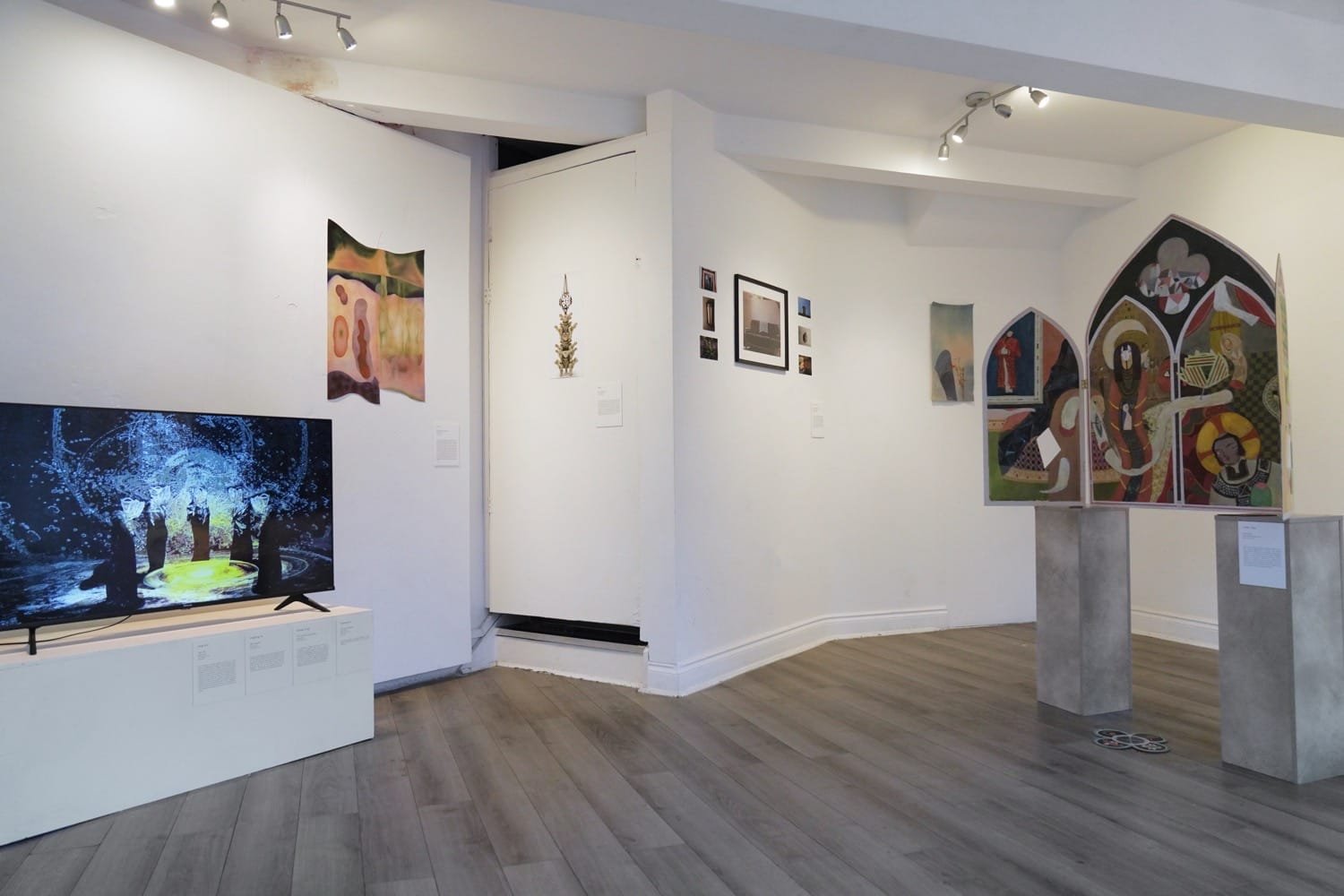
The visitor’s journey begins with Sia Li’s Domain of the Senses, which turns looking into ritual. With its dusty hues and muted tones, Li’s work is a testament to the phenomenological experience of perception. Positioned at the entrance, it casts attention on visibility and exposure and questions the politics of looking. This is one of the exhibition’s strengths: the choreography of space is never incidental. Each transition feels deliberate, a slow unwinding of Saturn’s cyclical time.
From here, the garden unfolds in concentric thematic rings – “Resonance and Airborne,” “Soil and Strata,” “Hybridity and Grafting,” and “Arbor and Wildflowers” – a structure that proves both legible and atmospheric. The exhibition’s conceptual framework is compelling. Rather than corralling diverse works into a single narrative, the metaphor of the garden allows for multiplicity without incoherence.
“Resonance and Airborne” is especially strong. Works by Tong Niu, Jingjing Xu, and Glassessia circulate like mist or pollen, ephemeral yet pervasive. Their use of frequency, allegory, and sonic diffusion endows the exhibition a sensory richness beyond the visual. Xu’s adaptation of Sisyphean myth contrasts epic monumentality with everyday monotony, while Glassessia and Niu explore memory as drift rather than archive. This section conveys how culture travels through fragile, transitory forms that evade capture.
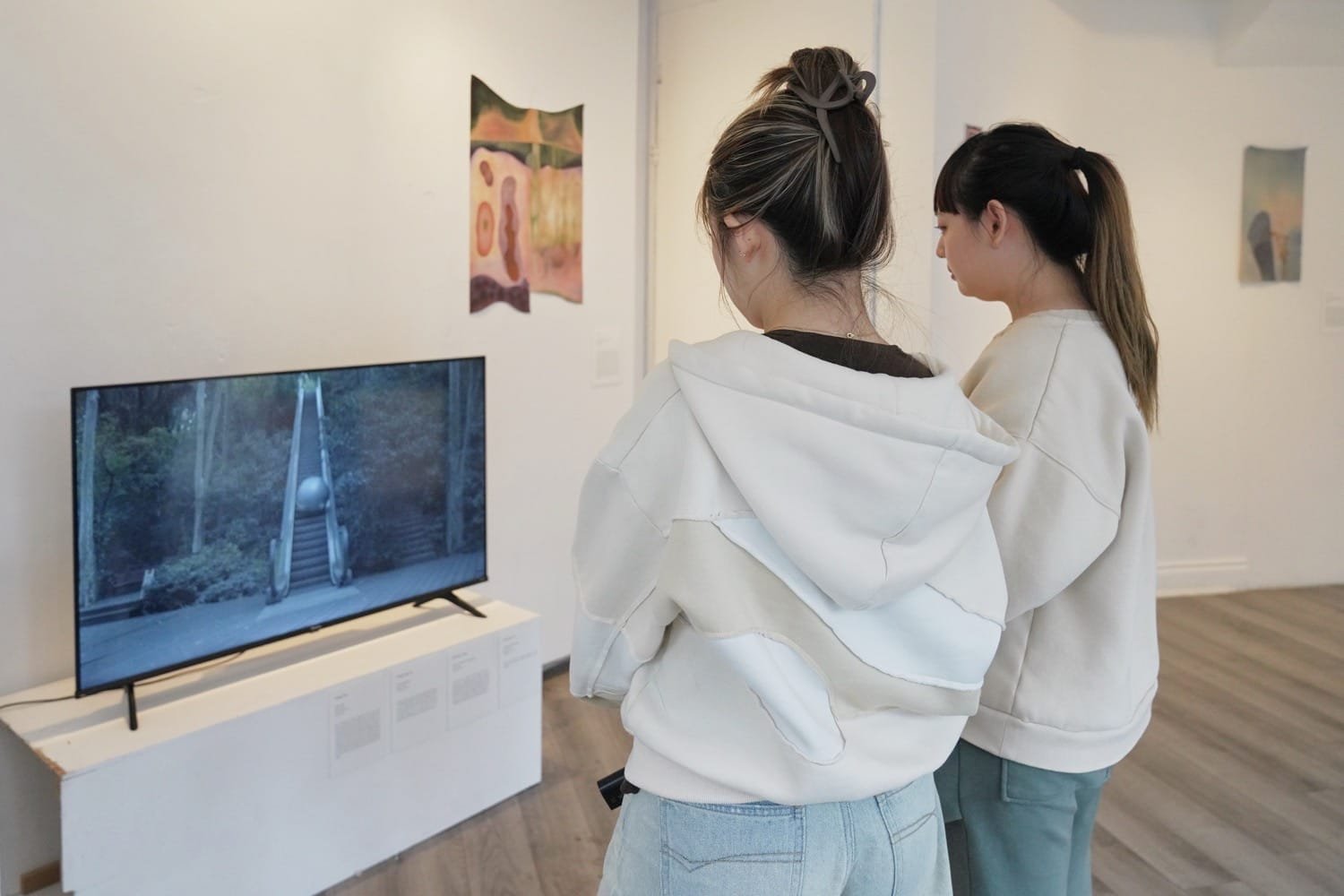
The mood shifts in “Soil and Strata.” Works by μDust, Chris Kraniotis, and Haoting Wu return us to gravity, excavating memory’s sediment. In Womaterial and Without Foundations, body and home are archaeological sites, gouged and eroded surfaces, recalling how memory “settles like strata.”4 Wu’s Caressing the Anchor blends the delicacy of traditional Chinese painting with sharp laser-burnt motifs, visualising brain fog as both haze and incision. These pieces grant weight to the airborne dispersals of the previous section, demonstrating the exhibition’s capacity to hold contradictions within the same ecology.
In “Hybridity and Grafting,” works by Ketong Xing and Zhixin Mai showcase material inventiveness. Xing’s digital work converses with Mai’s silver and wood jewellery, together fusing organic matter with cybernetic geometry. Hybridity here is literalised: bark with metal, paper with light. Their pairing demonstrates how transgressing boundaries births unforeseen forms, making theory tangible.
The exhibition arcs back toward tenderness in “Arbor and Wildflowers.” Paintings by Yang Chao and Anastasia embody resilience without sentimentality. Tree rings accumulate slowly, wild blossoms self-seed beyond human control. Anastasia’s Flowers in My Forest draws from the subconscious, allowing gestures to emerge unmediated, capturing “the energy of becoming.”5 Both works endure uncertainty in favour of cultivation and growth.
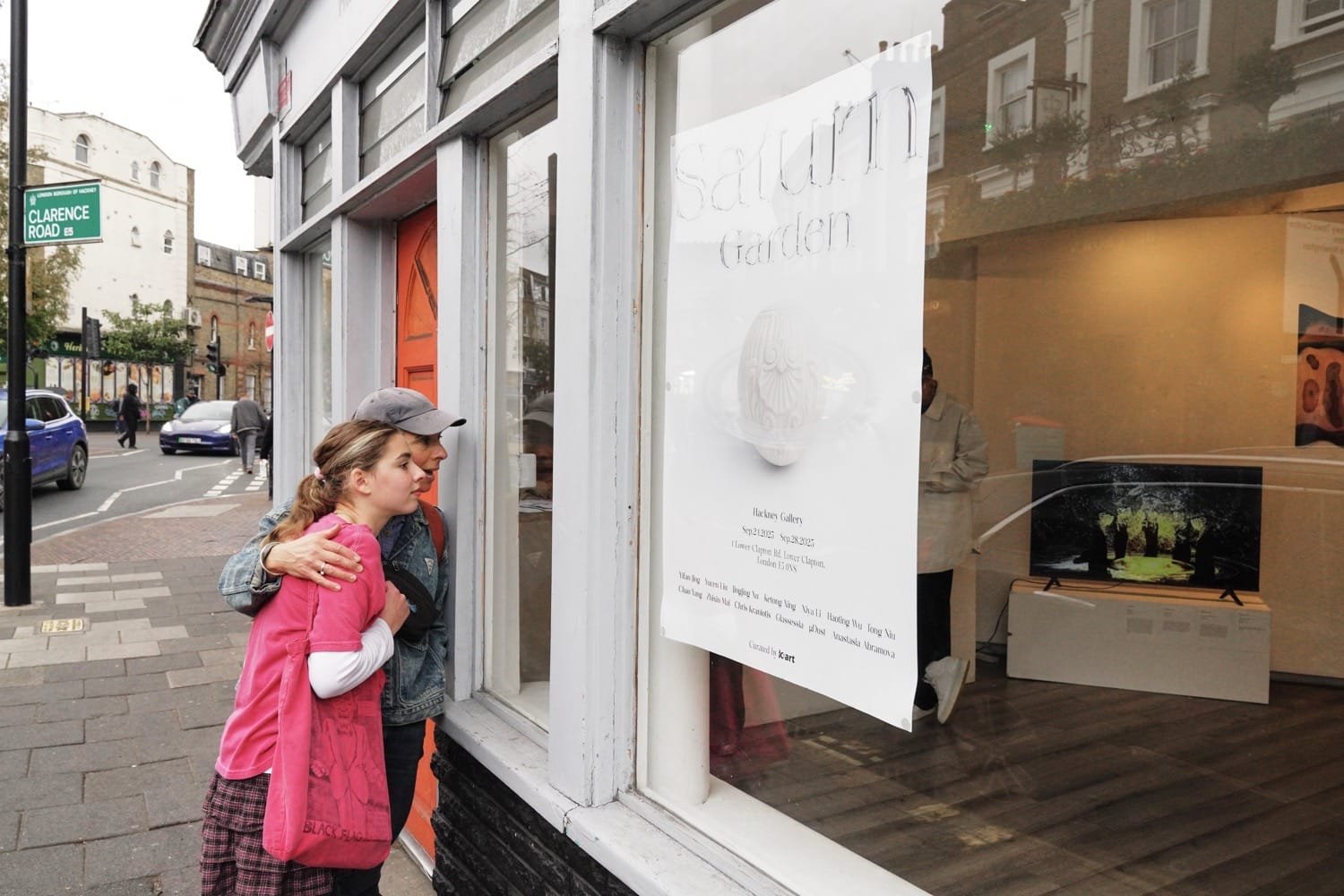
The final punctuation belongs to Yucen Liu’s Self Tied Self Lost. Suspended at the exit, it appears as remnant, knot, and echo. Empty yet retaining form, the glove speaks to the body’s absence and its lingering trace. Liu formally attests to the allegory of transitional periods, resisting closure. Migration, memory, and culture remain unfinished, knotted into futures still unfolding.
If there is a risk in the exhibition, it lies in the occasional over-poeticization of its language; the garden metaphor threatens to become diffuse. Yet the curatorial restraint in spatial design, combined with the coherence of its thematic clusters, keeps the show grounded. Importantly, the works themselves carry the weight of the argument; the curatorial voice frames but does not suffocate.
What makes Saturn’s Garden successful is its balance of ambition and sensitivity. It tackles a subject often flattened by rhetoric yet refuses to monumentalise or reduce it. Instead, it constructs what Qin aptly calls “an ecological structure,” one in which memory, hybridity, and resilience are experienced bodily as visitors traverse the garden.6 Avoiding the typical didacticism of commercial migration surveys – which too often collapse complex diasporic experiences into spectacle or trauma – Saturn’s Garden closely aligns itself with the experimental ethos of artist-run spaces across the city, where nuance, tenderness, and formal risk take precedence. It demonstrates that smaller-scale exhibitions can articulate migration with greater intimacy and acuity than blockbuster shows ever could.
Crucially, the exhibition’s location amplifies its resonance. In Hackney – a borough shaped by overlapping migrations – this “symbolic greenhouse” feels less speculative and more lived.7 Hackney Gallery itself, as an artist-run cooperative, embodies the ethos of collective cultivation. Saturn’s Garden thus operates not only as metaphor but as site-specific reflection: art as soil for cultural renewal.
Through its circular choreography, layered symbolism, and sensitivity to place, Saturn’s Garden achieves a rare coherence. It insists that even under impossible conditions, life persists through fragile, hybrid, and infinitely regenerative states.
Written by Sofia Chamchoun