




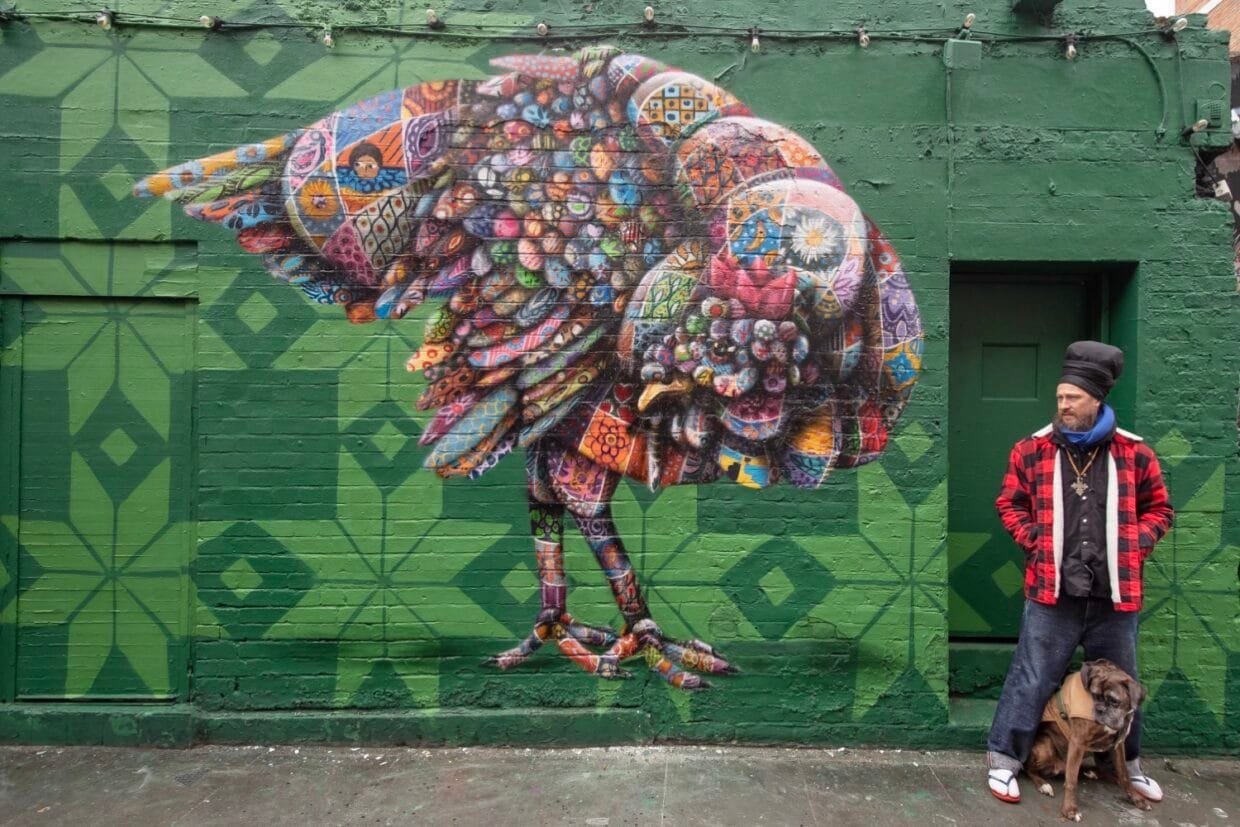
Louis Michel has spent more than a decade using street art to spark public conversations about species loss, empathy and environmental change. His latest collaboration with Viva! brings that mission to Shoreditch, where a bold, festive mural invites Londoners to rethink how we see turkeys at Christmas. Combining cultural detail, activism and his signature patchwork style, the work becomes both a visual statement and a call for compassion. To explore the ideas behind the project, we caught up with Louis Michel and did an interview.
Your upcoming Shoreditch mural with Viva! puts a festive twist on a serious issue. What made you want to use public art — especially something so bold and playful — to spark conversations about the treatment of turkeys at Christmas?
I’ve been using the public domain to spark conversations with people about environmental issues surrounding species extinction for almost 15 years now. Within that series, I’ve also touched on speciesism and allowed the artwork to challenge the general public’s views on how we associate certain animals as food. As a vegan for the past 13 years, I can’t help but be visually traumatised by the seasonal adverts that flaunt dead turkeys all over buses, billboards and magazines. This just seems like a small attempt to throw some balance into the mix.
Much of your work turns endangered or mistreated species into soft, plush-toy-like figures. What does this visual language allow you to say about vulnerability, empathy and the future of animal life that traditional realism can’t capture?
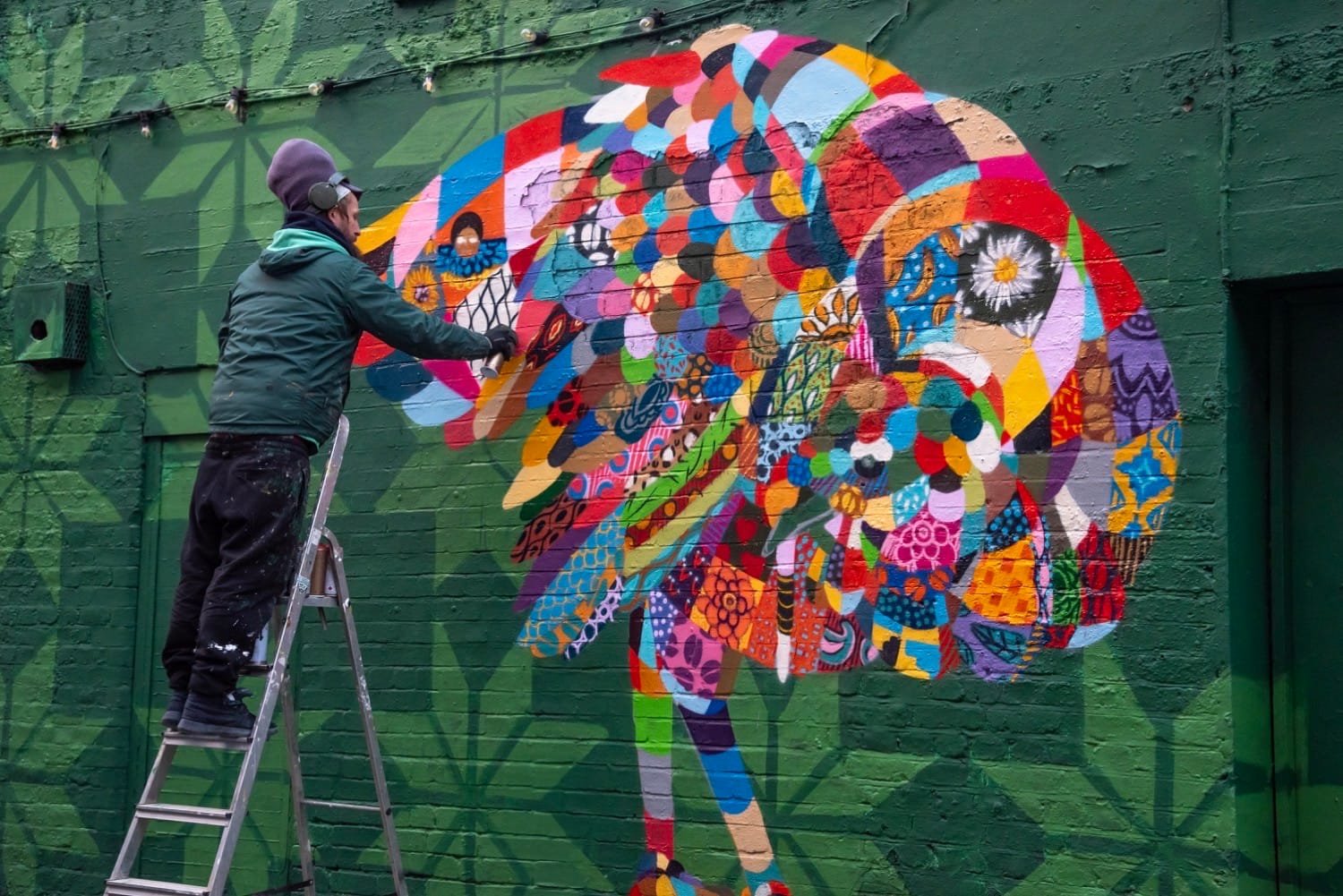
I think it was back in 2015 that I had a solo show in London exploring the notion of what is left after a species is termed extinct – perhaps souvenirs and toys are all that remain. At the time I was painting more realistically, and for this series I juxtaposed a realistic animal with a toylike counterpart. One of those paintings was a patchwork plush toy, and I’ve been exploring that style ever since.
You’re right – it does create a level of empathy and acceptance of species that are slightly scary to some because it allows the creature to be perceived as soft and cuddly. This is great for the narrative because most of the critically endangered species aren’t the ones people are naturally drawn towards. The most rewarding thing about the patchworks, however, is my sudden ability to be inclusive to a wider audience – that’s why sometimes you’ll see cultural fabric patterns, pop culture and cartoons. I like to draw all eyes to the bigger picture by starting with the small details first.
→ For more interviews with artists reshaping culture through bold ideas and visual storytelling, explore our Creatives & Creators category.
This campaign focuses on making people “pause in the street” and rethink a cultural norm. How do you think street art can disrupt habits or traditions in ways that more conventional activism can’t?
This is a great question, actually, and one I ponder over a lot. I also find myself speaking with activists often about why art is so important. I feel like it’s not used enough by activism, if I’m being truthful.
So does it create change – can it create change? The answer is yes, absolutely, but it has to be multi–layered; it doesn’t work insularly. Let me explain this more. I’m painting these turkeys in the public domain. Some will have slogans, some won’t. Some will have more Christmas–themed attributes, some might even be realistic in look over the patchworks.
Art is subjective, and the murals will sit there and be enjoyed and accepted as part of someone’s day–to–day, and for the most part that will be all they are: paint on a wall. However, Viva! will be handing out leaflets to add that call–to–action value to the creation. Would people take the time to stop and talk with Viva! if the mural wasn’t being painted? Chances are the level of engagement has increased.
Now, I’m not painting these turkeys just for the immediate public who walk past the murals. They get shared on social media, we talk about them in other forms of media, blogs, publications – and it’s here that people start to look at the paintings as having a purpose. It’s here that the conversations go one step further. It’s here that the debates start.
For me and my series, however, there is another level of activation: I’m writing a book. A cross–pollination of recipes that switch out the animal that I’m depicting in the artwork. These books will be collected by people who love street art as much as foodies. It’s here at this next phase in the journey that new levels of change can be realised.
So it’s not a one–trick pony, what I’m doing. I’m layered, and with each season I let a new audience engage with the conversation. Traditional activism mostly has no nerdy collectability to it – and art does. I can’t say for sure, but I’m pretty convinced this approach has more leverage than a lot of traditional activism.
Your murals often merge cultural patterns, pop references and conservation themes. For the Hanbury Street turkey, what symbolic details or hidden elements did you weave into the final design — and what do they represent?
Well, being that I haven’t yet painted the patchwork details on the Hanbury mural, I’m not sure what will join the patchwork – the details tend to come to me as I paint. To get the nice detailed pop culture cartoons, I need to be painting a bigger wall, or not a bird… birds are great to paint but not so great for the cartoon references because the feathers all have drop shadows and you lose the details.
This specific painting will probably have my infamous bananas, though. They represent pop culture in art – think Andy Warhol – but they also have a fascinating case study reference for the issues around mono–farming. Bananas are also going extinct, for the second time. Go read up on it. I’ll definitely sneak some cultural Bangladesh fabrics in there too, being that I’m on Brick Lane.
Shoreditch has a long history of using walls as canvases for social commentary. How does working in this neighbourhood inform the way you approach a mural like this, knowing the audience is creative, diverse and always moving?
Shoreditch is a very unique place. Millions of people walk the streets looking for vintage clothes, art galleries, art, walking tours, food, bars and clubs… there is literally something for everyone. When I first moved to London, Shoreditch wasn’t the same as it is now – today it feels more commercialised and a bit of its magic is lost.
That being said, its culture is still electric, and it’s that very spark that got me addressing how my art exists in the public domain, within a community. Shoreditch reminded me to look at who lives with my artwork. These days I always look for a way to be inclusive if I can and acknowledge the communities that I leave my works with. I have to give thanks to the real Shoreditch people for shining that light for me.
Viva! describes turkeys as intelligent, sensitive animals. As an artist who gives species a “voice” through your murals, what did you want people to feel — not just understand — when they look up at this turkey in its festive hat?
I don’t know if you remember a big campaign the PDSA ran called “A dog isn’t just for Christmas.” Well, for me, I don’t see any difference between a dog’s life and a turkey’s life. I just want people to remember that a turkey is a living creature, not a food product.
This past weekend I painted a turkey in Margate, and a lady came up to me and said, “I hate turkey.” I said, “Mmmmm… that’s interesting because I’m painting it to encourage you to recognise it’s a bird, not a packaged food.” She looked slightly shocked at what I was saying and started to look remorseful. She wasn’t eating turkey, but she still considered it a product. I said, “Perhaps now you can love turkeys.”
The PDSA campaign was revolutionary, and now fewer puppies are bought as Christmas presents. Perhaps one day there will be less blood on the festive dinner plate and the turkeys can live out a happy life. I’d like people to feel some extra compassion — isn’t that what the festive season is about, after all?
Your international projects often highlight biodiversity collapse and species loss. How does collaborating with activist groups like Viva! expand or shift your approach compared to independent, artist-led work?
This is a campaign that I’m working on anyway. I invited Viva! to come on board and collaborate, so it doesn’t shift or change anything – it’s already an artist–led project. Working with Viva! will hopefully encourage other activists to partner up with visual artists in the future.
Public murals can be fleeting — painted over, weathered, or replaced. What impact do you hope this Shoreditch piece leaves behind, both in people’s minds and in the ongoing conversation around compassionate, plant-based eating?
Yup, nothing lasts forever. As I touched on before, the end result isn’t the mural – it’s the book. The impact will be continuous once the book is released and in circulation. The mural will be forgotten about, but hopefully after the tour has visited several cities around the UK and multiple media desks engage with the conversation as you have, the record of the activation lives on forever in the archives of the internet.
I’m OK with the mural passing away over time. So long as we reach a few people and reduce the amount of consumption of their flesh this year, then next year perhaps some will be spared the death penalty.