




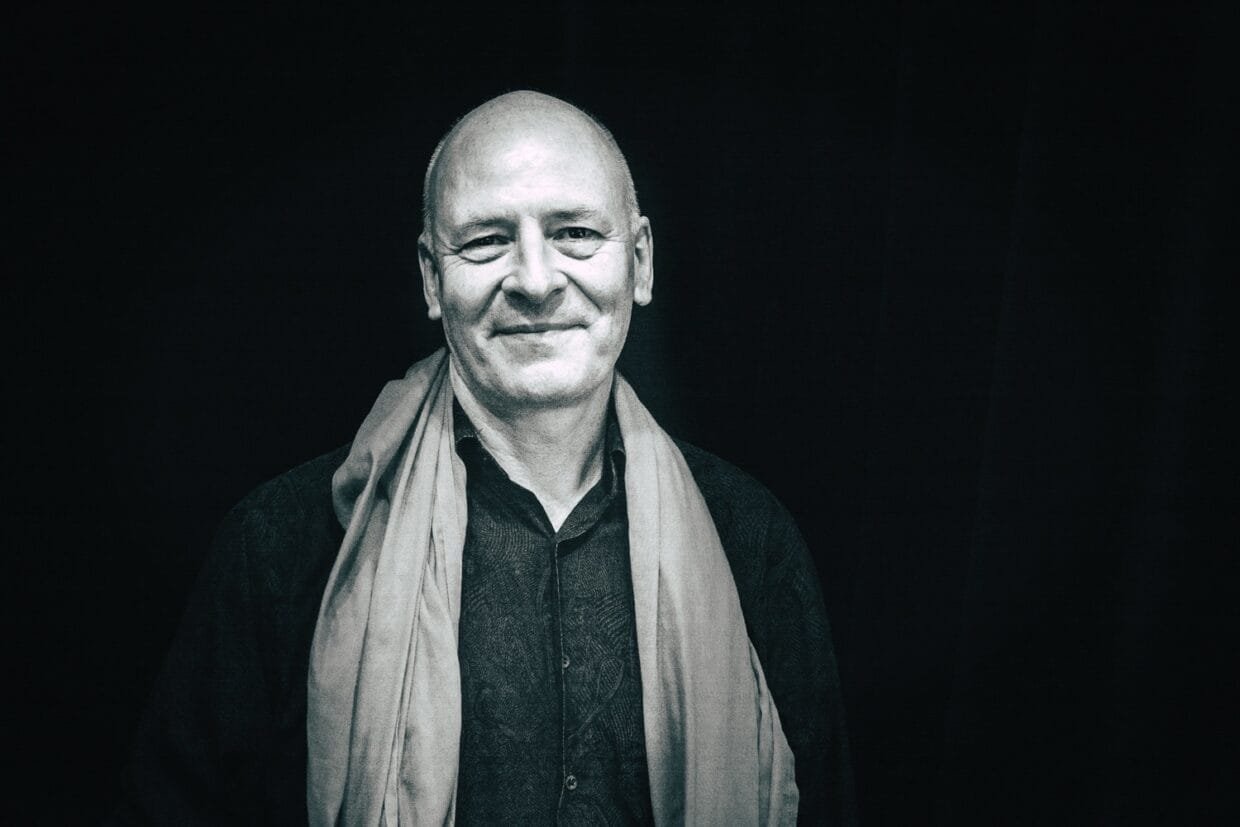
You founded the Crick Crack Club back in 1987 and have been at the forefront of reviving storytelling as a contemporary art form. Looking back, what first compelled you to launch a storytelling movement in the UK — and what continues to drive it today?
It starts with my love of the stories. Specifically traditional narratives – folktales, fairytales, epics and myths (as opposed to personal and original tales.) Traditional tales have existed for far longer than written narratives. They have been shaped by countless millions of anonymous mouths and ears and thus contain concentrated distillations of common ancestral experience. As a corpus of work, they directly address every conceivable question concerning human nature, from our greed and violence to our joy and compassion, because, as my colleague Hugh Lupton asks, ‘What contemporary issue has not always been a contemporary issue?’ In addition, a huge percentage of these stories– similar in plot and motif yet clothed in varying forms – are spread across the globe, speaking to a commonality of human experience.
These stories use an archetypal language of metaphorical images and scenarios… In certain genres – especially fairytale, epic and myth – this is very vivid, akin to the language of dream and is often shockingly extreme. The material penetrates. This language spoke to me as a child and continued to speak to me as I became an adult. I realised that only the exceptional ‘high artificiality’ of East European fairy tale films, some puppetry and the extraordinary theatre of Peter Brook’s Paris research centre (Ubu, The Conference of the Birds, The Bone, and finally the Mahabharata) could deliver these stories in any external form better than my own imagination. But theatre and film are excluding media, costly and complex and requiring rare genius to deliver well… Yet this repertoire is at the heart of ‘folk culture’ and folk culture belongs to us – all of us – and who are we but ‘the folk’? The folk are the rich AND the poor, the wise AND the foolish, the men AND the women, the young AND the old, etc. How could we reclaim it? One day in 1978 someone gave me a book with descriptions of storytellers telling stories in yards and porches in Haiti – and I realised that the power, accessibility and magic of storytelling lay in something that was materially much simpler than theatre or film – the spoken word.
In 1981 – relishing the DIY punk ethos – I set out with colleagues (including TUUP from Transglobal Underground) to rediscover how professional storytelling might work – particularly in multicultural Urban settings. And that fabulous journey is still ongoing.
Your background spans mime, image-making, directing and mythology. How have these disciplines shaped your approach to storytelling as both a craft and a-live-performance experience?
I left school aged 17 and did a mime course, explored puppetry and mask making and then spent a year in Burnley as an apprentice Image maker with the late, great, John Fox and the rest of the Welfare State International theatre company. This placed me in the world of community arts and street theatre. It awakened a real interest in speaking to audiences – particularly socially diverse audiences. How to find something truly popular? Storytelling requires no material support (no props or costumes) and can happen almost anywhere there are people – from the street, to a retirement home, to a 14,000-seater stadium. Most people have an imagination and as long as there is a common language, and provided you have the skill set, you can catch it, and set it gloriously on fire!
The Crick Crack Club has a long history in East London, particularly at Rich Mix and now at Folklore in Hoxton. How has the East London audience influenced the spirit, energy and evolution of your shows?
As young storytellers we were working on the streets in the very early City of London Festivals, and the Crick Crack Club moved from the Candid Café at the Angel Islington to the Spitz in Spitalfields Market in the early 1990s, so it is a very long relationship.
Around 2009 the then artistic director of Rich Mix, the fabulous Oliver Curruthers, sought us out and asked us to bring our shows to them. We started creating shows on themes – the Charity Shop show, Mad March Hares, Downright Rude… and many more. Our Day of the Dead show became an annual ritual, as did our Grand Annual Lying Contest (sort of). We miss Rich Mix and its audience, but Covid and the continued underfunding of Arts has changed so much.
We’re still very much in the East End. We programme monthly Fairytales for Grown-ups shows at the glorious (if bonkers) Folklore in Hoxton, and we put on ‘bigger’ shows at the stunning Hoxton Hall who are doing amazing work creating arts venue that both serves, and is in service to a community.
We’ve watched the social demographic of East London change and change again. I dislike the restrictive signalling of the corporate vibe and have always enjoyed rough and ready venues (as long as they are acoustically viable!) and the sort of audiences who don’t mind that. These are the folk who are not too materially concerned… Who want to live for the experience of NOW.
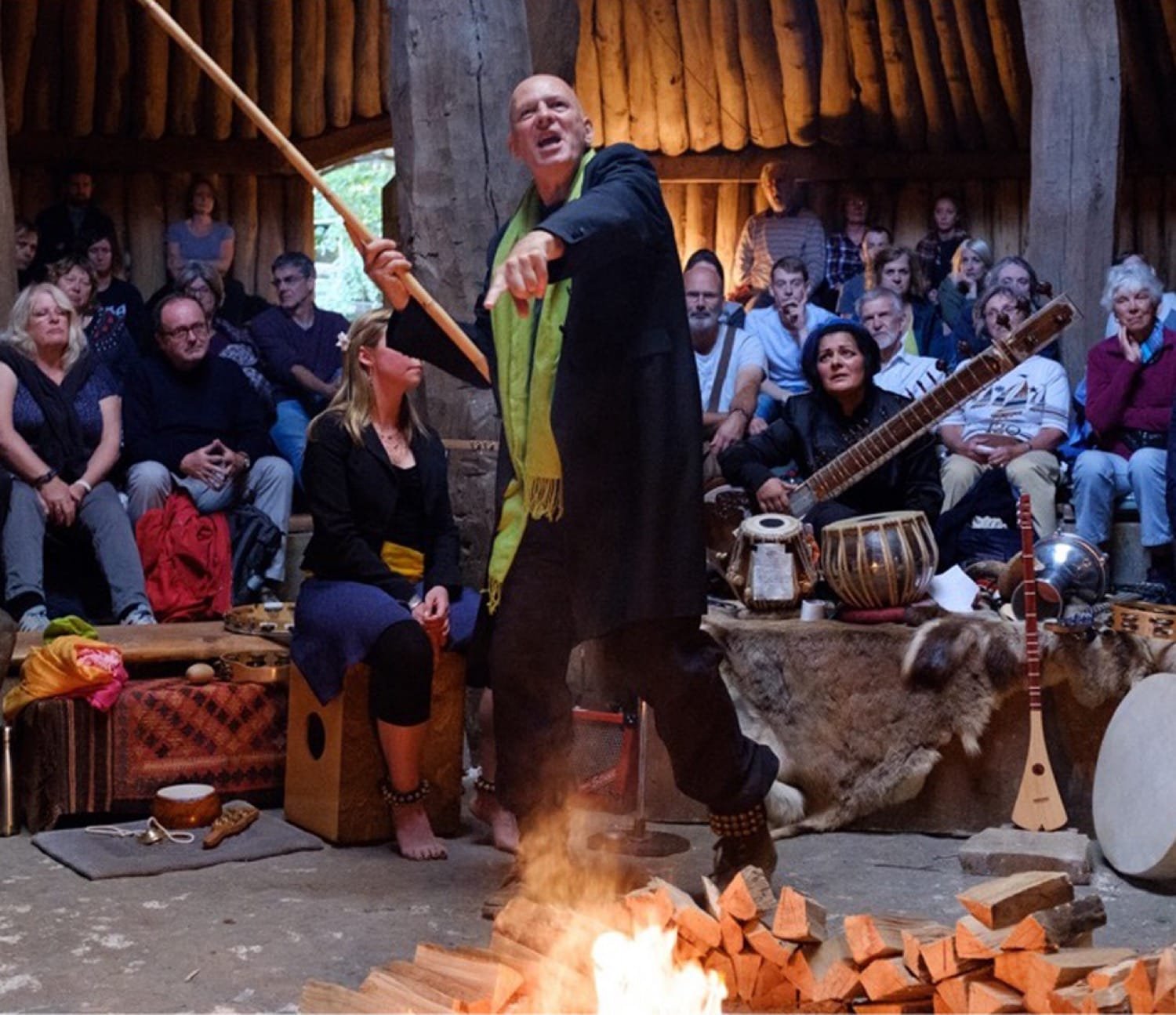
This year’s Crick Crack Club Christmas Carols Show brings together storytellers, musicians and a riot of festive mischief. What makes this event different from a traditional Christmas show — and what do you hope audiences feel as they step into this world?
Magic and Festivity!
We are singing carols because they are the one form of communal song very many people know, so they can be joined in with – irrespective of religious beliefs (and people can always la la la the lyrics!). Ours is not a Christian event rather it is a mid-winter celebration of life, community and coming together. The stories are from different parts of the world addressing themes of wonder and joy. And with Sheema Mukherjee and Raoul Nuemann as our band, the music has a transglobal touch…
You’re known for performing everywhere from caves to Carnegie Hall, with stories ranging from Gilgamesh to Frankenstein. What draws you to such a wide spectrum of mythologies, and what makes a story feel “alive” on a modern stage?
The paradigm of contemporary performance storytelling is the same as the historic paradigm of wandering bards, griots, troubadours and epic singers, the world over (and in many cases it is still so today). The specific paradigm is a solo artist on a stage (though often accompanied by a musician) holding the attention of a large audience of strangers for two hours. When put like that you begin to appreciate the skill sets involved: because there is no author and no director, the performer has to do it all – and ‘it’ is not the recitation of a fixed script! The oral storyteller is not making the story up as they go along – but they are improvising the language that communicates it, finding it in the moment. If the story has been told many times its linguistic form may become settled by repetition – but only to a degree: there is always a freedom to respond to each audience in a slightly – sometimes majorly – different way!
This requires an immense amount of focus and energy over a sustained time and the resulting internal biochemistry of the performer can become heightened. This in turn sometimes allows what could be called ‘mantic flow’ to appear and when you are telling stories which require giving voice to various anthropomorphic ‘Gods,’ this can become deeply surprising. Much insight about many things can be gained.
Your work with the Silk Road Ensemble, creating epic narratives for large-scale concerts across Europe and America, must have been extraordinary. How did those collaborations change the way you think about global storytelling and cross-cultural-myth?
I spent 10 years with YoYo Ma and the incredible musicians he gathered around him. It transformed my understanding about both the diversity AND the commonality of myth, folklore and in fact all creative endeavour. Humans have been exchanging all manner of material and intangible cultural artifacts for a very long time – generally, by peaceful and joyous means, but sometimes, of course, less so… Everything real has a shadow. We need to understand our global history much better and the long-term deep time migrations of people and cultures. It should be an encouraging rather than fearful experience. This is one world. There is one humanity facing a climate crisis that threatens us all. We need to work as one and those who have good fortune need to sacrifice and share with those who have less. This is one of the recurring messages in the stories.
Storytelling is often seen as ancient or nostalgic, yet your work proves it is anything but. What do you think people misunderstand most about contemporary storytelling — and why do you think audiences are craving it now more than ever?
As I quoted before, ‘what contemporary issue has not always been a contemporary issue?’ This repertoire of commonly owned tales, this global human heritage, is an ancestral gift passed on with generosity to help each generation as it arises. Our work uses the unfamiliarity of extraordinary visualisation to blast the imagination into activity – to help people appreciate that it is there… something powerful, mysterious and underexplored. Storytelling’s improvisatory paradigm allows audiences to feel – to know – that their presence is actively contributing to the event – there is an archaic rawness and vitality that nourishes the soul in a way that digital experiences cannot.
We want to nourish the subconscious and plant seeds which will germinate as future wondering – and we want people to feel they have shared something alive in the physical co-presence of their neighbours. A meal of dreaming if you like. We are not alone and, strangely, the ancestral voice can still be heard. It is benign, full of encouragement and love.
The Crick Crack Club has nurtured an entire generation of storytellers. As Artistic Director, what excites you most about the future — both for the art form and for the next 30 years of Crick Crack Club?
We are thrilled to watch several small groups of artists whose potentials were noted long ago and were nurtured for many years, bloom, blossom and set their own seeds. The training of the Irish Bards lasted for 12 years and the compositional and performance skill sets required for in this professional artistic paradigm are long to acquire. The generation of UK artists now reaching maturity that includes the likes of Sarah Liisa Wilkinson, Emily Hennessey and Steph Brittain excites me, as well as a generation of artists abroad such as Mikke Oberg in Sweden and Martina Pisciali in Italy.
The British storytelling revival of the 80s was made possible by a government lead commitment to multiculturalism – particularly by establishing an economy of work in primary and secondary schools. This was severely damaged by a change of school funding arrangements in 1992. There are signs that the current government is realising what a catastrophe the loss of enrichment through visiting artists to school premises has been, so maybe this will help a new generation make a viable living through this profoundly essential art. More generally, the current interest in folklore and mythology is largely the direct result of the labour of my colleagues and I over the past 40 years. I hope that as people learn more and more about global and comparative folk cultures and history, there will be a lessening of fantasies about ‘national’ identities and a more celebratory approach to commonality, directing effort towards the common human cause of saving a beautiful planet threatened by our greed and excess.