



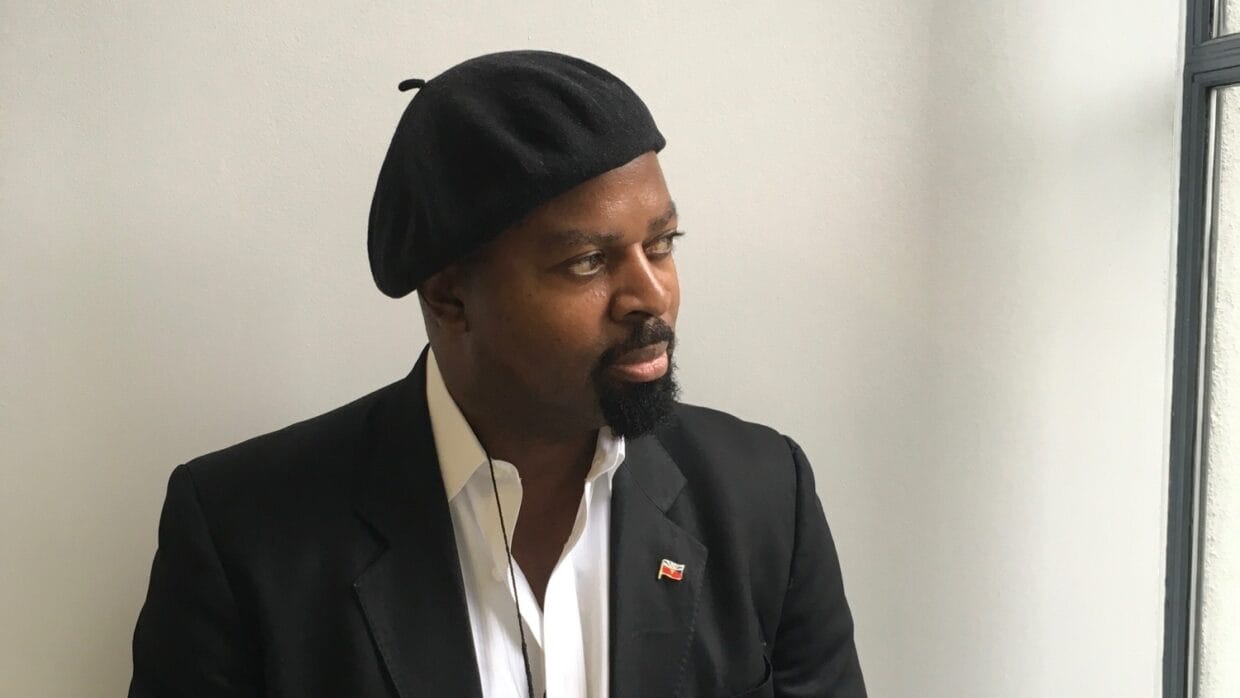
Fresh from his appearance at the Festival of Words, Ben Okri continues to challenge the way we think, feel, and imagine. In a world overwhelmed by grief, confusion, and a crumbling relationship with truth, his voice cuts through the noise. The Booker Prize-winning author’s new novel, Madame Sosostris, invites readers into a myth-soaked realm where tarot, memory, and heartbreak entwine. Blending magical realism with razor-sharp cultural insight, the book isn’t just a story—it’s a reckoning. We caught up with Ben Okri to talk London, narrative power, and why realism no longer tells the whole truth.
Your new novel Madame Sosostris draws inspiration from T.S. Eliot’s mythical fortune teller—what made you want to reimagine her story now?
I didn’t re-imagine her story. I borrowed her from Eliot who borrowed her from Huxley. I needed a tarot card reader in the story. And I needed the most famous tarot card reader. I’ve always wanted to borrow a figure from literature and make them real. I mean, we always borrow from life and make it literature. So I do the opposite for once. Each element in the novel came about logically from the initial premise. It was about the broken and the broken needed to be healed. There was a festival and it needed a core and the core had to deal with the things that most fascinated people, their past or their future. But Madame Sosostris is one of the most famous tarot card readers in literature so she had to be there. But her role is ambiguous. She is there not there. Her absence is more powerful than her presence.
How does The Festival for the Brokenhearted reflect the emotional or spiritual undercurrents of this current cultural moment?
My original inspiration was an image of the broken. I feel we are living in broken times and the underlying feeling of the age is heartbreak and grief and a need for healing. I always begin my books with a deep listening to the mood and underlying currents of the times. Then I let it crystallise into an image, or if I am lucky into a story. In this instance I wanted to focus on a story and to let the story stand for all the other stuff going on. Wars and dispossession and the loss of democratic rights. In short grief and heartbreak. But I wanted to keep the story to one thing. It’s about these two couples and also about class and gender and the masks we wear and illusions we lived by and our curious paths to happiness and unhappiness.
As a Booker Prize-winning author, how has your relationship with storytelling evolved in recent years, particularly with your more lyrical and visionary works?
My form of storytelling has changed in many ways. For one thing I’ve become more concentrated. And yet simpler. I am constantly finding new ways of telling stories and creating characters. I try to do more things in less space, to compress, but with lightness. I am working with lightness of touch right now. I believe you can be light and devastating at the same time. I think lightness is the new frontier. Madame Sosostris is light in touch but its themes are many and complex and if you read it too quickly you might miss some of them. I would say there is more hidden in that book than is visible, themes of class, identity, illusion, personality, climate change, love, heartbreak, transformation.
London has long been a muse in your writing. How does the city’s energy shape your latest work—and does Shoreditch’s creative chaos influence you at all?
London is one of the best cities in the world to write in and I have been very lucky to have this great city as the place to wander and think. There are cities that inspire writing and there are cities in which writing is best done. London is a city inclined towards narrative and poetry. I love wandering through Shoreditch, when I get the chance.
Your novels often blur the lines between myth, dream, and reality. What does magical realism allow you to express that realism alone cannot?
Realism is limited in what it can do. It can’t convey simultaneity, in a way that is simultaneous. It doesn’t allow for any expression of character that does not conform to the socially accepted norms. A character can’t experience, in immediacy, life as a dream. It doesn’t allow myth to work through story, through events. Accelerated consciousness baffles realism, because things have to obey the law of sequentiality. Sometimes events are perceived irrationally, or magically, because that is how the character’s mind operates; but with realism the writer has to explicate this, and in so doing breaks the spell of the way it is experienced. There are hundreds of things realism can’t do or would take three times as long to do and when done that way loses its punch. Realism is stuck in its own philosophy of materialism. But a different philosophy requires a different technique. Realism doesn’t accommodate a world view different from its own. That is its principal limitation.
But its existence and its persistence compels those using a different technique to convey a richer conception of the human spirit must also find a way to get their work to also speak to those used to realism. So it is a benchmark of comprehension, a tyranny of comprehension. Realism has shaped the human mind now for hundreds of years. So one must take it into consideration. But you have to remember the lesson of quantum mechanics. Matter is an illusion. The basis of realism has been undermined by science. We are still clinging to a pre-quantum world, which is a flat earth theory of reality. Sooner or later we will need a new way of narration to convey the strangeness of reality. Realism is already obsolete. It is just that millions of us still persist in the illusion that the world is as we see it. And we writers still live in that extinct world. The future is towards an investigation of truer ways of telling stories about the mystery that are human beings in the mystery of the world.
What emotional journey do you hope readers take away from Madame Sosostris—and is there a message for those feeling lost in today’s world?
I don’t deal in messages. The novel offers a journey that the reader makes into themselves. The characters are us. We need to re-examine who we are and who think we are. We need to tear down our masks that stop us experiencing one another fully, that stop us experiencing life more richly.
BeThe underlying theme of our times is grief and heartbreak. Beyond the novel it us worth noting that attempted genocide is taking place in our times, in plain sight. There are brutal wars souring the taste of the world. Freedoms are being lost. Our humanity is shrivelling. We need to re-define what humanity is. We need to heal the earth. We need to be truthful to ourselves about the kind of world we want. We need to see through the lies masquerading as truth.
You’ve written across forms—poetry, novels, essays, even visual art. How do you decide which medium best suits a particular idea or emotion?
I don’t decide. The idea decides. I have to listen. The hardest thing to do is listen. If we really listen the work is always telling us what it needs to be.
In a time of division and disillusionment, what role do you believe artists and writers must play in reshaping public imagination and healing?
The role of the artist now is truth-telling, truth-imagining. But with rigour. With truth being twisted and turned upside down, with the conquest of alternative facts, artists need to be especially rigorous and disciplined. We need to help purify the language, the language of thought, the language of the heart. We need to reinstate justice as a central fact of the human experience. We need to help restore our humanity, for we are losing it a little under the pressure of the times and under the force of politicians who turn us against ourselves and make us meaner and colder in the heart and smaller in spirit. The artist reminds us that we are greater than all that.