



With his debut feature Paul & Paulette Take a Bath, filmmaker Jethro Massey has crafted an unconventional romantic comedy steeped in macabre curiosity. Inspired by Lee Miller’s infamous photograph in Hitler’s bathtub, the film explores how love, obsession, and history collide in surreal and unsettling ways. Following acclaim at Venice and Dinard, it’s now arriving in UK cinemas. We caught up with Jethro Massey to talk about his inspirations, risks, and the unexpected tenderness behind his darkly comic tale.
The film was inspired by Lee Miller’s photograph in Hitler’s bathtub—what about that image sparked the idea for Paul & Paulette Take a Bath?
The juxtaposition of horror and intimacy. It’s an image that raises so many questions. It haunted me for years, with fascination and repulsion at the same time. Why does this image stay with me in a way that it wouldn’t if it was taken at his desk, or his living room?
Why did Lee Miller choose to make herself the subject of the photo after months of documenting the war from behind the lens? (She did take a photo of her colleague David E Scherman in the bathtub, but she chose to publish this one).
This is the space where Adolph Hitler took off his clothes, brushed his teeth, saw himself naked in the mirror, where he was at his most fragile. There’s something about the proximity to the human being who was responsible for these atrocities.
It’s an image that pushes back against the reduction of Hitler to just a symbol of evil, to something we can simply file away in our mind as other.
I wondered if the photo perhaps calls on the same instincts that feed our car-crash head-turn look-don’t-look curiosity, our true crime fascination, our fetish for violence in film. We want to know it, but we don’t.
The image, and the feeling it gave me, stayed with me for years. That terrain, of unanswered questions, of discomfort, always strikes me as interesting ground to dig into.
So I started writing a story about two characters who make a point of not looking away when most would, who go to places where terrible things have happened, who try to climb under the skin of historical criminals and victims, to understand the minutiae of the human interactions that took place at those sites, to take the audience on a sort of road trip with them, exploring that same unease that Miller’s photograph gave me.
You describe this as a romantic comedy, but it veers into the macabre—how did you find the balance between dark humour and emotional sincerity?
To be honest, I didn’t think of the film as a romantic comedy when I was writing it; I just wrote characters that made me smile, chuckle at times, characters I wanted to go on this trip with. The film treats some dark subject matter, but I didn’t want it to be heavy. My favourite films are ones that are easy and fun to watch, but leave you with something to think about at the end.
Ultimately, this a film about transgression. It wasn’t so much about finding balance, as of asking a question: Where is the line? And I took any opportunity I could to poke and prod at that line.
Paul & Paulette, objectively speaking, aren’t bad people, they don’t commit any acts of violence, they don’t hurt anyone else, but I knew that at some point in the film, people will think they’ve gone too far with their game. But I knew that the moment when they cross the line would be different for everyone in the audience.
And that’s what excited me – asking the audience the question; how far is too far? And know that each person would respond differently.
The crime reenactments are both absurd and strangely intimate—what drew you to this as a narrative device for exploring human connection?
There’s a wonderful scene in Bertolucci’s “The Dreamers”, where the characters re-enact the race through the Louvre from Godard’s “Bande à Part”. Being in the audience isn’t enough for them, they want to immerse themselves in the film.
I think Paul & Paulette are doing something similar, but whilst the Dreamers are reaching into the cinema screen, Paul & Paulette are plunging into the darker side of human nature. Reading books, or looking at photos in a museum is only scratching the surface, and for them, there’s something more honest, more real about their re-enactments than mere observation.
It’s what we do as children, isn’t it? Playing out scenes with friends, with cars, dolls and figurines, recreating the adult world in order to understand it. But in that process we’re not just learning about the world, we’re learning about ourselves and each other.
The relationship between Paul and Paulette is rooted in performance and fantasy—what does the film say about authenticity in modern love?
What profile picture do I choose? What do I wear? How do I show I’m a fun, interesting person to be around? The early days of most relationships are rooted in performance. And then peeling the layers of that performance away to reveal the real person beneath.
The modern world has put more layers between us. We spend so much of our time looking at screens that create an illusion of connection, but in reality are driving us further apart.
These are two characters rebelling against that feeling, they need to reach into the physical world, to reassert their connection to it. They jump into performance, into play, into fantasy to understand themselves (and each other). But ultimately they’ll only find their balance as the artifice of those games falls away.
Paris plays a vivid role in the film—how did you use the city’s real locations to heighten the tension between romance and danger?
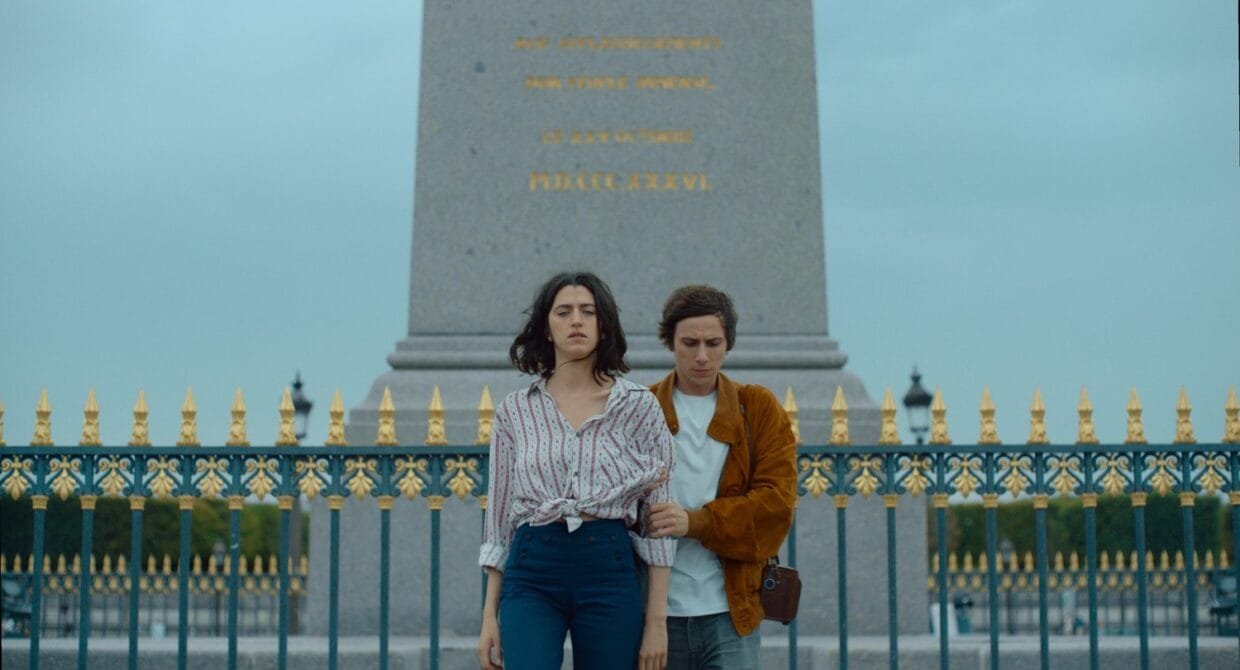
I often wonder how important it is to be in the real location in cinema. I know how it makes me feel, being there, and so it felt important to take the crew and the actors to these sites; the Conciergerie, where Marie Antoinette was incarcerated, the wall where the Communards faced the firing squad, the Jardin d’Agronomie tropical, where you can still see the remnants of the colonial human zoo. When Paulette looks out of the window in Munich, the apartment we see is Hitler’s real apartment. I’m sure there’s some kind of texture, that sense of dread you feel when you are there, that finds its way into the film.
I think every major European city has a dark history lying underneath, plenty for Paul & Paulette could have gotten their teeth into, but of course Paris holds a unique place in people’s minds. It was irresistible to me to play with, and ultimately take apart that romantic image.
What you see really depends on where you turn your attention. When you go to the Place de la Concorde, is it the beautiful central square, where the presidents sit for the July 14th parade? Do you think about Marie-Antoinette and the guillotine? And if you do, do you think about the terror of putting your head down on that wooden block, and waiting for the blade to be released?
I’m fascinated by how places and objects change when we tell a story about them. It’s just a bathtub, like any other, until we tell you whose bathtub it is.
As a first feature, this is an ambitious and visually layered piece—what was the biggest creative risk you took, and did it pay off?
It was a completely self-produced film, no outside financing or support, which I don’t think shows on screen. I had an incredibly talented cast and crew. Where we didn’t have money, we took the time to prepare. But that was the boldest leap; looking the cast and crew in the eyes, and saying “we’ve got no money, this is the first time making a feature film for most of us, and it’s absurdly ambitious. But don’t worry, we’re going to get there”.
It’s not really for me to say whether it paid off or not, but for a film made this way to make it to Venice Film Festival, let alone to win awards there, is virtually unheard of. So I’m going to say it did.
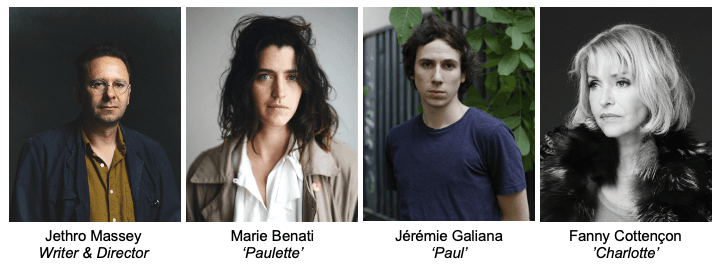
How did you work with Marie Benati and Jérémie Galiana to ground their eccentric characters in emotional realism?
I can’t take much credit beyond finding two incredibly talented actors who had great on screen chemistry, and who really understood my intentions with the characters and script.
Marie’s performance is completely unselfconscious, capturing Paulette’s impulsive nature, her need to grasp the world with two hands. Meanwhile Jérémie was an incredibly attentive actor, guiding our eyes to what Paulette was doing, asking us to see her through Paul’s eyes.
Neither of them have had lead roles in a feature film before, but they have done a tremendous amount of theatre work, which served us so well. There wasn’t a single take where their performance didn’t feel truthful.
After winning major awards at Venice and Dinard, what conversations do you hope ‘Paul & Paulette Take a Bath’ will spark with audiences?
It’s the greatest compliment when people have said to me that the film stayed with them, that they were still talking about it weeks after watching. There’s a lot to chew on in the film, and if it sticks in between people’s teeth for a while, I’m over the moon.
I can tell you my absolute favourite reaction to the film so far. A neighbour, a 70 year-old Parisian, came to a screening. I passed him in the stairwell a week later. Though he’d lived in the city his whole life, he didn’t know about the human zoo, or that there was a plaque at the site of Marie-Antionette’s execution. He told me that the day after seeing the film, he had ridden out on his bicycle to see them with his own eyes, just like Paul & Paulette would have wanted.
xxx
PAUL & PAULETTE TAKE A BATH is in UK & Irish cinemas 5th September www.conic.film/bath