

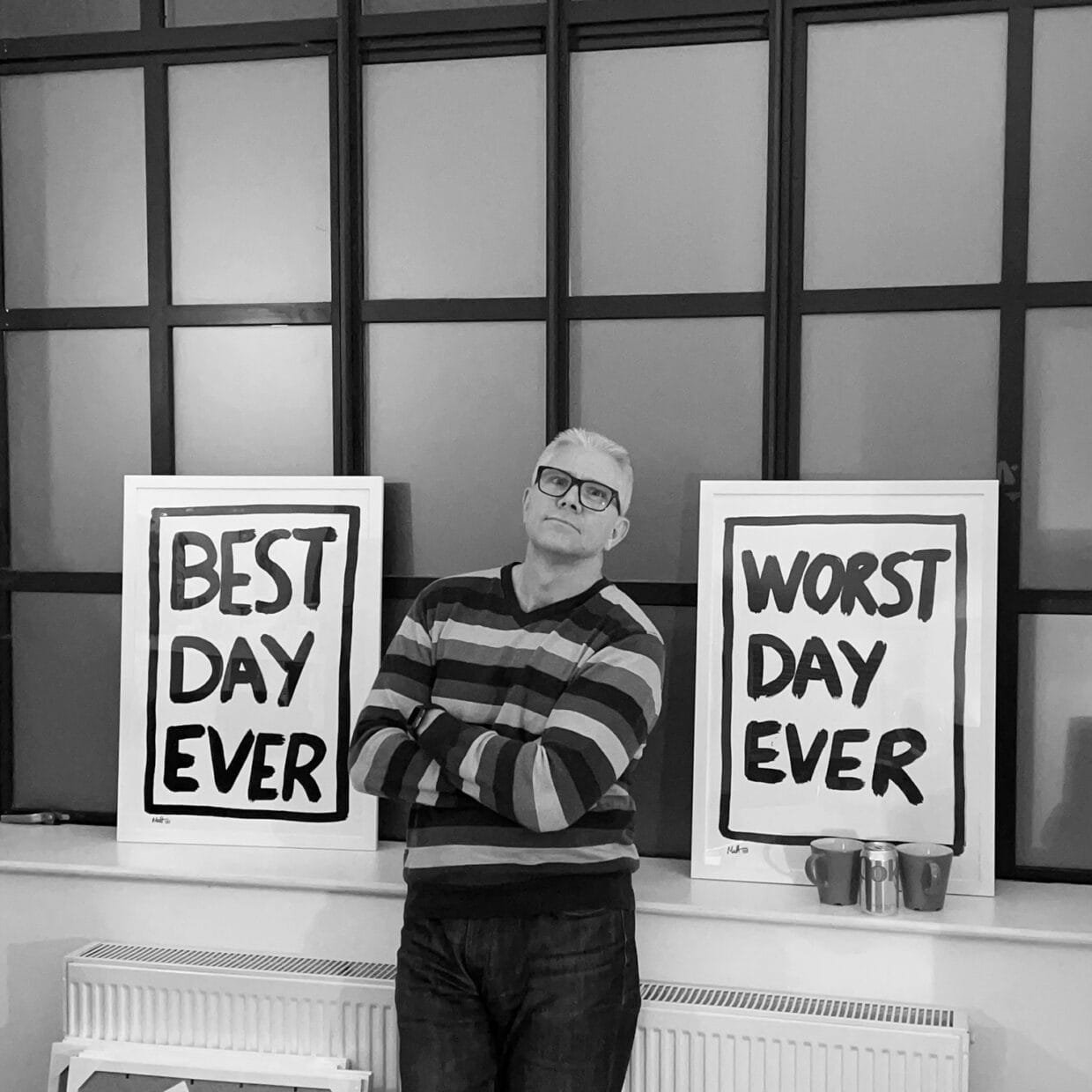
British artist and typographer Matt Eley believes words are more than just language—they are memory, permanence, and raw emotion. His paintings strip back typography to its purest form, inviting audiences to feel rather than simply observe. From his collections Love Lettered and Echoes of Urban Decay to his reflections on the fragility and resilience of language, his work explores how words endure when everything else fades. To learn more about his journey and philosophy, we caught up with Matt Eley for an interview.
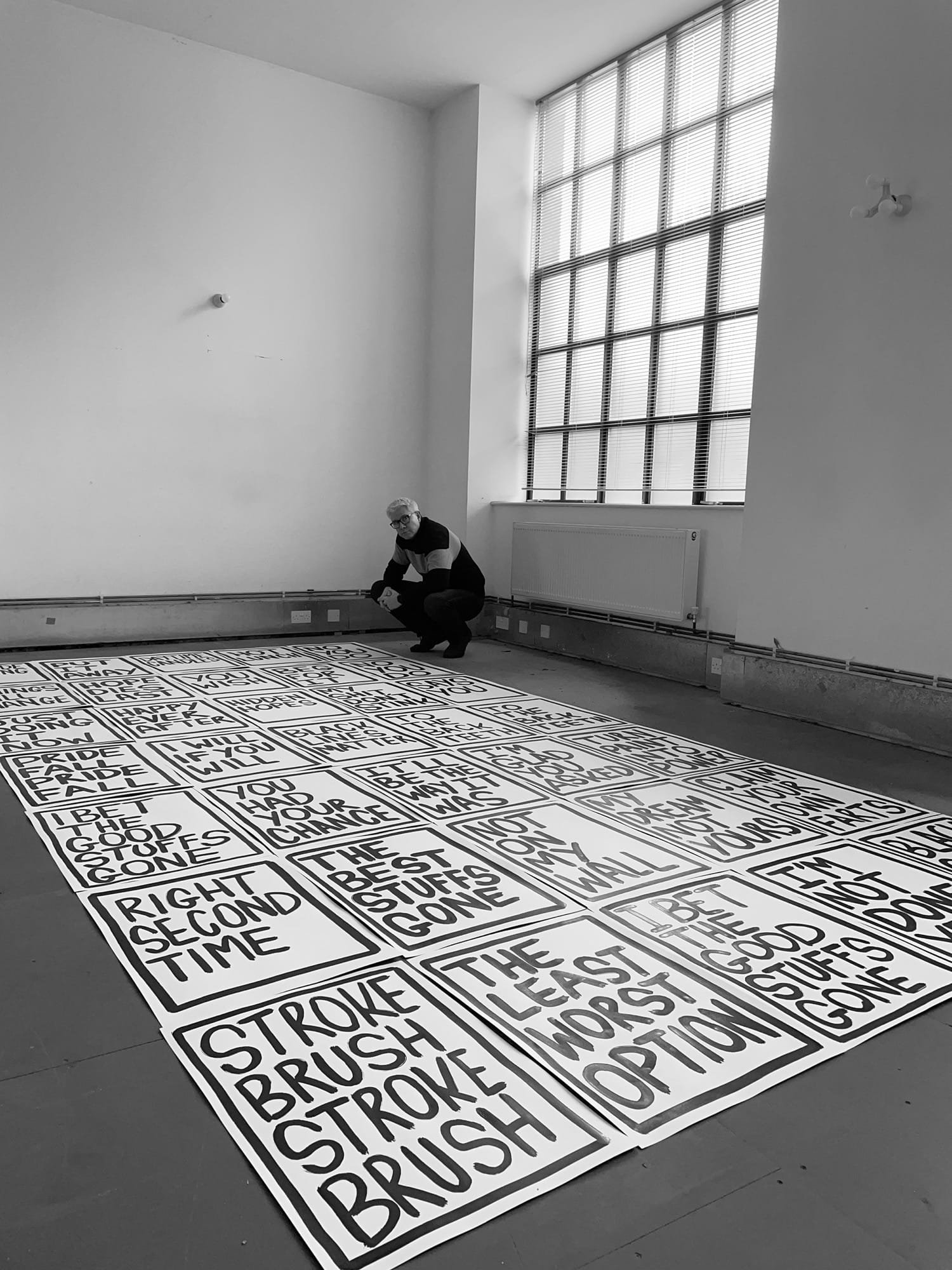
Q: Your journey began in graphic design before shifting into painting. What pushed you to step away from campaigns and into something more permanent?
Graphic design has given me a strong foundation in visual communication, but ultimately it always comes with constraints, deadlines, briefs, clients, and a sense that the work is temporary. Campaigns arrive with a great fanfare, live in a moment and then fade, often forgotten within a few weeks. After many years of that cycle, I started to feel a pull towards something that wasn’t just about solving problems for others, but about expressing my own questions, memories, and emotions. Painting offers that space. It gives me permission to slow down, to create without a set outcome in mind, and to explore permanence in a way graphic design never could. Stepping into painting felt less like leaving graphic design behind and more like finding the medium I was always meant to grow into.
Q: You’ve said none of your decades of design work would be saved from a house fire. How does that contrast influence the way you now create?
Graphic design always feels somewhat transient to me. It serves its purpose, to communicate, to sell, to inform and then its time is up. I never felt an emotional need to hold onto the work. With painting, the relationship is completely different. Each work carries something of myself: a thought, a memory, a piece of language that has marked me. They feel irreplaceable, not because they’re “precious” in the traditional sense, but because they contain lived experience. That contrast is what fuels my practice now. I want my paintings to endure, to feel like they matter beyond the moment of their creation, so I approach them with a weight and care that’s just not possible in graphic design.

Q: Typography has been central to your practice since childhood. What was it about those giant utilitarian letters in car parks and galleries that first captivated you?
I think it was their blunt honesty. These weren’t letters designed purely for art or beauty, they were designed to direct, instruct, and often to control. Yet there was something powerful in that stripped-back utilitarianism. As a child, I became fascinated by the fact that these ordinary words and signs shaped behaviour, memory, and space without anyone questioning them. They had authority. Over time, that fascination deepened into an exploration of how typography carries emotion even when it isn’t meant to. It’s less about the flourish of a font and more about the resonance of words themselves, the way their physical presence alters how we receive them.
Q: Your collections Love Lettered and Echoes of Urban Decay show two very different moods. How do you see them in dialogue with each other?
They exist in tension, and I think that’s what makes them work together. Love Lettered is tender, intimate, and rooted in expressions of connection and desire. Echoes of Urban Decay, by contrast, is heavier, it’s about absence, erosion, and the way language can endure despite the passing of time. Seen separately, they might feel like opposites, but in dialogue they reveal the spectrum of what words can hold. Love, loss, hope, and decay are all part of the human experience, and language can reflect both ends of that emotional scale. In a way, the two collections are speaking to each other, one reminding us of the beauty in vulnerability, the other of the inevitability of impermanence.

Q: Words today are politicised, weaponised, and endlessly reproduced on screens. Why do you think painting them by hand still matters so much?
Because it forces us to re-encounter words with presence and weight. On screens, language has become almost disposable, we scroll, skim, and discard words at lightning speed. Painting resists that pace. It requires intention, both from me as the creator and from the viewer who engages with the finished work. A hand-painted word isn’t easily swiped past; it demands attention and reflection. There’s also something about the human imperfection in painted text that restores intimacy. In a world where language is constantly politicised or weaponised, painting words by hand reclaims them, slows them down, and allows them to be experienced in a raw, unmediated way.
For another perspective on language, identity, and visual storytelling, explore our interview with Bradley Theodore on colour, icons, and legacy.
Q: Pieces like PRETTY MUCH PERFECT and STOP TELLING ME THE TRUTH feel both deeply personal and universal. How do you navigate that tension?
That tension is at the heart of my practice. The words I paint usually come from a very personal place, a conversation I’ve had, a lingering memory, or an inner dialogue I can’t shake. But once it’s out in the world, the phrase detaches from me and takes on its own life. That’s the beauty of language: it’s inherently open to interpretation. Someone might read STOP TELLING ME THE TRUTH as painful, others as liberating, and others as humorous. I embrace that ambiguity. I don’t want to dictate meaning; I want to create a space where people see themselves in the work. In that sense, the universal emerges naturally from the personal.
Q: Your work is described as serious and intellectual, yet it embraces raw human emotions like grief, longing, and joy. How intentional is that balance?
I think of it less as a balance I construct, and more as an honesty I allow. The conceptual framework is serious, I spend a lot of time thinking about language, memory, and the permanence of words. But emotions are unavoidable; they seep into the work whether I plan for them or not. To me, the most powerful art happens when intellect and feeling sit together, when an idea isn’t just superficially clever but also deeply felt. That’s why I don’t shy away from grief, longing, or joy, they make the work alive, human, and accessible even when the concepts behind it are weighty.
Q: Looking ahead, what conversations do you hope your paintings will spark about language, memory, and the emotional permanence of words?
I hope they make people pause and reconsider the words that surround them every day. We’re bombarded with language constantly, but rarely do we stop to feel its weight. My paintings are about restoring that pause, about reminding us that words shape memory and emotion in ways we often overlook. Looking ahead, I’d like my work to spark conversations about how language defines who we are, collectively and individually and how words resonate through time. At its best, I want my work to feel like an invitation to hold onto something lasting, in a world that often feels transient and forgetful.