



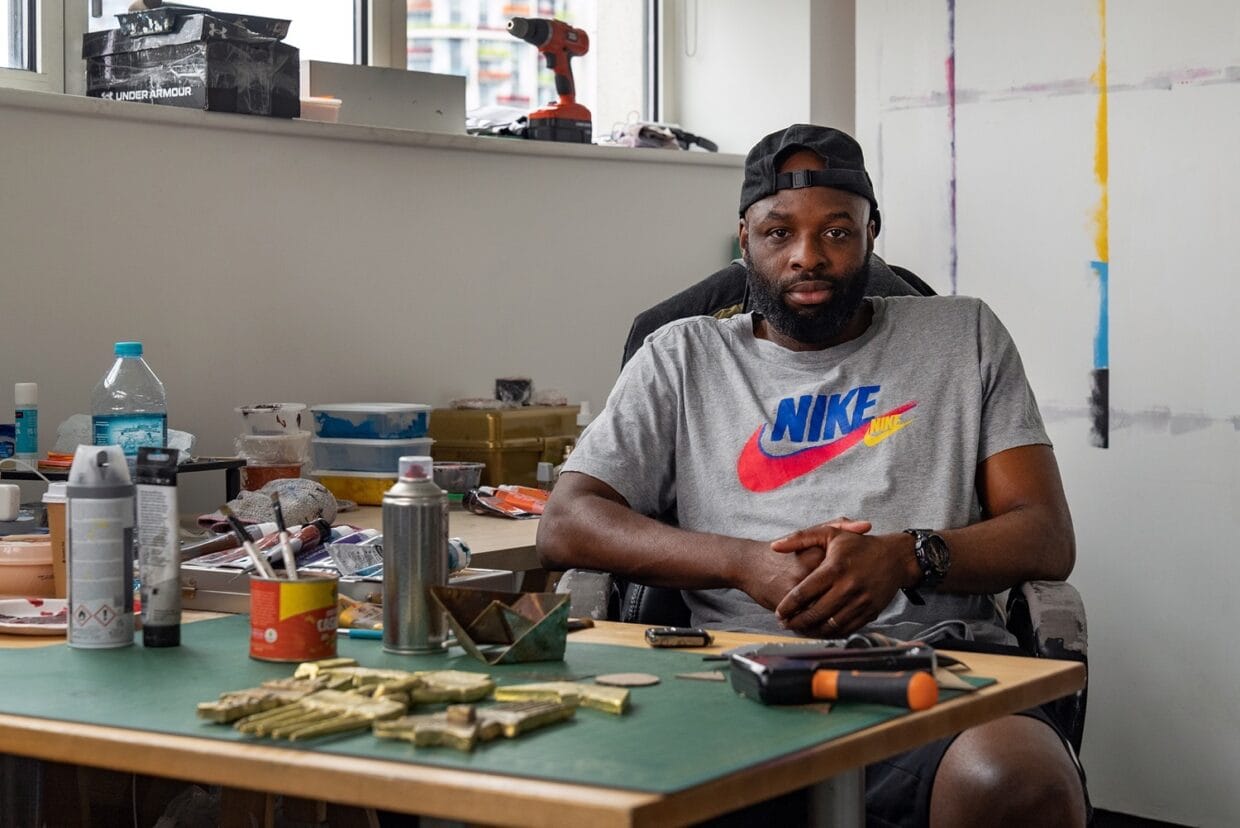
London-based Nigerian-Swedish artist Joseph Ijoyemi is redefining how migration and identity are experienced on stage. His new performance, Candles in the Dark — premiered at Whitechapel Gallery as part of the East London Prize takeover — fused afrobeats, grime, and live storytelling into a moving reflection on belonging, memory and resilience. Blending sound, faith and cultural hybridity, Ijoyemi creates a space where light cuts through uncertainty and the personal becomes universal. We caught up with Joseph Ijoyemi to talk about hope, heritage and building community through art.
Your performance Candles in The Dark at Whitechapel Gallery fuses music, film, and live storytelling. What first inspired you to create a piece exploring migration and the experience of Black communities in this way?
My initial inspiration is from the Bible Matthew 5:14-16 “You are the light of the world….” What inspired Candles in the Dark really comes from my own lived experience. I’m a migrant myself, a second-generation one, currently based in London, and a lot of what I explore in this piece comes from the stories and realities I’ve grown up around. Many of my close friends are either first- or second-generation migrants too, or were born here to African parents, and those layered experiences of identity, belonging and movement are what you’ll hear echoed throughout the performance.
Over the years, living in different countries has made me feel like I exist somewhere in between — not fully here, not fully there, and that sense of in-betweenness has shaped how I see things. Music has played a massive role in grounding me through that. Living in London, sound and rhythm have become a way to connect to who I am and where I come from. Also my faith has grounded me on who I am and who I can lean on to… My parents taught me that… So with Candles in the Dark, I wanted to bring all of that together, using sound, voice and everyday noise to reflect the shifting identities within Black and migrant communities and how we carry our stories through movement, memory and music and the light is us around the continent.
You’ve described Candles in The Dark as an “interdisciplinary performance.” How do the different elements — from afrobeats and grime to recorded conversations — come together to create a single narrative on stage?
It really depends on the mood and energy of the voice notes recorded by my friends who’ve contributed to the performance. What you’ll hear are poems, conversations and reflections that carry their own emotions, and that naturally shapes how the sound or music unfolds during the performance. I respond to those recordings live, layering beats and samples through the drum machine to mirror the tone of what’s being said.
There are also elements of water throughout the performance…. I recorded sounds at Lekki Beach in Nigeria last year, and those recordings weave in and out of the performance. For me, water introduces a sense of memory, movement and travel, connecting past experiences with the present moment.
Throughout the performance, I’ve also invited my friend Shyaam Caine to play keys at certain moments, helping to shift the mood and atmosphere in the space. It’s all quite fluid and instinctive…. the sounds, voices and instruments feed off each other, creating one continuous narrative that moves between intimacy, tension and reflection.
Migration and identity are central to your work. How have your experiences moving between Nigeria, Sweden, and now London shaped your understanding of belonging and cultural hybridity?
I’m still navigating this journey to be honest, but my faith in Christ has really grounded me and allowed me to be myself and stay unapologetic. Being Swedish-born with Nigerian heritage and now living in London has pushed me to embrace all three cultures in different ways. It’s like constantly balancing between worlds, finding the connections and beauty within that mix.
The idea of cultural hybridity, and I like that saying, it’s something I’m still developing and exploring deeply, I actually want to create a show that focuses purely on that theme. My past experiences have shaped me a lot, from dealing with racial abuse to struggling to find a sense of home and even denying my African roots when I was younger out of confusion. But over time, I’ve learned to embrace everything that makes me who I am. That process of acceptance has become a real purpose in my practice, using art to reflect on identity, belonging and faith in a way that feels honest and human.
The title Candles in The Dark carries a sense of hope and resistance. What does it mean to you personally, and what emotions do you hope audiences leave with after the performance?
For me, Candles in the Dark is about reflection but also joy. It’s an invitation for people to look inward and think about their own personal journeys and sense of identity while also celebrating themselves. The performance carries moments of honesty and vulnerability, but it’s equally about light, energy and hope.
Personally, it’s about reminding myself to enjoy the process, to encourage myself through the performance, and to recognise that there are many others like me who carry dual identities and are still finding their place. The title speaks to that…..even in dark or uncertain times, there’s still light, still movement, still something to hold onto. That’s the feeling I want people to leave with.
You often work with archives, traditional craft, and community projects — from Thamesmead murals to Royal Museums Greenwich installations. How does that practice of connecting past and present feed into Candles in The Dark?
A lot of my work deals with connecting the past and present, whether that’s through archives, traditional craft, or working directly with communities. For Candles in the Dark, I’m doing something similar but through sound. Musically and sonically, I see it as just another medium really…. a performative way to explore memory, history and lived experience.
The performance brings together real voices, field recordings, and sounds that hold personal and collective meaning. Just like I might use archival materials or found objects in an installation, here I’m sampling memories and emotions through sound. It’s about creating a dialogue between what’s been and what’s happening now, using rhythm and storytelling to bridge that space.
Your art blends both figurative and abstract forms. How do you decide when to communicate through symbolism versus direct narrative when addressing issues like migration or identity?
It really depends on the theme and the kind of conversations I’m having with people, as well as the resources and materials I’m working with. Sometimes a story needs to be told directly, especially when it’s rooted in real experiences or personal narratives about migration and identity. Other times, abstraction or symbolism allows for more emotional depth and space for the audience to find their own connection to the work.
Collaboration is clearly important to you — from working with musicians to co-founding The Collective Makers. How does collaboration influence your process and the stories you want to tell?
Collaboration is 100% at the heart of my practice. The art of collaboration makes the work stronger and more visible, especially when you’re working with people who share a similar vision. It’s about creating impact through connection.
That same spirit is what inspired The Collective Makers. For me, the word “collective” is about togetherness… building something that creatives have in common. When me and Lison Mussuet co-founded it back in 2021, we were both on similar journeys, dealing with the lack of creative opportunities and spaces that truly supported emerging artists. So we decided to build a community where we could help one another, share resources and grow together with other creatives.
I always describe it like the Avengers, every creative has their own superpower, but when we come together, it becomes a powerful force. That energy of unity and shared purpose naturally flows into everything I do, from my performances to my installations.
Looking ahead, how do you hope Candles in The Dark contributes to the wider conversation about migration, race, and cultural inclusion — both within London’s art scene and beyond?
As an artist, I am not trying to give answers, I am just trying to ignite what others are already thinking or feeling deep down. Candles in the Dark is about sparking reflection and reminding people that there is light within them, no matter their story or background.
When it comes to migration, race, and cultural inclusion, I want the work to create space for honest conversations, not just within London’s art scene but wherever people experience that feeling of being between worlds. If someone leaves the performance feeling seen or reminded of their own strength and belonging, then that means everything to me.