



Artist Bobby Zhaocheng Xiong is renowned for installations that interrogate the societal implications of technological advancement, weaving dark, futuristic-retro narratives that feel strangely present. His work—which has been showcased from the V&A Museum’s Digital Design Weekend to international exhibitions—consistently explores the tension where the organic meets the artificial, prompting critical reflection on our relationship with belief and simulated nature. As an artist who grew up witnessing rapid urbanisation and now works in London, his pieces are shaped by observations of shrinking green spaces and digitised rituals, offering a unique perspective on the future. We caught up with Bobby Zhaocheng Xiong to discuss censorship, the poetry of old technology, and why AI-generated truth is the true dystopia.
Your installations often place nature and humanity inside technological frameworks. What first drew you to imagining futures where the organic and the artificial coexist, but under tension?
I grew up in cities in China that are very different from what I later found in London. There were parks, but almost everything I saw was artificial. The trees were lined up carefully, the grass was shaped, and many natural elements were replaced by things designed, made of plastic. When I arrived in the UK, I then realised how close I could be to nature in a more honest way. I often sit alone on the grass in the parks, looking at trees that grow freely and watching deer, horses running around without limitation. Also, I witnessed the rapid urbanisation. Green spaces disappeared piece by piece and were replaced by neatly planted street trees. Villages inside the city were removed, and the ancestral halls that once held people’s beliefs disappeared as well. In their place, skyscrapers rose quickly. The future in my imagination has always been somewhat dystopian. These observations and experiences naturally led me to imagine what a world would look like if nature and human life were entirely wrapped in technology.
For me, my installations are not only symbols, but narrative scenes built from background and context. They reflect my memories, cultural environment and my imagination. I like science fiction works like Brave New World, Do Androids Dream of Electric Sheep?and Ghost in the Shell. These stories describe futures where technology becomes part of daily life while never resolving the tension between human emotion and mechanised systems. I am attracted by the idea that technology can expand us while also restricting us. Together, these influences guide how my works imagine the ways nature or ritual might continue to exist in technological futures that feel tense or unsettling.
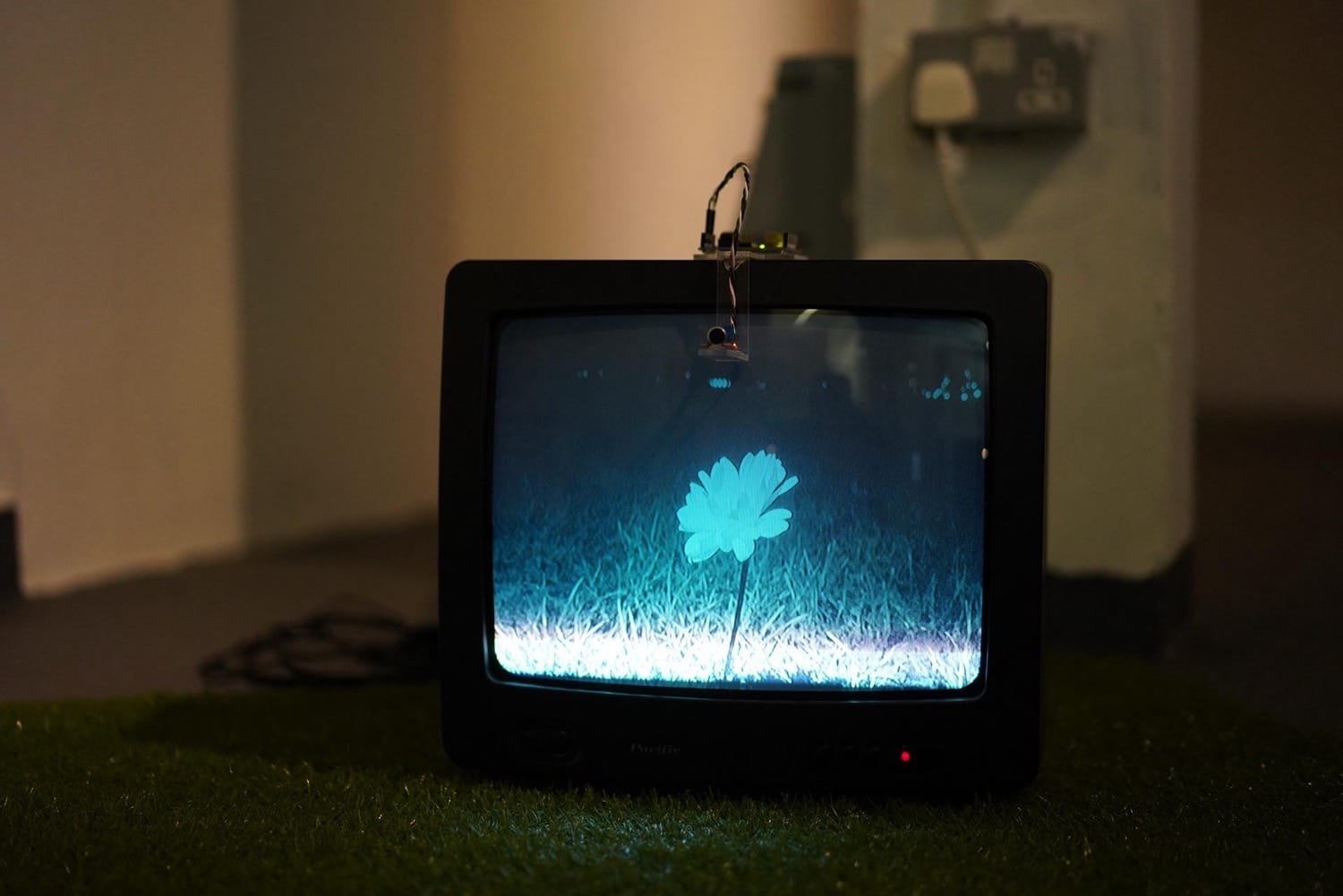
In “Flower,” a simple human gesture—blowing on a daisy—becomes a poetic interaction with a synthetic ecosystem. What does this quiet exchange say about how future generations might experience nature?
In this simple piece, I borrowed a few instinctive gestures when we are in nature. We sit on the grass, watch the horizon, touch the plants beside us, brush insects away, or blow gently on a small flower just to see it move. These actions are simple and human. They are part of how we relate to the living world. As technology develops and environmental changes accelerate, we are forced to reconsider how these gestures might survive in a few generations. In Flower, everything has already been reconstructed. The grass is artificial and the daisy displayed in the CRT monitor. The movement of the petals is created by sensors that translate breath into data. Although the natural interaction is physically possible, it all feels completely different. The displacement opens my question: if our relationship to nature becomes simulated, does the emotional meaning remain the same, or does it slowly fade? The piece tries to hold both feelings at the same time. It is soft and poetic, but it is also a warning about the fragility of the world we take for granted.
“New Deity” proposes a world where faith migrates fully into digital space. What questions were you hoping to raise about spirituality, belief systems and the ways technology now shapes rituals?
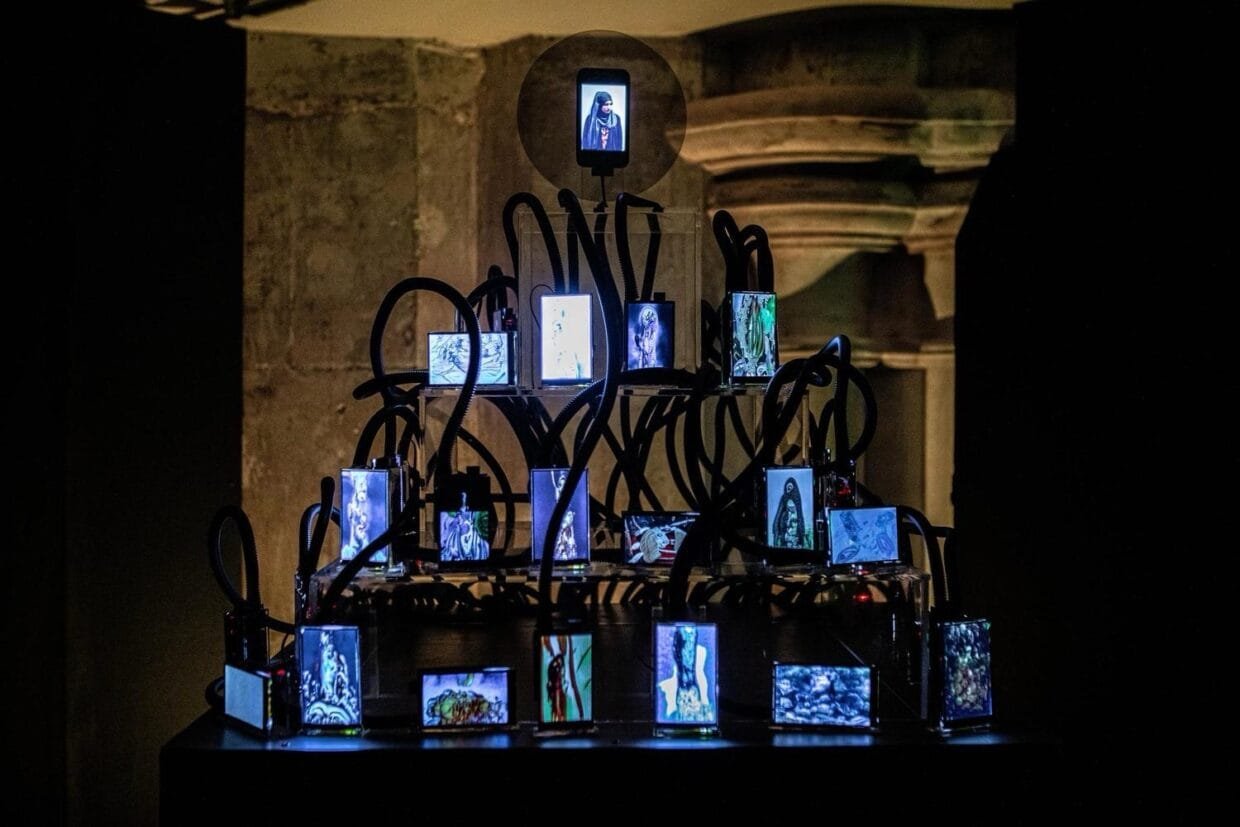
I have so many questions to ask here… Human beings hold many different forms of faith, whether rooted in organised religion or in folk traditions, but they all share a similar physical core. People rely on rituals to seek protection, presence, or blessing from something beyond themselves. When physical rituals begin to disappear, whether belief without effort or embodiment can still be called belief? And traditionally, the relationship between believers and the divine is established through very specific gestures, rules and ritual sequences. If these actions vanish, can the spiritual link still be formed, or does it lose its foundation entirely? At the same time, rituals are inseparable from the space. Temples, churches, mosques and small altars in alleyways each carry their own atmosphere and sacred logic. When they are all moved onto the same digital medium, their differences collapse. I am curious if these deities remain distinguishable in such a space, and if they would feel displaced or even offended. New Deity presents precisely this condition. The altar becomes a melting point where images of gods from different belief systems mix into one another.
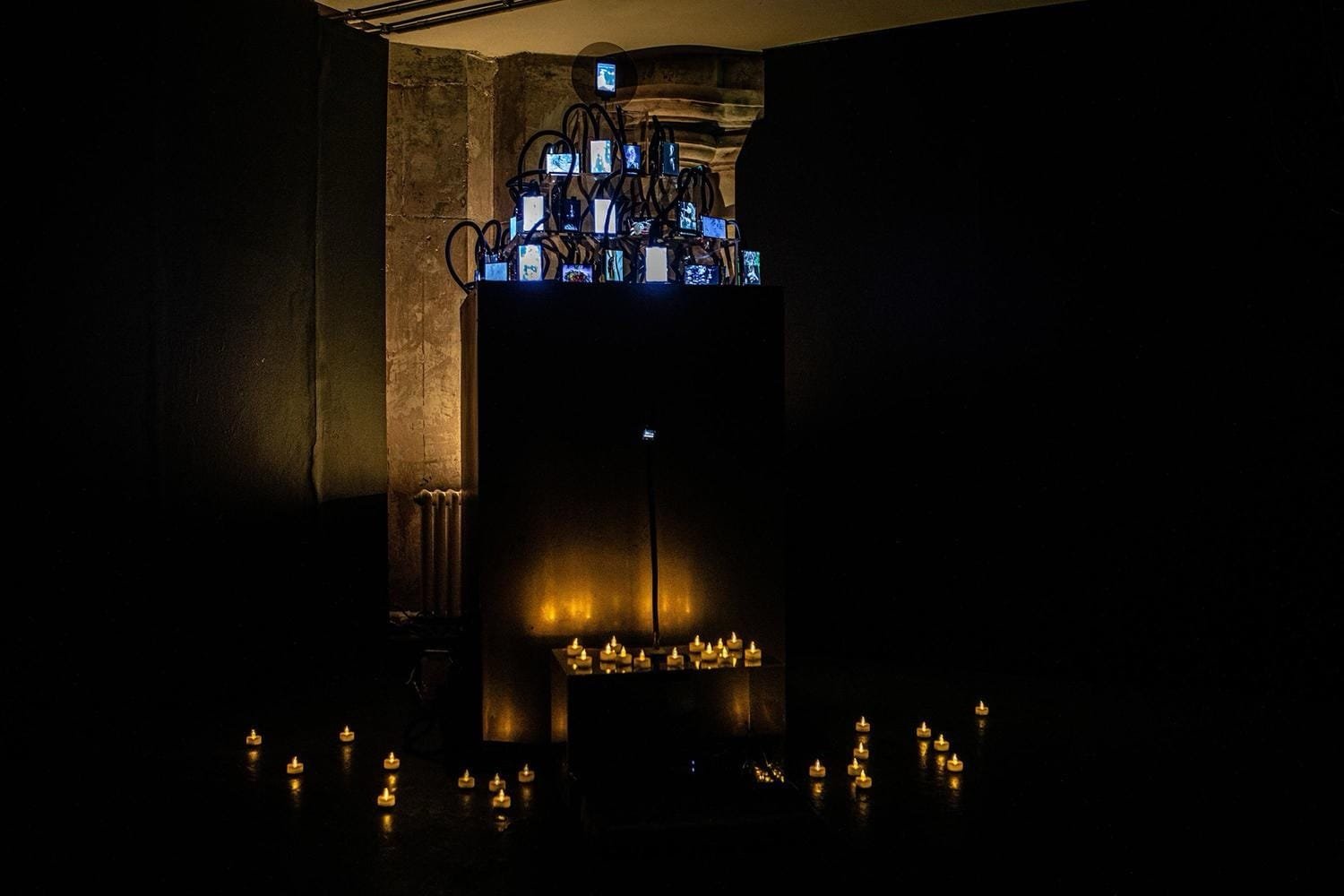
The hybrid divine figures in “New Deity” shift and evolve in real time. How do you decide where the boundary sits between critique, reverence and satire when dealing with religious imagery?
I have always held my respect for religion, superstition and all kinds of belief. I am not a formal practitioner, but I do believe that spiritual systems have real emotional and cultural power. In my work, religious imagery is treated in a very abstract way. It doesn’t refer to any single belief system but evokes a general sense of the sacred. The images on the screens in New Deity are generated through a machine learning model trained on a dataset of more than 2000 images. The process was with careful research and wide selection, and I did not limit the dataset to religions that exist physically. Fictional belief systems, mythologies in the games, and even cultic symbols were included. This creates a kind of conceptual distance that allows the work to step away from literal representation. Therefore, I always see myself working from a neutral position rather than one of judgement. The work does not criticise religion itself. Instead, it questions a trend, which is the rapid and sometimes careless digitalisation.
“Prophecy” portrays a world collapsing under misinformation produced by machines. How do you think AI-generated truth is already reshaping public understanding today, not just in the imagined future?
I’ve seen so many people around me using ChatGPT and other large language models as their primary search engine, even for factual or encyclopaedic information. But we know these models still produce strong hallucinations. Their answers often appear logical and well-structured, but actually they are completely predictive text, not existing truth. At the same time, social media is filled with GAN-generated images, some of which have even been used in news reporting, causing serious confusion and misleading the public. So, the work is not a fantasy about the imagined future. It’s more like an amplification of the present moment. We are already moving in this direction, and Prophecy tries to make that shift visible in a dystopian way.
Across your work there is a recurring sense of stillness—slow, meditative environments built from retro-technology. What attracts you to CRT screens, typewriters and older machines as tools for imagining tomorrow?
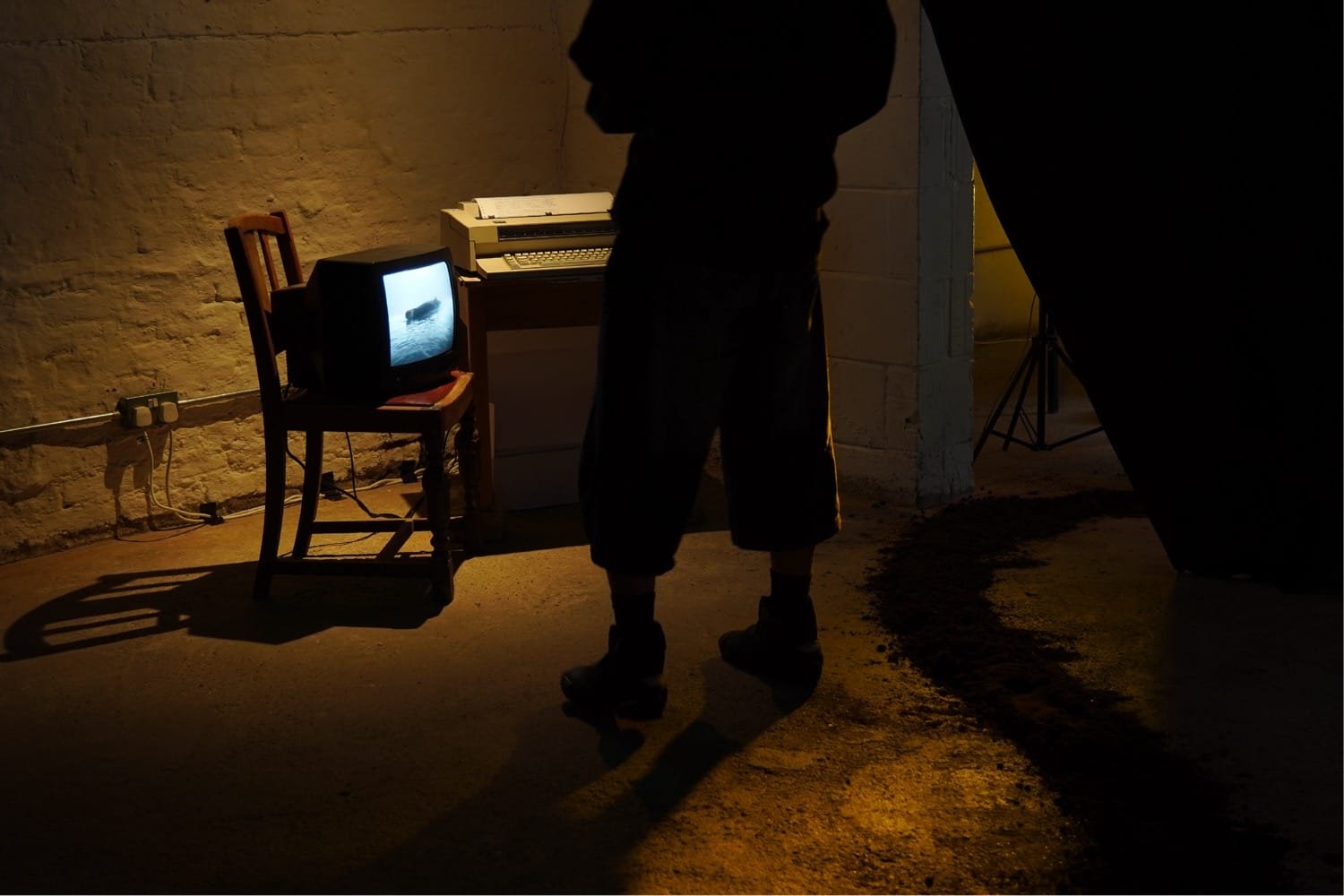
Though my work talks about the future, I often choose to use older machines such as CRT screens or typewriters and unpolished raw modules in my works. Using these objects makes the present itself feel like a future. For me, the present is already a kind of future, it speaks of the future. I also want to show a dystopian condition where technology continues to advance, but the tools people actually use remain stagnant. This could be due to scarcity, inequality or simply the uneven distribution. Back to the equipment themselves, these older machines carry a sense of unfamiliarity for the audiences allowing people to momentarily step away from their daily life and enter the scenes I create immersively. They also provide a strong atmospheric cue. Compared to modern devices, which combine so many functions losing their sense of specificity, old technologies give the feeling of rooting in more specific contexts. They are poetry and help form the imagined future that feels both distant and strangely present.
Your practice spans major institutions from the V&A to international exhibitions. How has presenting your work across different cultural contexts influenced the stories you want to tell next?
It was very interesting to see how audiences in different places respond to my work in completely different ways. At the V\&A, many visitors were interested in discussing religion and belief. Some shared their own spiritual practices, and there was one moment when a missionary tried to preach to me in front of the installation. In the galleries, artists and audiences tend to ask about the conceptual framework and the mechanics behind the interaction, which often leads to deeper discussions about technology and symbolism. Exhibiting in China was a very special experience. Because my work touches on religious themes, the pieces were continuously censored throughout the show. Everything from the artwork statement to the abstract images on the screen had to be altered. I was even asked to reinterpret the generated figures as “plant growth patterns” to avoid any reference to spirituality. The tension made the work even more ironic and made me realise how meaningful it is to continue exploring superstition, belief, and the ways technology reshapes spiritual imagination, especially as someone who grew up in China and was steeped in traditional folk beliefs.