



COBRA marks a major departure from your known painterly language into a fully immersive world of projection, sound, and sculptural objects. What pushed you toward this expanded form of storytelling at this moment in your practice?
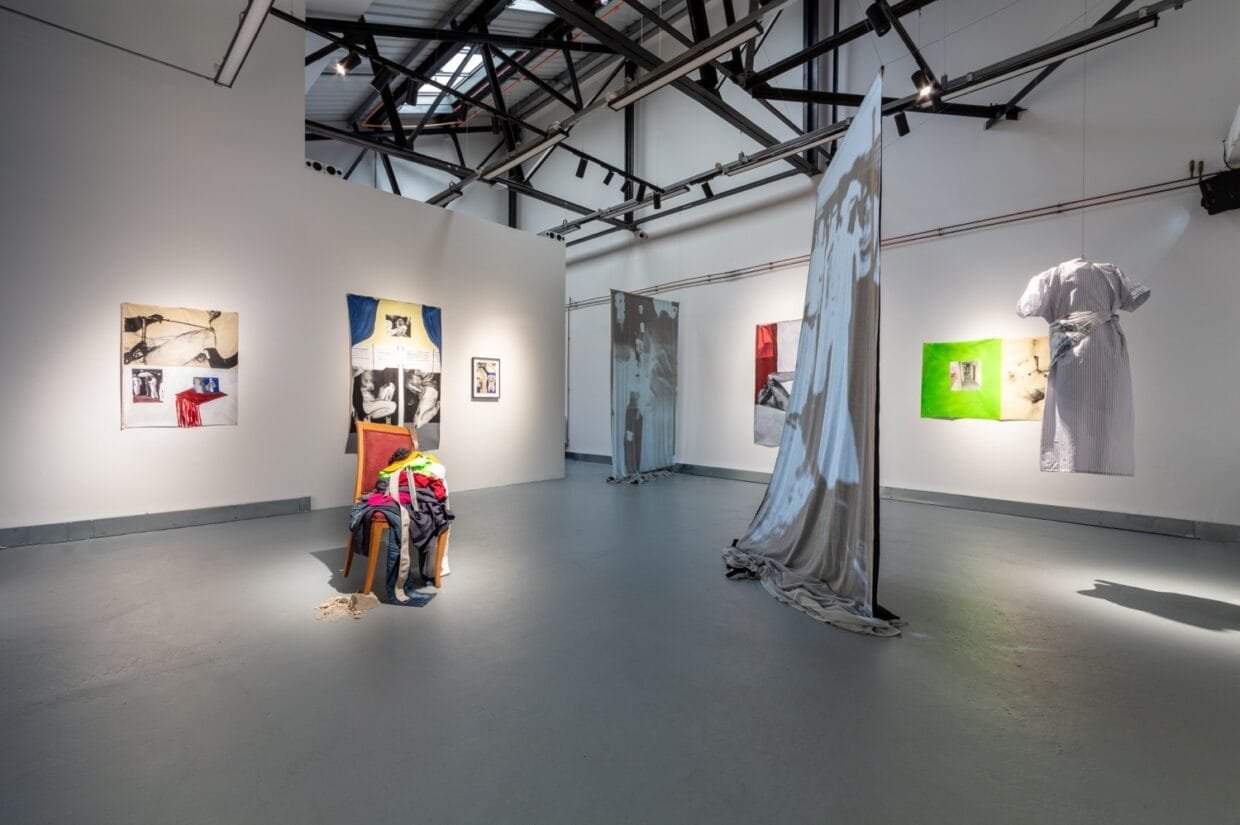
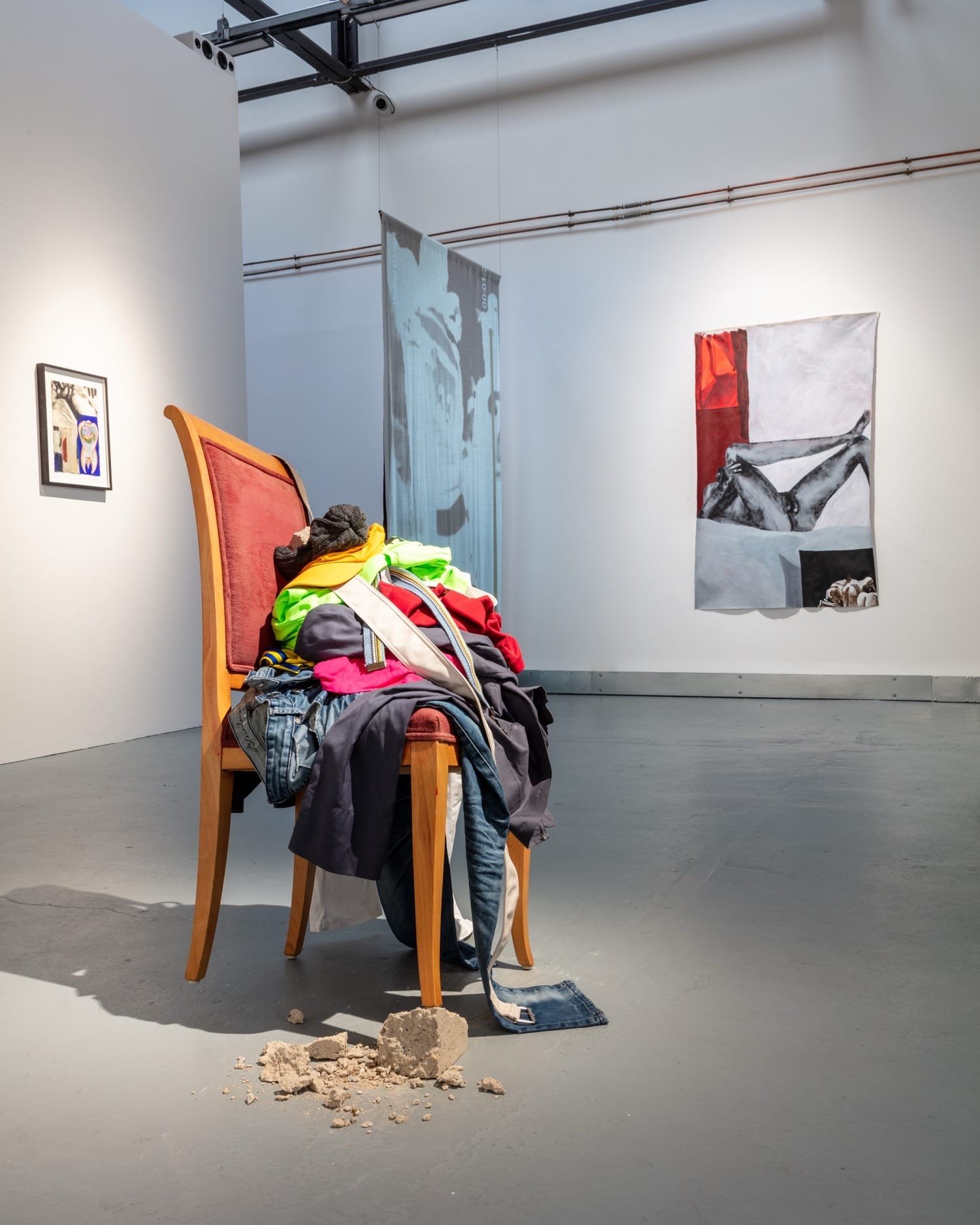
I approached my research in whatever way felt natural for what I was thinking about. I think painting is a powerful medium, but it’s also limited in some ways. I wanted this show to feel like stepping into a portal where time and images warp and distort linearity and expectation. Sound is a very powerful way to evoke emotion, and the low quality of sound I extracted from the found footage feels haunting in its noise and texture. The footage itself is the centre of the show, which I took and reduced into shadows and light, silhouettes moving and merging. I projected the footage onto two layers of fabric suspended from the ceiling. I wanted this footage to be the anchor for everything else around it. The paintings in this show draw from themes of image, violence and intimacy and are more reflective, whereas the sculptural works pull elements out from the footage, an almost resurrection of a time and place that doesn’t exist.
The exhibition draws from digital archives of queer men and transfeminine people dancing in Saudi Arabia—acts of joy, defiance, and community. What was your emotional experience in returning to these fragile online memories and reworking them into a new visual language?
I encountered these videos at various points in my life. I realised I was only seeing them. When I found them again, I decided to look and then to witness and then to honour. The emotional journey of sitting on my desk or bed, watching the same videos over and over, always on YouTube and never in my folders where I have them saved, has been quite intense. I felt a personal inner transformation in processing my own grief. I also felt joy at times, that these memories exist and that a fragile digital platform, one that constantly censors and hides videos like that, had become a graveyard for people to visit and pay their respects (and contempt at times) and to remember their friends. It compelled something in me. A sense of urgency to remember and make others remember as well.
The title “COBRA” comes from the online alias of someone featured in the footage who has since passed away. How did the weight of this discovery shape the tone, intention, or responsibility you felt while creating the exhibition?
Cobra is the name given to one of the people in these videos. Their name kept recurring in a few videos, especially in the title. From the comments I gathered that this person was quite well-known and popular in that particular scene. They left a big mark on people. They were influential. I also learnt from the comments that they had passed away. As you can imagine, this gave the responsibility so much more weight. I was now considering someone’s agency without being able to speak to them directly. I was also engaging with my own curiosity about a person I didn’t know. There were so many emotional layers to this, and they formed the emotional tone of the exhibition. I wanted to compress all of those emotions of discomfort, joy, grief, adoration, fear, etc. into one space.
Your figures often-exist in states of transformation—genderless, fragmented, unbound. How did this fluidity evolve when working with moving images and suspended projections rather than static canvases?
This fluidity is present in the footage. It has been edited heavily to keep people anonymous, but also it mirrors my interest in shadows and light, what they reveal and conceal. The figures in my work are genderless because I like to play with ambiguity and what happens when you add or remove identity markers. When you play with ambiguity and expectation, the viewer becomes the work in a way. Their assumptions and conclusions become an extension of it. It reveals all the personal, political, social and emotional construction of our thoughts and ways of seeing and understanding. When things move, there might be less room for ambiguity, because movement reveals. I have less control in a way, so I played around with placement and space to create that sense of illegibility.
COBRA navigates a space between resurrection and haunting. How do you approach the ethics of bringing lost queer images into a contemporary gallery context, especially when many of these lives existed in secrecy or precarity?
This has been the most complex part for me. I had these questions before I even began conceptualising the show. These questions kept me up at night and I ended up writing out a whole list of unanswered questions. I think ethically, I had to weigh out what I was attempting to do with the show. I asked myself, do these people want to be remembered in this way? This is a question I can only assume the answer to. Their image is out there anyway, on YouTube, titled with a slur. Their image exists despite many of the comments asking the uploader to take them down. Now that I have found this image– which isn’t violent in itself but violent in the way it was publicly shared– I had to ask: what do I do? I let these videos sit in a folder for years. Only going back to remember I had them. I realised, this is the only history we have. The only evidence of trans people existing at that time and place, and feeling joy and freedom to be. If this image must exist publicly, then I wanted it to exist under new terms, by a person that has a personal connection to that narrative. If I had access to a space for people to gather then I wanted it to be a place for people to gather and remember. Under better circumstances, this work wouldn’t be here, but there. I wanted this footage to be held differently, with care and reverence within a contemporary gallery context.
The sculptural elements—a stiffened thobe glowing from-within, folded garments, a balloon machine against a drum—interrupt the space with uncanny familiarity. How did these physical objects emerge in dialogue with the video work?
The objects came to be because I wanted to evoke the feeling of absence. There were objects that didn’t make it to the final install of the show, like the balloon machine sculpture for example. I decided to have the chair with folded garments as the central object of the show. One of the chair’s legs is balanced on a broken piece of concrete, and on top of it, found garments: shirts, jeans, hats, belts stacked on top and leaning, with a smaller piece of concrete balancing on top. I wanted it to feel precarious and delicate. It’s unsettling to see clothes without people, it encapsulates the feeling of something missing, but so much life is to be told in clothing that was once worn. I pulled those colours and textures directly from the footage, which is colourless in the projections. The thobe is frozen in time, in a subtle movement, towering above the viewer. I wanted it to be slightly hidden, to catch you off guard maybe. Those clothes are one of the most interesting elements of the footage, but their textures and colours aren’t visible there. The way masculine traditional clothes were feminised and given new life. I didn’t want to lose that as it was the heart of everything.
Much of your work sits between personal and political, intimate and confrontational. How do you hope audiences in London—many far removed from queer life in Saudi Arabia—experience or relate to this world you’ve built?
I conceptualised this show in response to this question. This is not a show necessarily about queer life in Saudi Arabia, although the footage depicts and memorialises those lives. This is a show about looking and what happens when two things meet and look at each other. The power dynamics and intimacy that looking reveals is the interesting part. This is work I’m well aware can never be shown there with this type of discussion, not yet at least. I’m also very aware of this voyeuristic lens at a life that is never imagined as probable, and in my discussions with all types of people here, that are detached from what that life is like, there is always this misunderstanding and intrigue, but most importantly, a resistance to believe. I didn’t want this work to make anyone believe or understand; I just needed it to be misunderstood enough to now have the power to look back at the viewer. In this confusion, the work is now haunted and alive. I want this world that I built to reflect back to the viewer their own beliefs and in the best case scenario, get them to question all the ways they look and consume and project onto images. I see that as universal.
Looking ahead, does COBRA signal a long-term shift in your practice toward more immersive installation and world-building, or is this moment a specific response to the stories and ghosts you’re engaging with now?
This moment, I hope, marks a real shift in my practice. The last few years have been particularly difficult for me personally and they have pushed me towards transformation in every direction. I’m approaching my practice in a different way, that feels more natural to how my mind works and I’m being truer to myself and my interests. I feel like my research and my studio practice have finally met up and are growing together. It’s a very exciting time for me creatively, despite all of life’s challenges.