





BreathFlow marks a major leap in sleep-tech — a phone-based system trained on 380 nights of sleep-lab data. What gap in awareness or care made you feel this technology was urgently needed?
Many people assume their disrupted sleep and excessive daytime tiredness are just “part of life,” not a potential breathing issue.
Conditions such as obstructive sleep apnea (OSA), in which breathing is reduced or temporarily stops during sleep, are both common and widely underdiagnosed.
We developed BreathFlow to give SnoreLab users a unique measure of breathing stability during sleep that grades periods of instability into two levels of severity that are highly correlated with clinical measures of sleep-disordered breathing.
Whilst BreathFlow is not a medical device or diagnostic tool for sleep apnea, it offers a convenient wellness metric that provides users with detailed insights into their breathing stability and can help them feel empowered about exploring next steps in their sleep journey.
SnoreLab has been downloaded more than 15 million times. What patterns in user behaviour or feedback most pushed you toward creating a breathing-stability metric rather than another snoring feature?
Whilst snoring doesn’t always indicate unstable breathing, both conditions arise from some degree of airway resistance and so they frequently occur together. What is interesting is that as airway blockage increases, snoring can actually decrease, and so snoring measurements alone do not tell the complete picture. BreathFlow helps people connect the dots between their breathing and their snoring.
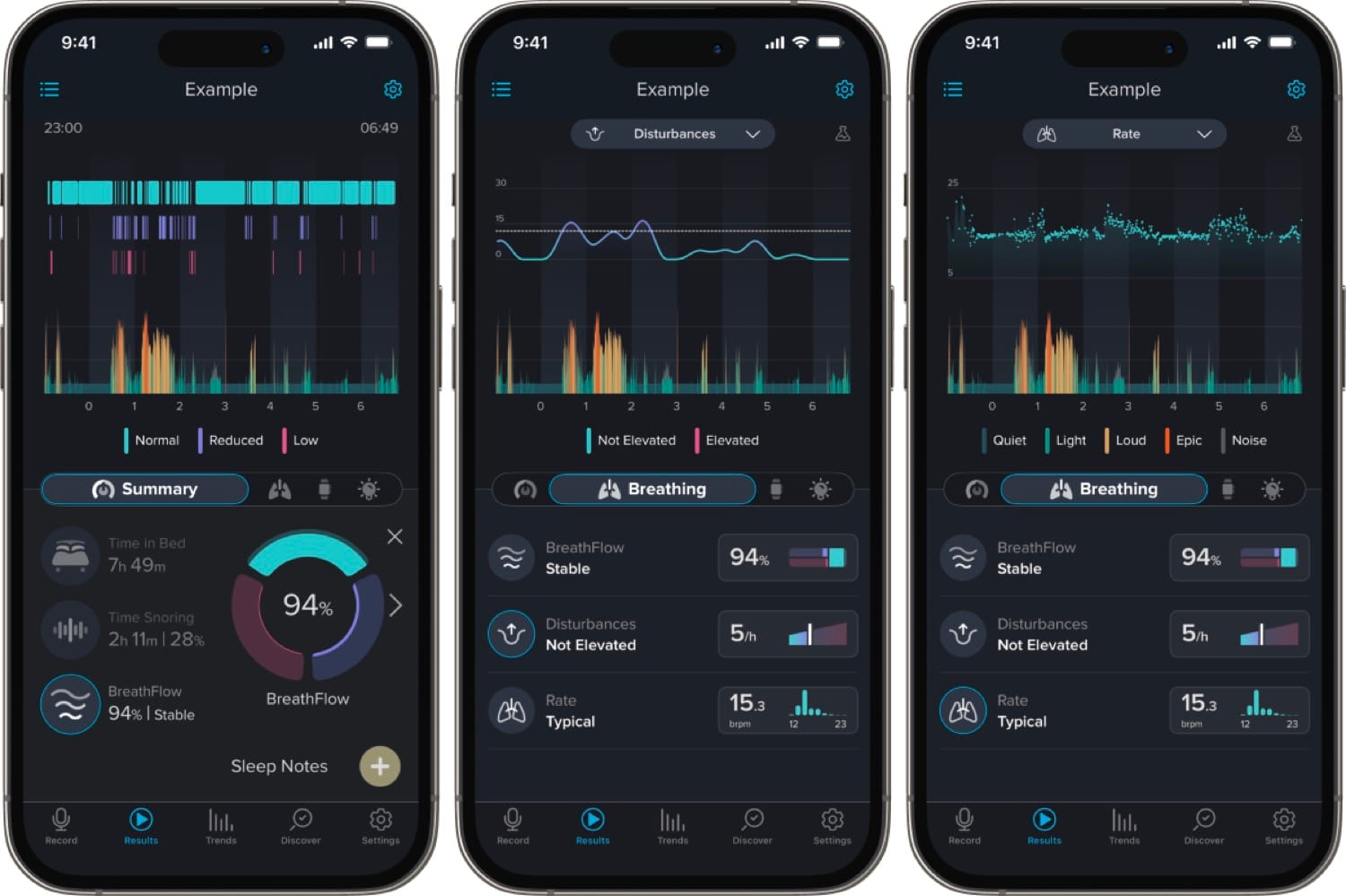
One of the reasons behind SnoreLab’s success is its ability to provide objective data on something we cannot see or hear, presented intuitively and interactively. Users love being able to play back their snoring and gain real insight into what’s actually happening during sleep. BreathFlow takes this even further, providing granular insights through detailed audio recordings and visualisations that enable users to both see and hear their nocturnal breathing.
You’ve said up to 90% of people with sleep-disordered breathing never get diagnosed. Why is it still so invisible — and how can technology shift that reality?
There is a misconception that sleep apnea only affects “overweight men” and is defined by obvious “gaps in breathing” and “loud snoring”. In reality, there are more subtle manifestations characterised by partial airway obstruction (hypopnea) which do not present as dramatically and can be easily missed.
Women’s symptoms often present differently to men’s, this can include morning headaches, fatigue, insomnia, low mood and frequent nighttime urination. They also tend to snore less loudly due to anatomical differences. Prevalence increases sharply after menopause, when hormonal shifts affect muscle tone and body weight.
Technology can shift this reality by making insights into our sleep more accessible to everyone and providing objective data. SnoreLab is often the first step in people realising the extent of their sleep issues.
Your team’s research shows women experience sleep-breathing issues-far more often than stereotypes suggest, yet are diagnosed later. What did you discover in the data, and how do you hope BreathFlow changes that bias?
Sleep apnea in women can be missed by some trackers that focus on “strong” disruptions more typical in men, rather than the “subtle” ones characteristic of female apnea.
In early model development, we noticed that predictive performance was consistently weaker for females, as stronger disruptions are more distinct than milder ones. By broadening event definitions and designing our model to capture a wider range of disturbances, performance improved considerably and ultimately led to the development of our novel BreathFlow scoring system.
BreathFlow is specifically designed to capture subtle as well as strong disruptions, with a BreathFlow score <90% being correlated with clinical thresholds of sleep apnea, using sensitive, female-friendly protocols favoured by many researchers (3% hypopnea rule).
Our hope is that this helps bring awareness to changes in breathing stability that would otherwise go unnoticed.
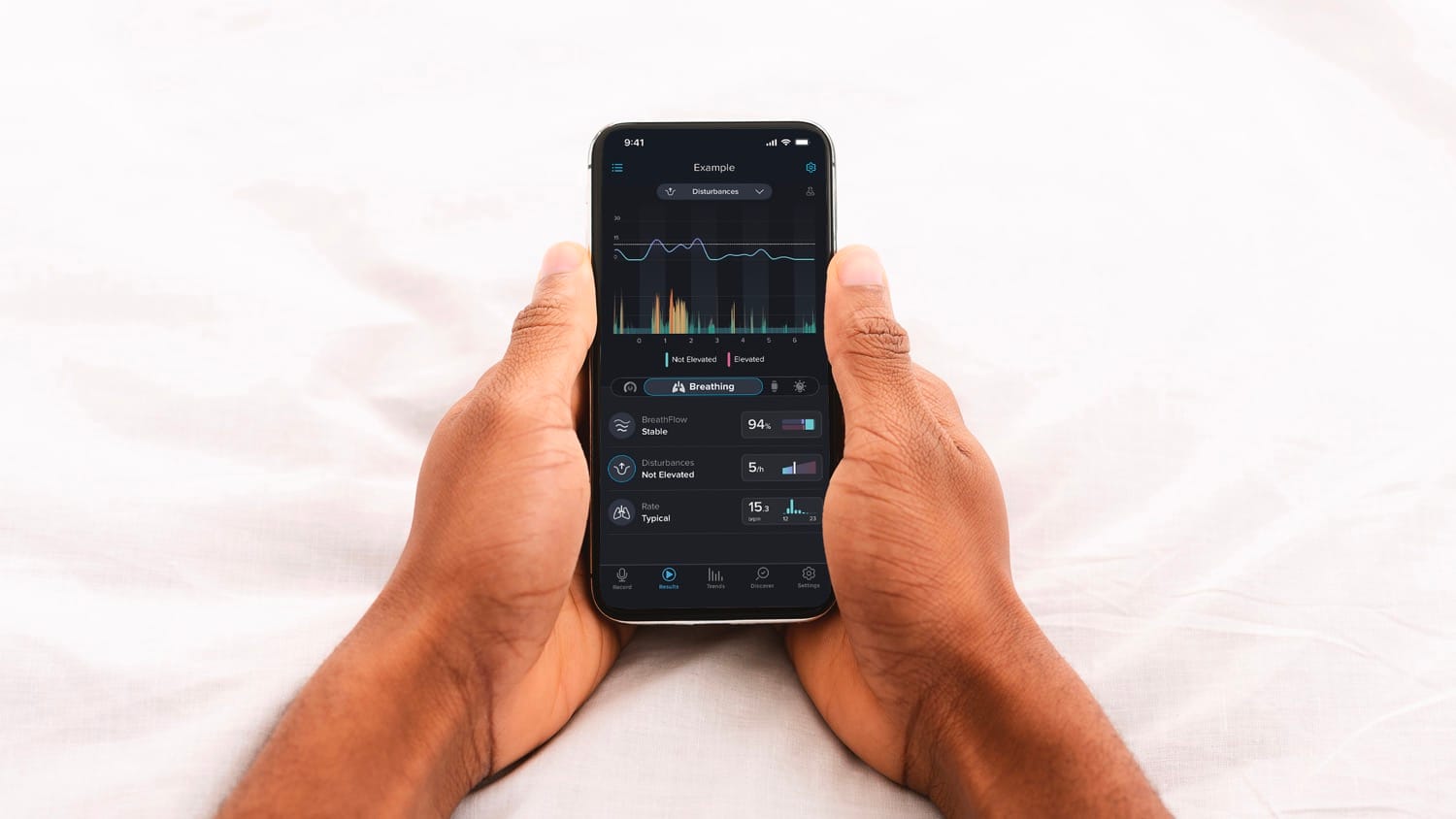
BreathFlow runs entirely on-device, using acoustic imaging and machine learning. What were the biggest technical challenges in building accurate sleep-breathing analysis without wearables or cloud processing?
Ultimately our model’s excellent performance is due to careful design, rather than just throwing data into a black box and expecting the computer to figure it all out. Our results are very much derived from “human intelligence” rather than “artificial intelligence”!
It is quite common to see academic research on small datasets demonstrating excellent results on their own dataset, but that performance doesn’t translate into the real world where conditions and subjects are more diverse.
Whilst the foundational datasets we used for model development were lab-based, throughout our process we benchmarked our predictive performance against non-lab recordings using the Apple Watch’s Breathing Disturbance Index as a reference. The Apple Watch is by no means a lab-quality assessment, but that data provide a crucial check that we weren’t overfitting to the lab data.
Many sleep apps focus on sleep “scores” that can feel vague or generic. How did you ensure BreathFlow gives users something actionable — not just another number?
BreathFlow has intentionally been designed as a positive wellness score that aims to empower people rather than discouraging them. A higher BreathFlow value is indicative of better breathing stability as opposed to being a count of distinct events. This metric may motivate users to aim for a score over 90% and ideally close to 100%.
Some sleep apps lack transparency on how their scoring system works. In contrast, we’ve released a detailed white paper explaining our methodology and validation process that was trained on 380 nights of gold-standard sleep lab data and benchmarked against the most reliable clinical measures. This level of openness is important to us at SnoreLab as users deserve to understand the science and research behind the wellness metrics they’re given.
SnoreLab now includes both BreathFlow and a Breathing Disturbance Index (BDI) aligned with Apple Watch data. Why was it important to offer two distinct but related metrics?
We knew that users would compare their SnoreLab results to the Apple Watch BDI, and so it was important to have a directly comparable metric, which is the SnoreLab BDI. Apple’s approach, however, was designed to focus on stronger forms of sleep apnea rather than milder ones. We wanted SnoreLab to cover the full spectrum of breathing conditions, and so we created a novel measure optimised for milder disturbances as well, which is BreathFlow.
SnoreLab’s two different but related metrics, BreathFlow and BDI, are not diagnostic measures of sleep-disordered breathing. However, these convenient scores provide signals that are highly correlated with clinical measures and empower users to track nightly variations in breathing stability using only a smartphone.
BreathFlow provides granular estimates of breathing stability throughout the night, graded into three levels: ‘Normal’, ‘Reduced’ or ‘Low’. These granular levels are then aggregated into a single wellness score for the night, with values above 90% labelled as ‘Stable’ and lower values as ‘Unstable’.
In addition to the sensitive BreathFlow measure, we’ve also developed a Breathing Disturbance Index (BDI) that is designed to estimate the occurrence of breathing disturbance events, comparable to the scale used by the Apple Watch BDI. SnoreLab’s BDI is based on acoustic analysis, in contrast to the Apple Watch BDI, which is based on wrist movements. Our validation study found a strong correlation of 0.92 with the Apple Watch, although individual results may vary.
Offering both gives users an in-depth picture of their breathing patterns during sleep and helps them contextualise our metrics to those from the devices they may already use.
Looking at the wider future of sleep health, do you see SnoreLab evolving into a full preventive-care ecosystem — or will the biggest impact still come from simple, accessible tools like this?
Diagnosing sleep disorders to a clinical standard requires equipment that is beyond the scope of a smartphone app. We are not looking to replace clinical pathways, but rather to complement them with high quality wellness scores that are convenient for home use and enable longitudinal monitoring. SnoreLab is widely recommended by clinicians in the sleep space, and we see them as our partners.
The potential impact of accessible tools like SnoreLab is immense, as they spread awareness about breathing quality and encourage users to seek out solutions to improve their sleep.