



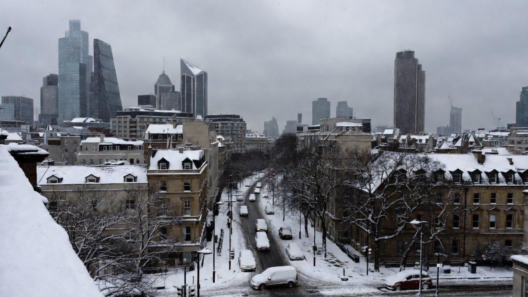
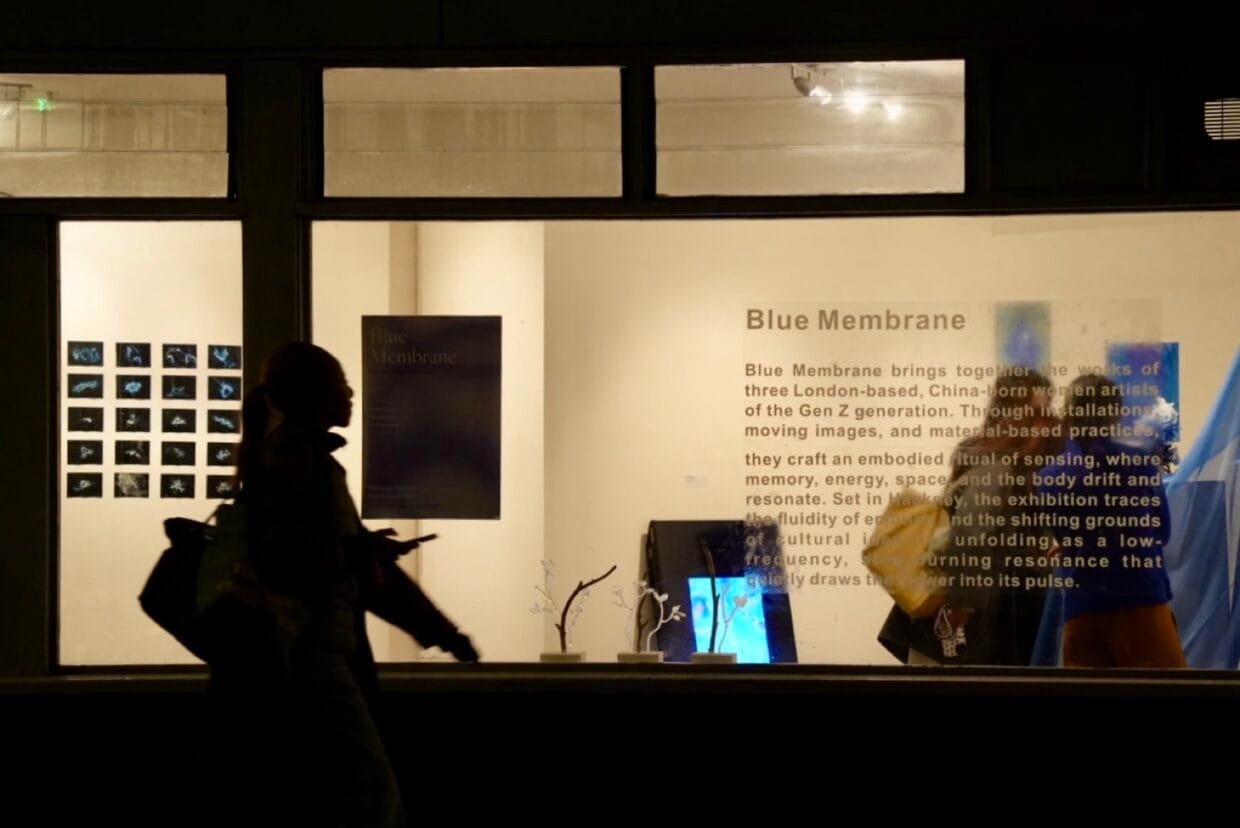
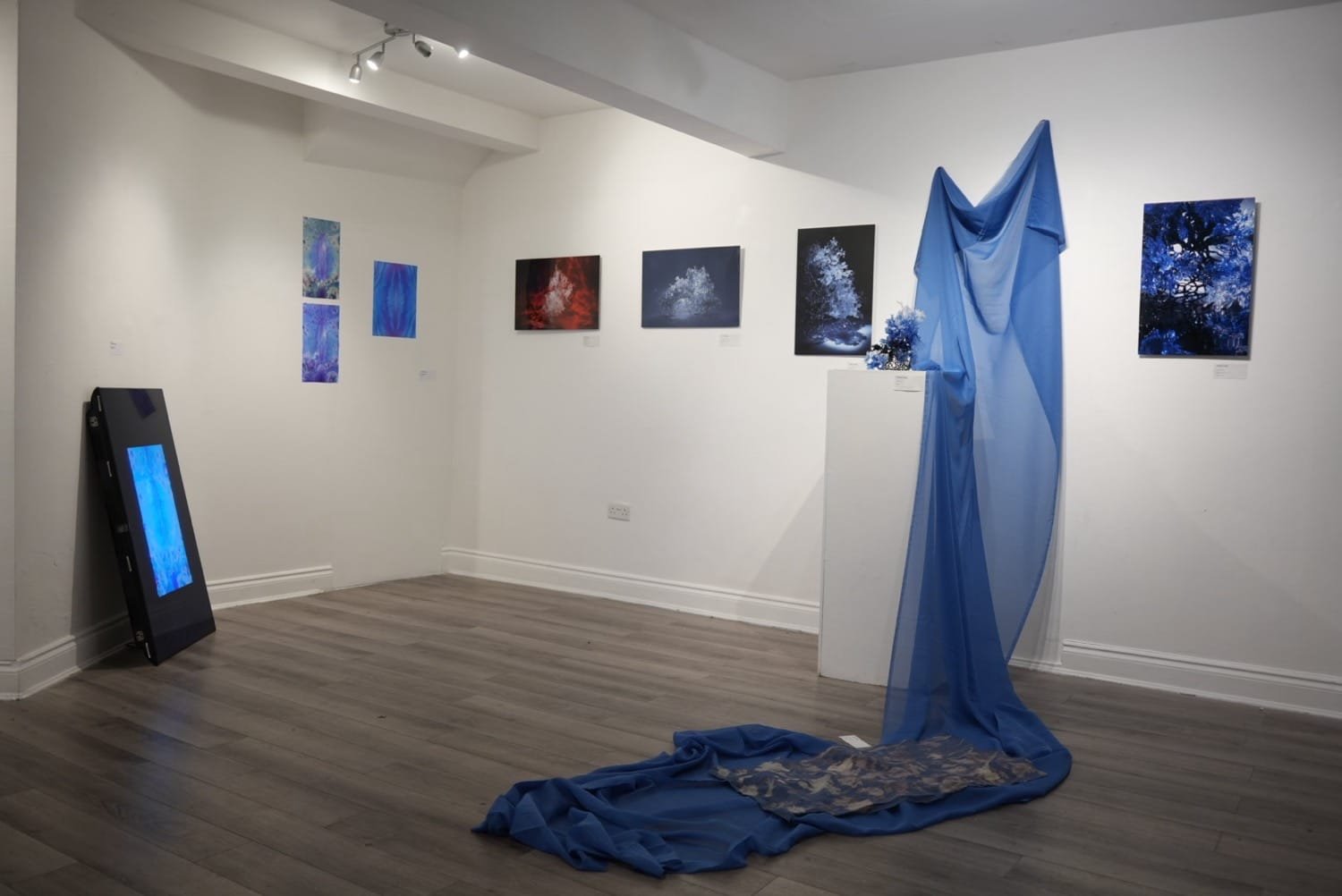
To experience “Blue Membrane” is to calibrate oneself to a pervasive frequency. The feeling conveyed by the exhibition is not the celebratory azure of an open sky. Instead, it is the environmental, ambient ‘blue’ that permeates East London—a frequency lurking in the damp, chilly air, the reflections in glass, and the cool glow of digital screens. This ‘blue,’ precisely defined by the curatorial concept, is a contemporary condition: one that profoundly captures the lived experience of fluid, contemporary individuals—a persistent, suspended state of hazy numbness arising from the complex interplay of digital socialising, a drifting existence, and spiritual self-rescue.
The setting of the exhibition, Hackney, is itself a melting pot of diverse ethnicities and cultures. This environmental “porosity” seems to co-author the artists’ practices, profoundly reshaping their creative trajectories. Consequently, the art in this exhibition is clearly not pursuing fixed affiliations or identity labels. Rather, it functions as a sincere response, addressing the intimate, lived experience of mobile individuals in the contemporary city. The works collectively inquire: How does the individual perceive the self amidst instability? And how can new connections be forged across cultural fissures?
Victoria Yuan’s digital work, Light in Womb, acts as the exhibition’s internal origin point. The piece evokes amniotic fluid and the inner sea surrounding the forming body, with a blue, translucent membrane referencing cellular boundaries. At first glance, the work sits within a familiar lineage of metaphors linking femininity, the body, and water. Yet, to read it as merely a metaphor for womanhood is to miss its critical, contemporary resonance.
In the context of a drifting existence and profound cultural instability, Yuan’s work must be read as a political reconfiguration of “origin” itself. The central, newborn-like form is not a nostalgic gesture, but a speculative one. It challenges the viewer by asking: when the external world offers no stable ground, what does it mean to construct an internal one? Is this an inward retreat, a utopian fantasy of self-protection, or a materialisation of spiritual self-rescue?
Perhaps. But the work’s power lies in its ambiguity. This “fluid cosmos” is defined by its permeability. It is not a fortress but a membrane, suggesting a radical template for a self that endures not by being rigid, but by being porous, capable of protection and renewal simultaneously. It posits a state of being that is fluid by necessity, mirroring the “fluidity of emotion” that defines the exhibition’s thesis.
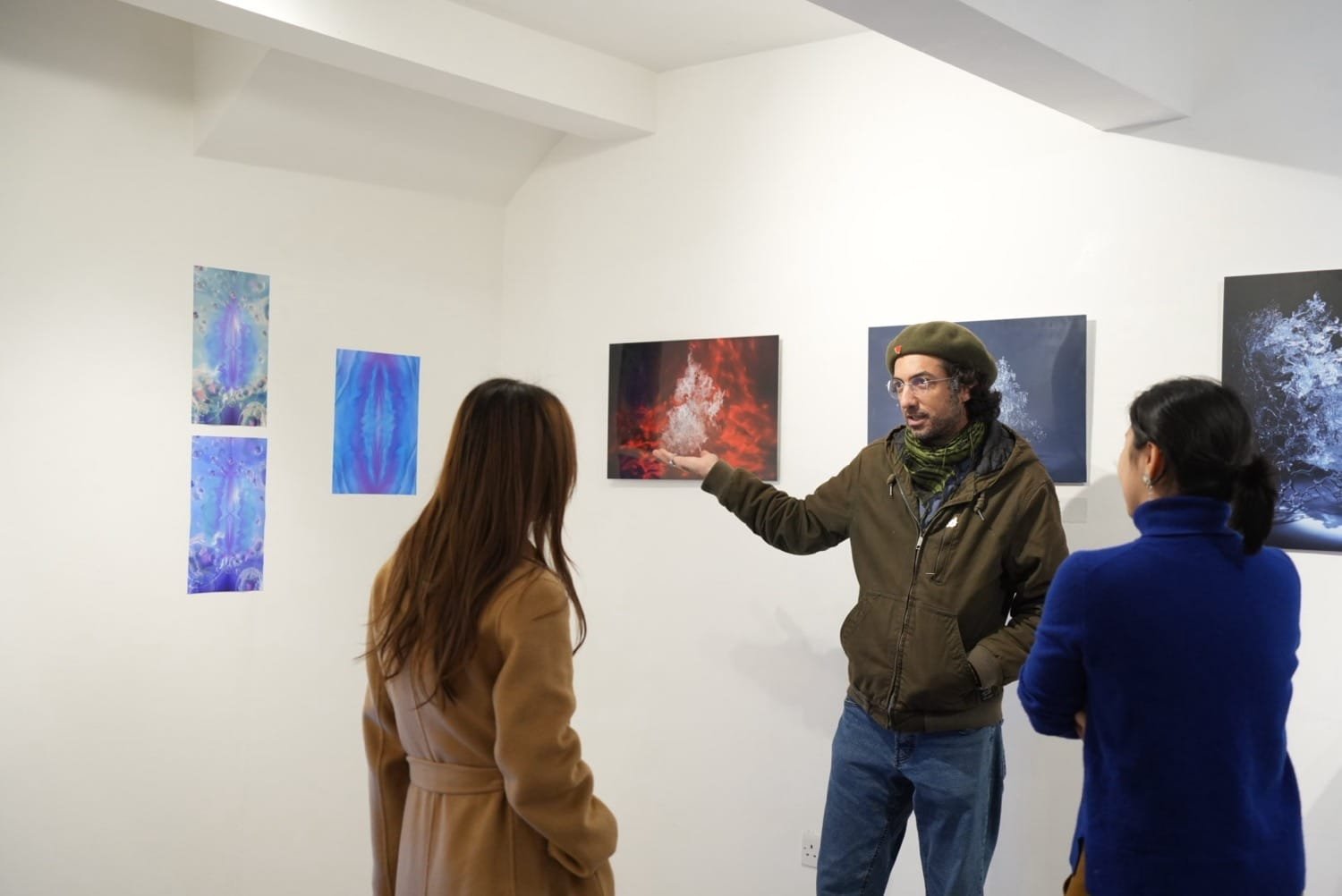
If Yuan maps the internal membrane, Shenlu Liu charts its external and spiritual extensions. Her works investigate how this membrane might be woven, fortified, and activated. SiO2. F8hz. T6s is a textile-based sculpture that mimics a living organism. Here, handwoven fibers and translucent silicone form a hybrid body, part mineral and part flesh. It is a speculative lifeform born not from nature, but from the very conditions of a life lived between the organic and the synthetic, the permanent and the temporary. This energetic anatomy can be read as a direct response to the drifting existence the exhibition explores.
This extension becomes explicitly strategic in Woven Sigils. In the highly secular, multicultural, and restless terrain of Hackney, Liu’s turn to ancient crafts of embroidery and beading to channel the energies of crystal arrays is a profound gesture. This is not a naive regression into mysticism. It is a calculated, intellectual strategy for re-establishing connection. The work acts as a spiritual resonator, creating a resonant organic web of healing intention. Liu transliterates spiritual practice into a material language, attempting to forge a system of connection that transcends specific cultural or identity labels—a necessary tactic for navigating the cultural fissures of a diasporic life.
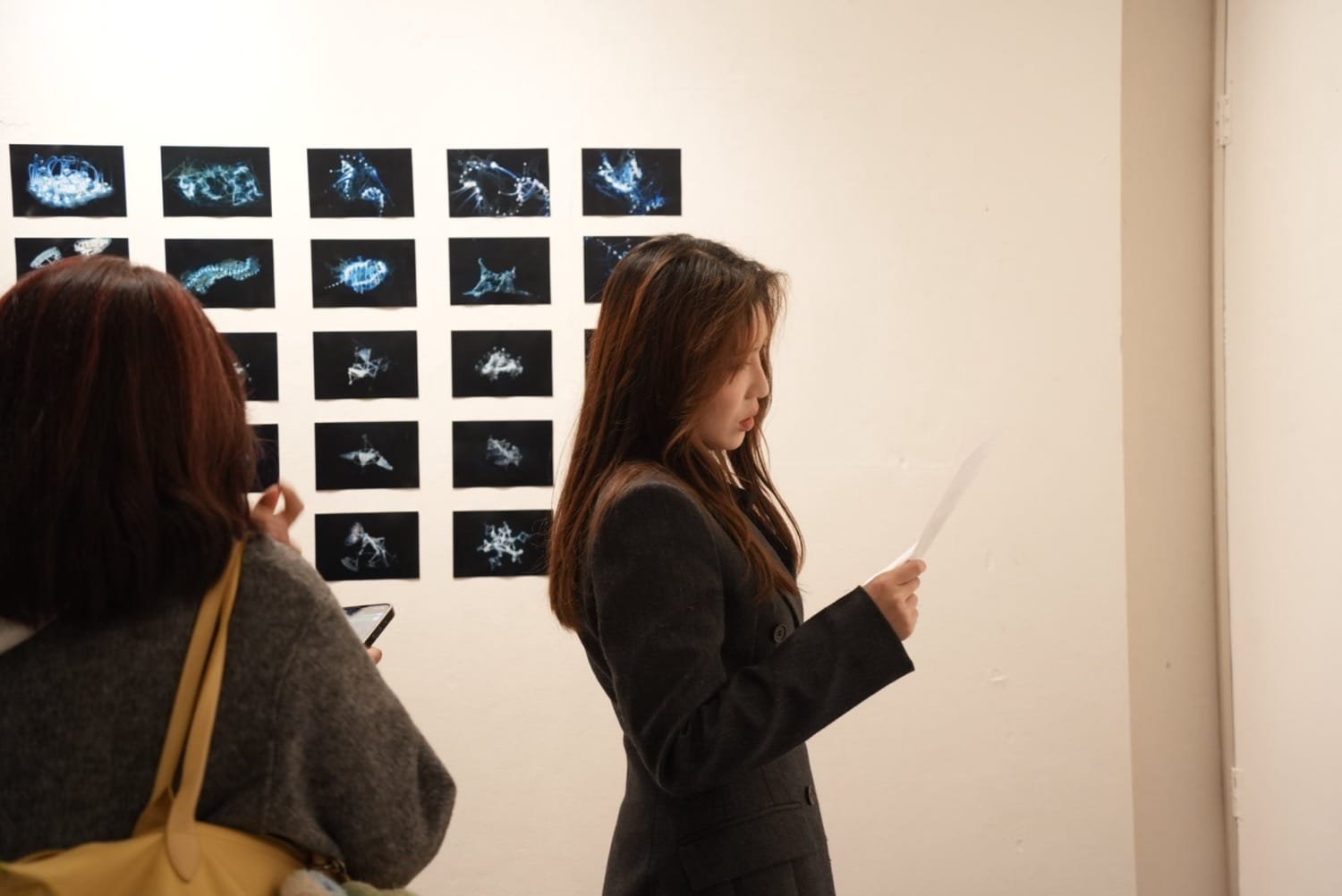
Yvette Yujie Yang’s work shifts the focus toward the critical state of the ‘Blue Membrane’ concept, concentrating on its dimensions of fragility, fracture, and erosion. Her practice is a stark meditation on the membrane’s inherent vulnerability, its inevitable depletion, and the severity of its creation process.
Her glass sculptures, Caerulea and Stillness of the Wind, present the membrane as a frozen, fractured state. Caerulea attempts to capture the very instant entropy unfolds, the moment order slips into chaos. The permanence and ephemerality of glass, its inherent fragility, becomes a material proxy for the precarity of the drifting existence. This is motion and stillness trapped in a paradox, a distortion of time that echoes the suspended state of the “blue” condition.
Stillness of the Wind is even more poignant. It is a dialectical dialogue about time, juxtaposing “driftwood” (a remnant carved and weathered by years) with molten glass branches. Yang clarifies that this is an attempt to freeze time, a fragile materialization of memory about life. One cannot help but see this as a perfect, devastating metaphor for the attempt to build structure and meaning within the rented spaces of a transient life—an attempt at entropy reduction that is known, from the outset, to be fragile and artificial.
Yang’s sharpest critique is leveled in The Otherness. Here, the “blue” of the membrane is explicitly identified with Denim, a material born from industrialization and mass labor. Yang uses bleach to inscribe withered leaf forms onto denim, creating images through erasure rather than addition. This single act connects all the exhibition’s themes. The blue fades to white, mirroring the slow erasure of biodiversity under industrial expansion. This work exposes the porous urban shell of Hackney not just as a site of multicultural potential, but also as a site of industrial erasure and othering. Yang’s statement is uncompromising: This is preservation as violence, memory as subtraction, archive as wound. It is a powerful, critical conclusion that implicates the entire system in which this “blue membrane” exists.
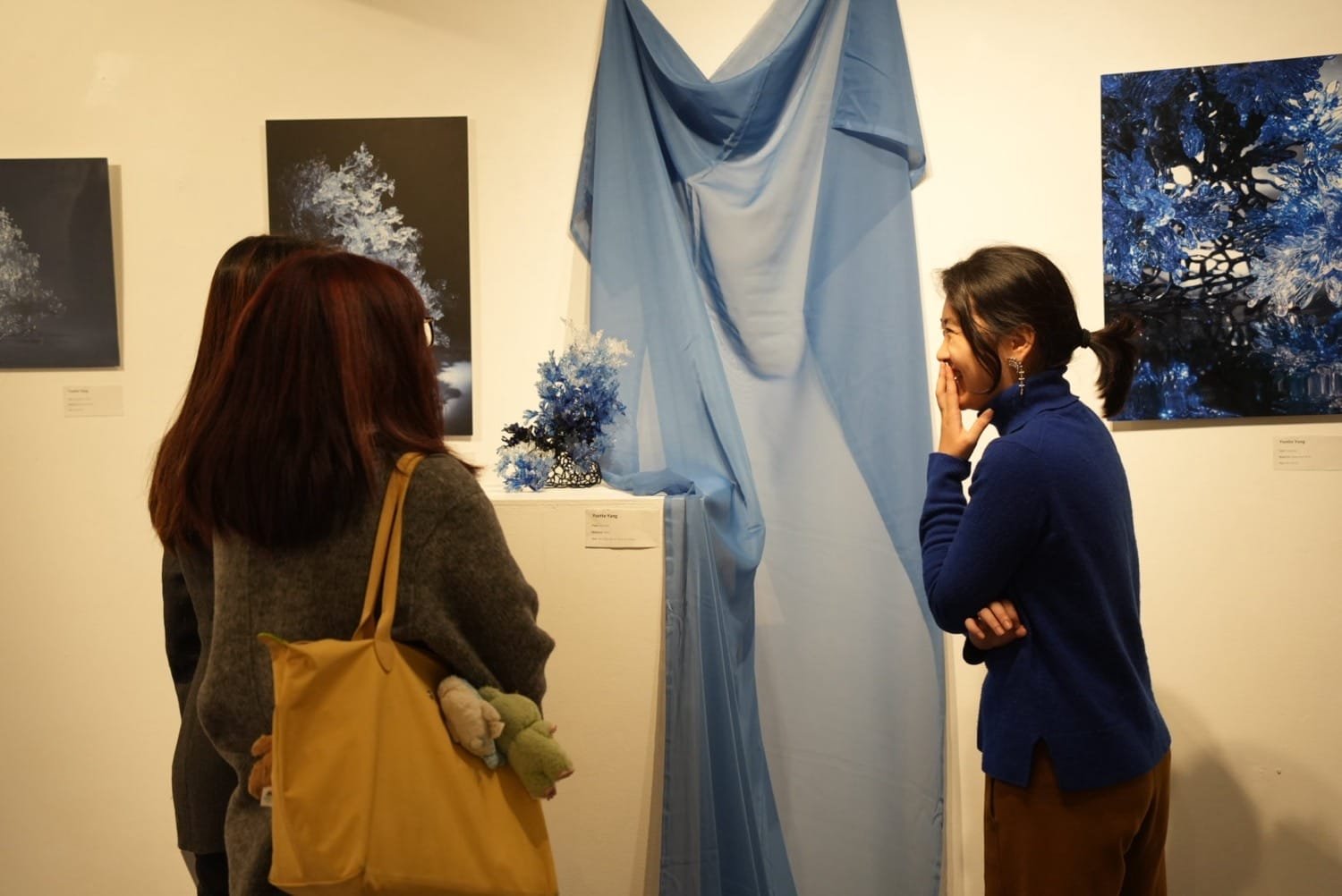
“Blue Membrane” does not resolve these tensions. It offers no simple healing. The curatorial text itself admits that the system fails to produce results, instead leaving gaps and echoes. This admission is the exhibition’s greatest strength. The collected works of Liu, Yuan, and Yang successfully transform the “blue membrane” from a passive state of numbness into an active, vibrating field of practice.
The exhibition confirms that art, here, is no longer just a metaphor for femininity or the body. It is a shared membrane that breathes with the viewer. “Blue Membrane” does not provide answers to the questions of identity and belonging in a precarious world. Instead, it provokes a more fundamental inquiry. It challenges the viewer to become an integral part of the sensory system, to enter this non-linear field of resonance and attune themselves to a “low-frequency, slow-burning” pulse. It is a damp, fragile, and quietly hopeful invitation, demanding a recalibration of our own perception—a shared breathing in the blue.
Written by Hanni Huang