


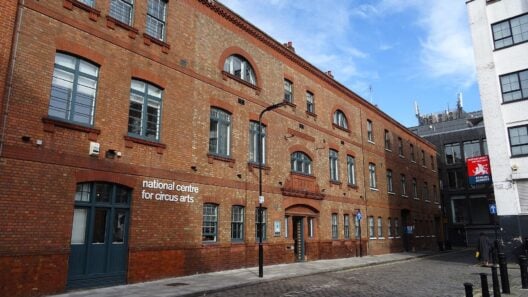
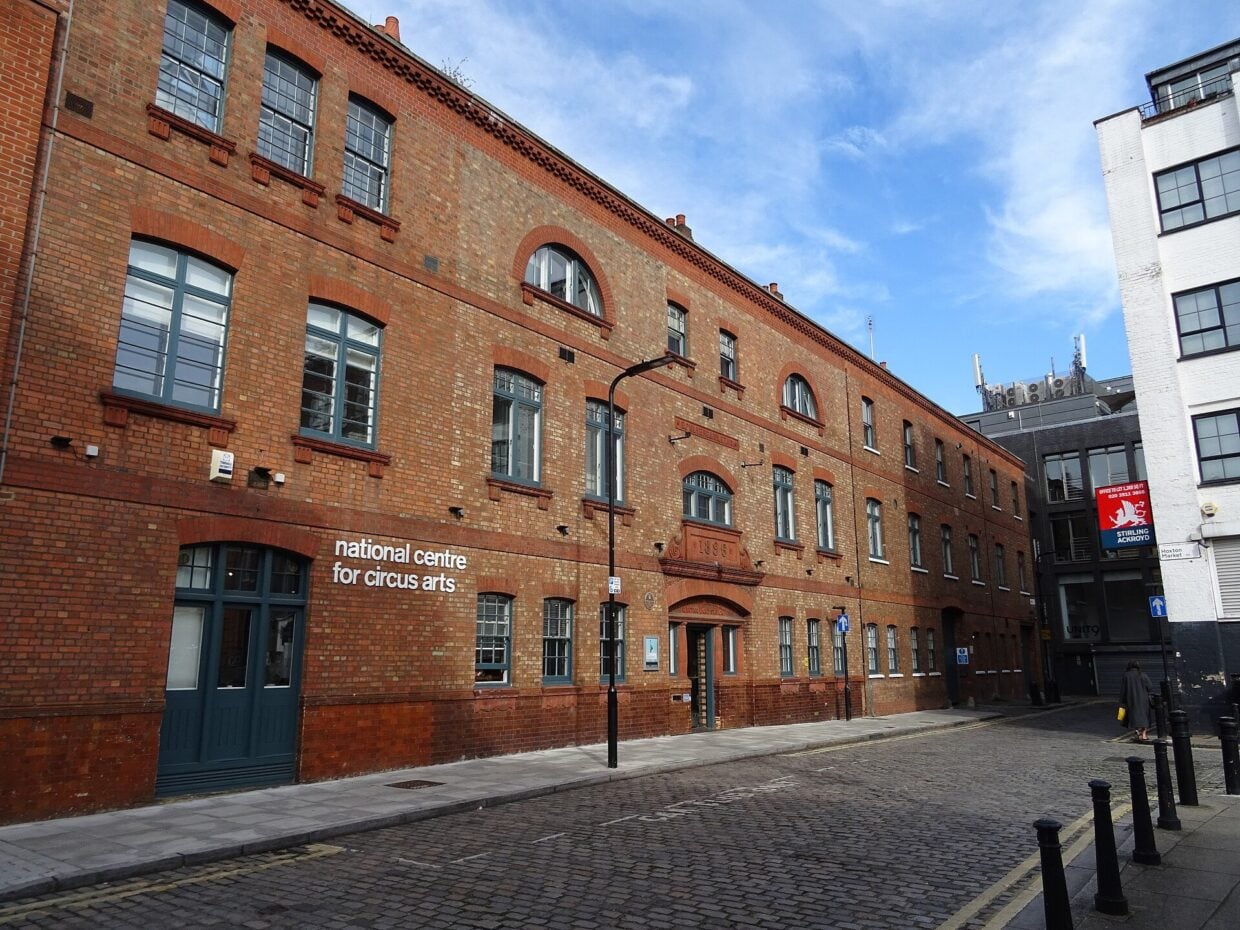
On 28 June 1897 Lord Kelvin opened a power station on Coronet Street in Shoreditch that made electricity by burning the parish’s rubbish. The building still stands, beside Hoxton Square, and is now the National Centre for Circus Arts.
On the front, facing Coronet Street, the builders set a motto in terracotta: E Pulvere Lux et Vis, Latin for “light and power from dust”.
Why a parish built a power station
The Vestry of St Leonard’s, which ran Shoreditch, decided in September 1891 to supply electricity itself, to stop private lighting companies from taking over the area. It was also looking for a cheaper way to get rid of about 20,000 tons of rubbish a year than sending it away by barge.
Its consulting engineer, E Manville, proposed doing both at once: burn the rubbish and use the steam to drive the generators. The vestry adopted the plan in 1893. Local ratepayers backed it at the 1894 election, and tenders went out in 1895.
How it worked
Carts tipped rubbish into hoppers that were lifted electrically above 12 furnace cells. The cells burned at about 2,000F under a 150ft chimney, and the leftover clinker was made into paving slabs.
The steam drove six engines and generators. Spent steam heated the slipper baths, a swimming pool and a public library built as part of the same scheme. The power lit 57 arc lamp posts in the streets.
The Greater London Industrial Archaeology Society calls it the first successful power station designed from the start to run on refuse. It credits the area’s rubbish, which burned well, and a large population of small businesses, “not to mention 300 pubs”, to buy the power.
In 1899 Shoreditch became the first local authority to put electric light into artisan housing, in its new flats on Nile Street, according to the society.
From power station to circus school
Demand soon outran what the rubbish could supply. By 1902 the vestry had built a coal-fired station beside the Regent’s Canal in Haggerston. By 1923 Coronet Street had become a distribution centre, and its converter station worked until the 1960s.
By the 1980s the streets around Hoxton Square were run down. A group of circus artists who had trained in North Road, Islington, raised money to restore it. It is now home to the National Centre for Circus Arts, a charity, and its halls are hired out for events as Shoreditch Electric.
The essentials
- Building: former Shoreditch Electricity Generating Station and Refuse Destructor
- Address: National Centre for Circus Arts, Coronet Street, London N1 6HD
- Opened: 28 June 1897, by Lord Kelvin
- Motto on the facade: E Pulvere Lux et Vis (light and power from dust)
- Nearest stations: Old Street (about four minutes’ walk), Shoreditch High Street