


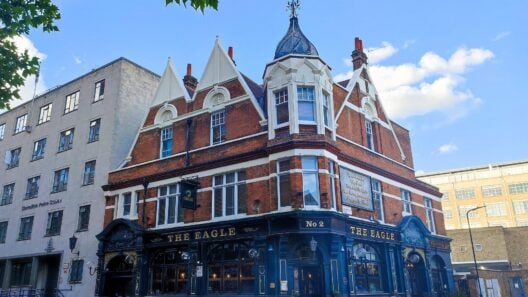
In the summer of 1882 the Salvation Army bought the lease of the Eagle Tavern, the pub off City Road named in Pop Goes the Weasel, so that it could stop people drinking there. The lease turned out to require it to keep the drinks licence.
The Spectator reported on 1 July 1882 that the Army had paid £16,750 for the lease of the Grecian Theatre and the Eagle, plus £365 a year in ground rent, for premises that held 5,000 people. The Archbishop of Canterbury started the public appeal for the money with £5.
The rhyme’s best-known London verse goes: “Up and down the City Road, / In and out the Eagle, / That’s the way the money goes, / Pop! goes the weasel.” Hackney Museum reads it as selling your coat to pay for drink.
A tavern in the fields of Shoreditch
The site, on what is now Shepherdess Walk in Hoxton, held a tavern called the Shepherd and Shepherdess before 1745, in a rural part of the parish of Shoreditch. Invalids stayed there for the country air, and it was known for cream cakes and furmety, a wheat porridge. The street is thought to take its name from it.
By June 1818 the tavern had become the Eagle. Thomas Rouse took the lease in 1822 and built it into one of the largest places of entertainment in London, with a pleasure garden, a dance floor, boxing and a theatre, according to a history of the site by Garth Hentzschel in the Australasian Journal of Salvation Army History.
The Grecian Saloon went up in its grounds in 1832 and was rebuilt as a theatre in 1841. It was licensed in 1858 as the Royal Grecian, with 2,500 seats, and a 4,000-seat theatre followed in 1877. The journalist and theatre manager John Hollingshead called the Eagle “the father and mother, the dry and wet nurse of Music Hall”. Charles Dickens sent two of his characters there in Sketches by Boz.
How the song got there
Pop Goes the Weasel began as a dance. By December 1852 it was being taught as a fashionable new number from the Court balls, and words were added by late 1854, possibly first sung at the Grecian. In 1856 a letter to the Morning Post complained: “For many months, everybody has been bored to death with the eternal grinding of this ditty on street.”
Nobody agrees on what the words mean. “Pop” was 19th-century slang for pawning, and City Road had a well-known pawnbroker in the 1850s. “Weasel” is often read as rhyming slang for coat, from “weasel and stoat”, although one writer notes that phrase is not recorded until the 1930s. The folklorists Iona and Peter Opie found that no one seemed to know the meaning even in the 1850s.
Licensed to sell beer
William Booth wanted the Grecian as a base for his preachers and sent an officer to the auction in disguise, Hentzschel writes. The Army opened its Grecian Corps and the Eagle Temperance Hotel on 21 September 1882. About 10,000 people came to the first meeting, and another 30,000 gathered outside to protest against the Army.
The temperance hotel did not last. The lease obliged the Army to keep the drinking licence, Hackney Museum says. Opponents went to court, and one case, which argued that the Army could not hold a licence without serving alcohol, succeeded. For a time a sign on the door read: “William Booth, licensed to sell beer, &c., to be drunk on and off the premises.”
Further legal action later took the tavern lease away from the Army, Hentzschel writes. In 1885 a 15-year-old Matilda Wood made her first professional solo appearance at the Royal Eagle Music Hall on 9 May, billed as Bella Delmere, according to the University of Kent’s special collections. By June she was performing as Marie Lloyd.
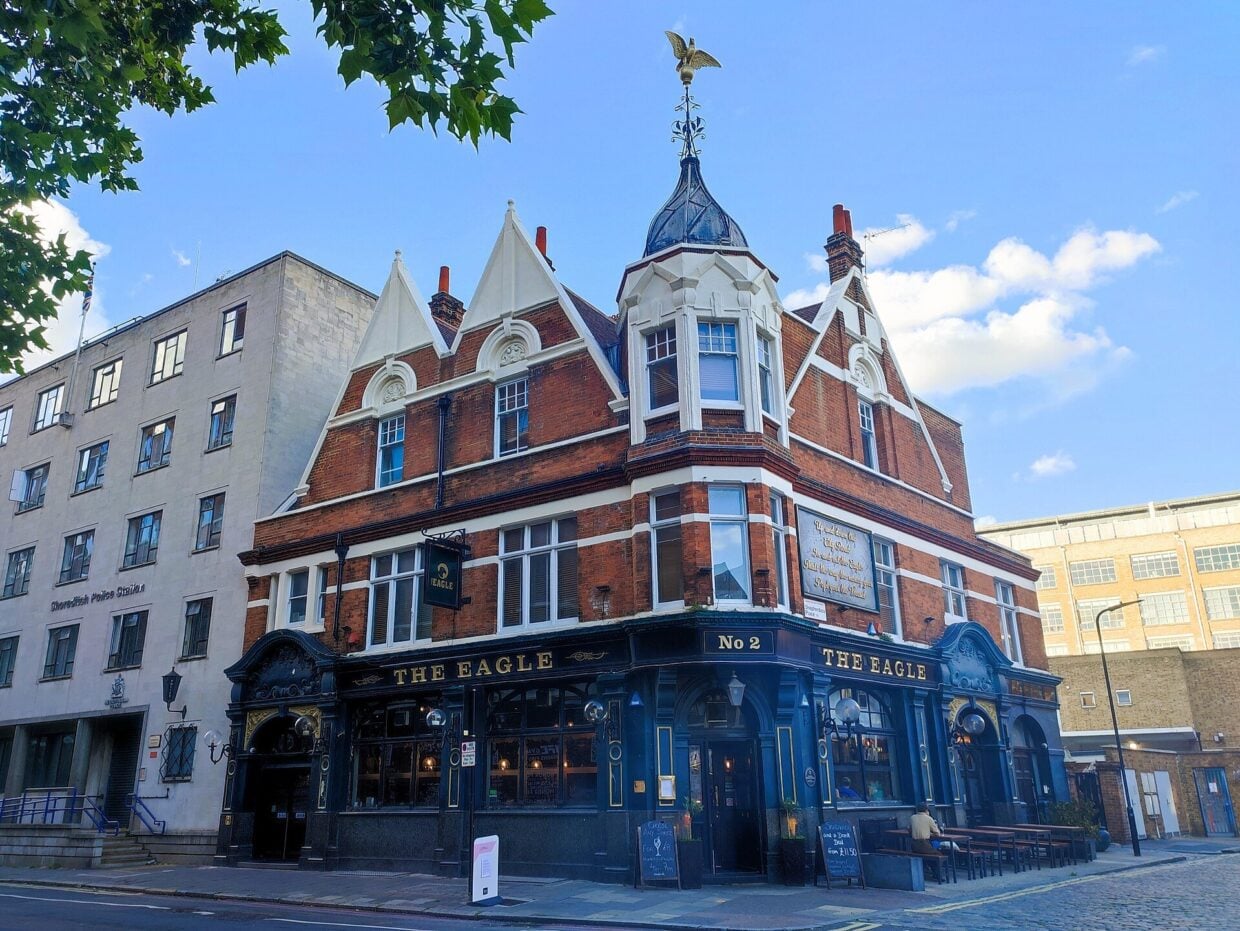
The Army’s Grecian Corps was forced out of the building after more court cases in late 1898. The theatre was demolished, and the present Eagle opened in August 1900. A police station was built on the theatre site a year later. The Grecian Corps became the Salvation Army’s Hoxton Corps, which Hentzschel says is still active.
The pub today
The Eagle still trades at 2 Shepherdess Walk, N1 7LB, a short walk from Old Street station. The City Road verse is painted on a plaque on its front, and a brown Hackney plaque records that the Eagle Tavern, the Grecian Theatre and its pleasure grounds stood there from 1825 to 1899, and that Marie Lloyd made her first public performance there in 1885.