






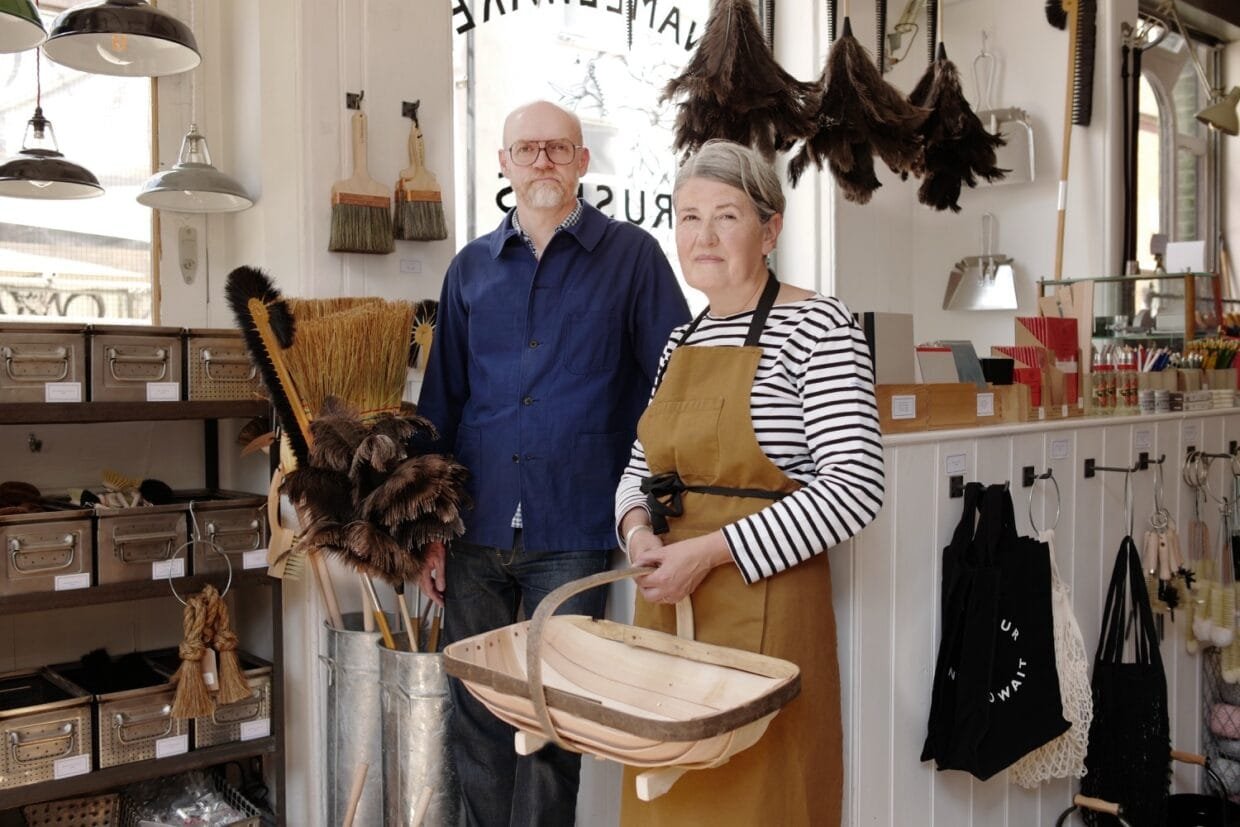
Labour and Wait has spent 25 years quietly rebelling against disposability. When you founded the shop in 2000, what gap in London’s retail landscape were you trying to fill — and at what moment did you realise your philosophy had struck a cultural nerve?
At the time, there was so much overdesigned product in the marketplace. It seemed that everything had to have a ‘Designer’ name attached to it, or it wasn’t considered to be of any worth. In our opinion there was too much novelty in design, which we felt would make the products date very quickly.
Your new Covent Garden location carries the patina of labour — a chapel, warehouse and seed merchant. How did the building’s history influence the way you imagined the space and the experience you want people to have when they walk in?
The feel of the building was key in our decision making. We had viewed other properties, but they didn’t excite us. If we were to open another shop, we wanted the customer to have a different experience, so that each shop would have its own personality. We have always harbored the idea of a shop which is a bit like a warehouse, where you feel you are getting a glimpse behind the scenes.
You often speak about permanence as something radical. In an age of fast retail and constant novelty, how do you resist the pressure to expand, modernise or ‘refresh’ for the sake of commercial expectation?
We still firmly believe in what you might call ‘Lifetime products’. Many items we sell have been stocked since day one. Our mission is to bring these products to our customer’s attention. We are still discovering great items, which we add to our assortment as and when. We don’t work to strict seasons as most retailers do.

Your backgrounds are rooted in design and menswear. At what point did your frustrations with seasonal churn turn into the conviction that timeless, utilitarian products could become a business — and a countercultural statement?
I think it was a gradual realisation. We both appreciated classic, anonymous design. As menswear designers, we were often referencing archetypal garments, but we knew we would rather have the real thing – the true classic item rather than a ‘version of’. Our appreciation of functional design applies equally to household goods as it does to clothing. We judge the merits of a sweater in the same way as we do a dustpan & brush, which is possibly unusual!
Labour and Wait’s aesthetic feels both local and global: Shoreditch pub-turned-flagship, Tokyo shop, Korean concession, Covent Garden warehouse. How do you maintain the brand’s character while adapting to very different cultural contexts?
It’s all about the product. We have always believed that true classics have a place in any environment. The goods that we sell can fit in a period setting, or a very modern one. Sometimes people perceive our aesthetic as nostalgic, but we appreciate history and modernity in equal measure. Timelessness is our goal. You can find our aesthetic reflected in our Shoreditch pub-turned-flagship and beyond.
You’ve championed traditional makers long before ‘heritage’ became a trend. How do you discover craftspeople and manufacturers who align with your ethos, and what does a partnership need to look like for it to endure?
We have always appreciated the handmade, not just craft objets to be admired on a shelf, but items to be used in daily life. Sometimes we are given a lead about individual makers, and sometimes they find us. We are very adaptable, some makers can only make limited numbers, whereas others are able to scale up production. We feel it is very important to support these makers, they are passionate about what they do. Handmade products are life enhancing.
The new shop allows customers to see the workroom in action — a rare level of transparency in retail. Why was it important for you to bring the behind-the-scenes process into the public eye?
People are fascinated to see the workings of the business. Customers have been known to ask if we make everything downstairs! Whilst we don’t do that, there is quite a bit of processing that goes on behind the scenes. In addition, we now have the ability to fulfil online orders from the shops, and spend our lives surrounded by mountains of cardboard and brown paper!
As you mark 25 years and enter a new chapter, what questions are you asking yourselves now about the future of Labour and Wait, and what does longevity mean to you today as designers, retailers and custodians of everyday classics?
We will simply continue on our path. Our aims and objectives are the same now as they were when we first opened. We hope to provide timeless products which people can enjoy using in their daily lives, and hope that more people will appreciate what already exists, rather than constantly looking for ‘the next thing’.