


The Boundary Estate, the ring of red-brick blocks around Arnold Circus just off Shoreditch High Street, was opened by the Prince of Wales in March 1900. The London Archives describes it as the world’s first council housing estate.
It was built by the London County Council on the site of the Old Nichol, one of the most notorious slums in London, on the border of Shoreditch and Bethnal Green.
The Old Nichol
The Old Nichol was known for its overcrowding and poverty. Arthur Morrison set his 1896 novel A Child of the Jago there. When the council cleared it, 730 houses were demolished and more than 5,000 people were moved out, according to The London Archives. Even the street name Old Nichol Street was changed.
Few of the people who lived in the slum came back. The London Archives says they were not rehoused in the new buildings, and the London Gardens Trust says few of them could afford the new rents.
What the council built
The estate was designed by the LCC’s architects, with Owen Fleming in charge. It has tree-lined streets running out from a central circus, with mostly five-storey blocks. The London Archives puts the total at 1,069 homes for 5,524 people.
The council also built 18 shops, a surgery, workshops, a central laundry with bathrooms and two clubrooms. The blocks were named after Thames riverside places such as Taplow, Walton and Cookham, according to a contemporary report of the opening.
The estate drew attention from abroad and influenced housing schemes in Paris, Amsterdam, Berlin and Vienna, according to the London Gardens Trust.
Why Arnold Circus is a mound
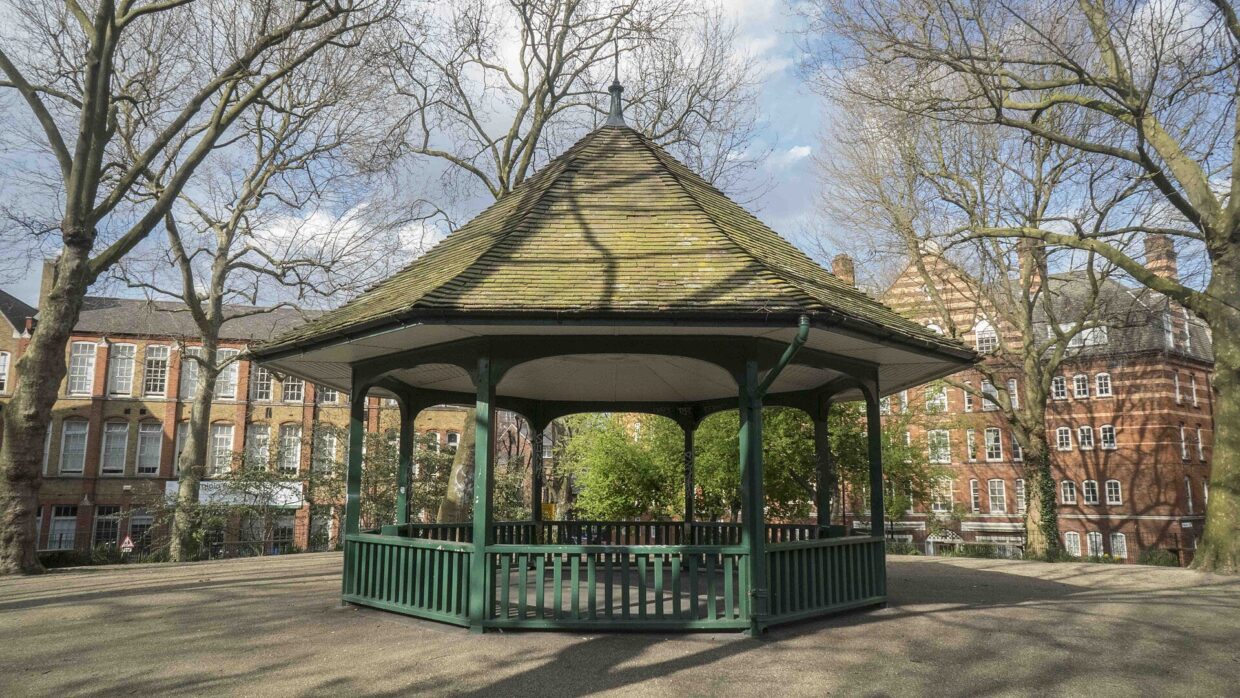
Arnold Circus, the raised garden at the centre, was made from the earth dug out for the foundations of the blocks. Piling it up in the middle saved the cost of carting it away. The bandstand at the top was built in 1899.
Four flights of steps lead up from the compass points to the bandstand. The garden was restored in 2009 and 2010 after a campaign by the Friends of Arnold Circus, a residents’ group set up in 2004. The bandstand and the estate blocks are Grade II listed, and the garden is open at all times.
The opening
The Prince and Princess of Wales opened the estate on Saturday 3 March 1900. “There is no question at the present time of greater social importance than the housing of the working classes,” the Prince told the crowd, as reported at the time.
The essentials
- Where: Arnold Circus, London E2 7JF, between Shoreditch High Street and Bethnal Green
- Getting there: Shoreditch High Street (London Overground) is the nearest station; enter by Calvert Avenue
- Opened: 3 March 1900, by the Prince of Wales
- Garden: open at all times
- Listed: the bandstand and the estate blocks are Grade II listed
Video
Arnold Circus is a short walk from Brick Lane and Columbia Road flower market. For more on the area, see our Shoreditch area guide.