




Le Corbusier and Frank Lloyd Wright are two of the architects most often named as the founders of modern architecture, the style that dropped historical ornament for steel, glass and reinforced concrete in the first half of the 20th century. Antoni Gaudí is often listed with them, but he belonged to a different movement, Catalan Modernisme, and his buildings look nothing like theirs.
Le Corbusier (1887 to 1965)
Le Corbusier was born Charles-Édouard Jeanneret in La Chaux-de-Fonds, Switzerland, and took the name Le Corbusier in 1920. He worked mainly in France. In the mid-1920s he set out five points for a new architecture: buildings raised on pilotis, or columns, a free plan, a free facade, long horizontal windows and a roof garden.
The Villa Savoye at Poissy, outside Paris, built from 1928 to 1931, puts all five into one house. His Paris houses for Raoul La Roche and his brother Albert Jeanneret now hold the Fondation Le Corbusier. In 2016 UNESCO added 17 of his works in seven countries to the World Heritage list.
Frank Lloyd Wright (1867 to 1959)
Frank Lloyd Wright led the Prairie School, low houses with long horizontal lines that he designed in and around Chicago in the early 1900s. He called his approach organic architecture, meaning buildings shaped by their site and materials.
Wright designed 1,141 works, of which 532 were built, according to the National Building Museum. His best known building, Fallingwater, a house over a waterfall in Pennsylvania, was designed in 1935 and built between 1936 and 1939. In 1991 members of the American Institute of Architects voted it the “best all-time work of American architecture”. It is one of eight Wright buildings UNESCO listed together in 2019, along with the Guggenheim Museum in New York.
Antoni Gaudí (1852 to 1926)
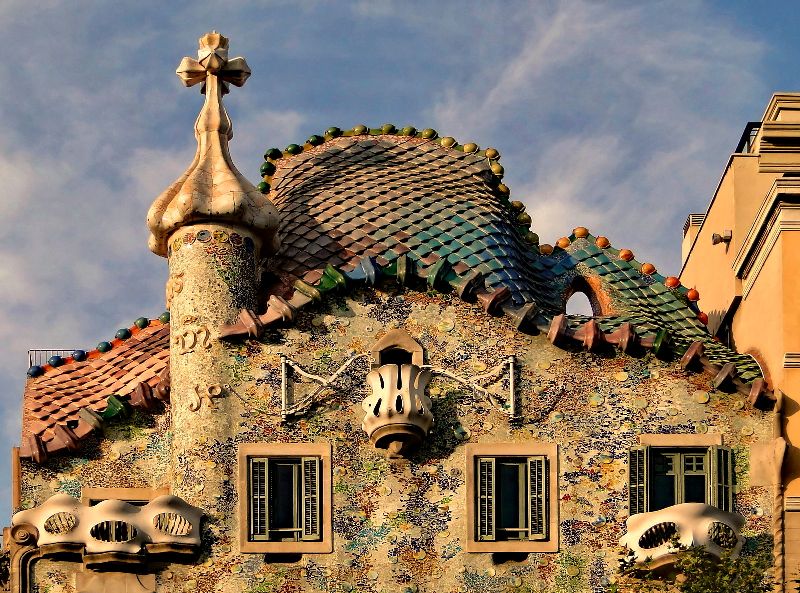
Gaudí was the leading architect of Catalan Modernisme, Barcelona’s version of art nouveau, and his work is closer to that than to the modernism of Le Corbusier. His buildings use curves taken from nature and trencadís, mosaics made from broken tiles.
His main works are in Barcelona: Casa Vicens, Park Güell, Casa Batlló, Casa Milà and the Sagrada Família basilica, which he took over in 1883 and worked on until his death in 1926. UNESCO listed his works as a World Heritage site in 1984 and extended the listing in 2005.
Modernism in East London
The nearest example of the style to Shoreditch is Balfron Tower in Poplar, designed by the Hungarian-born architect Ernő Goldfinger and built between 1965 and 1967. Its separate service tower is joined to the flats by bridges on every third floor. Historic England upgraded it to Grade II* in 2015.
For more on art and design, see 20th century art movements explained.