




No beer has been brewed at 91 Brick Lane since 1989. The ten acres behind the gates, known to most people as the Old Truman Brewery, now hold workspace, independent shops, cafes, galleries, bars, music venues, street food and markets, on a site the London Museum says “evolved from one founded on this site in the 1660s”.
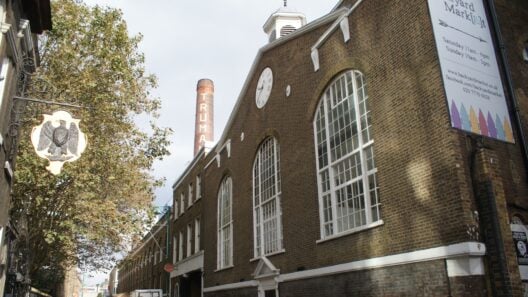
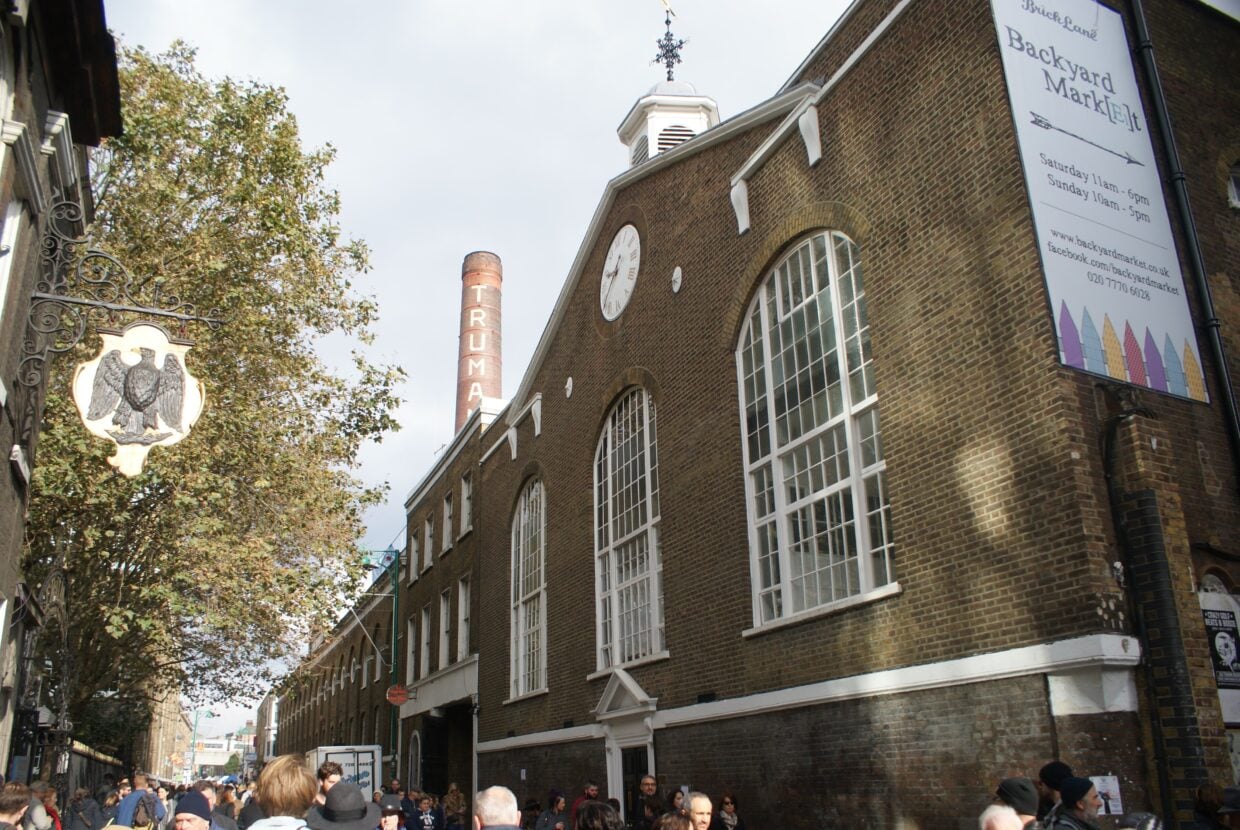
That phrasing matters, because the brewery’s origin story is tidier than the paperwork behind it. The firm that grew here brewed porter on a scale that drew sightseers, bought a Burton-upon-Trent plant to make pale ale, passed through two takeovers in the 1970s and stopped brewing altogether in 1989. What survives is the ground plan: brick buildings on both sides of Brick Lane, set around the yards the draymen worked from.
A brewhouse off Brick Lane in the 1660s
The Brewery History Society records that the Black Eagle Brewery “was built by Thomas Bucknall in about 1666 and it was acquired by Joseph Truman in 1679”. That 1666 date is traditional rather than documented, and the Survey of London’s volume on Spitalfields is careful about it. Bucknall, a citizen and merchant taylor, was let land off Brick Lane in 1669 by John Stott and died in 1679. He put up two new houses on that ground, “but there is no proof that he erected the brewhouse”.
Joseph Truman first appears in Spitalfields in August 1683, described as a brewer “of brick lane”. The earliest lease to him the Survey could trace is dated 1694 and covers a messuage, brewhouse, granary and stable with two small pieces of land, along with the use of two passages, one into Pelham Street (now Woodseer Street) and one into Brick Lane. He paid £10 in 1694 to avoid serving as overseer of the poor in Spitalfields hamlet, and served as churchwarden from 1699 to 1701.
In 1701 Truman took a sub-lease from Humphrey Neudick on a plot eighty feet square fronting the west side of Brick Lane, with a dwelling house and brewhouse already standing on it. The documents are too vague to say who built them or when. The firm detail about the shape of the place is that in 1681 and 1682 the buildings on this stretch were already set around an entrance yard, close to the arrangement the brewery kept later.
Porter, steam and 200,000 barrels a year
Benjamin Truman, born around 1700, became a partner in 1722 and was knighted in 1760. After his death Sampson Hanbury joined the business, and in 1811 Thomas Fowell Buxton, then 25, came in as a partner. The firm traded as Truman Hanbury & Buxton & Co and was registered in January 1889. The Brewery History Society also lists a trade mark entry for an eagle, number 40,779, applied for on 10 November 1884.
By 1835 the Brick Lane works was harnessing steam power and producing, according to the London Museum, 200,000 barrels of porter a year. The complex “was compared to a small town and attracted curious sightseers”. It was written up in The Noted Breweries of Great Britain and Ireland, published by Alfred Barnard in 1890.
Porter was the house product; pale ale was the gap. To brew it, the company bought Phillips Bros Brewery in Burton-upon-Trent in 1873, rebuilt it and brewed there until 1971. The owner’s current consultation website says that by 1873 the business was “the largest brewery in the world”, a claim about the company at its height rather than the Brick Lane plant alone. The owner’s About page describes the Brick Lane site as “once home to London’s largest brewery”.
The end came with the mergers of the 1970s. Grand Metropolitan Hotels bought the company in 1971 and the name changed to Truman Ltd. From October 1974 it was merged with Watney Mann. Brewing ceased in 1989, after which, the consultation site says, the site “fell into a largely derelict state” before close to 30 years of regeneration put it back into commercial use.
What the ten acres hold now
The operator describes the site today as “exclusively independent shops, cafes, galleries, and markets”, with workspace for creative businesses, music venues, bars, street food and event spaces across the ten acres at 91 Brick Lane, E1 6QL. Truman is a registered trade mark of Zeloof LLP. The beer is not brewed here.
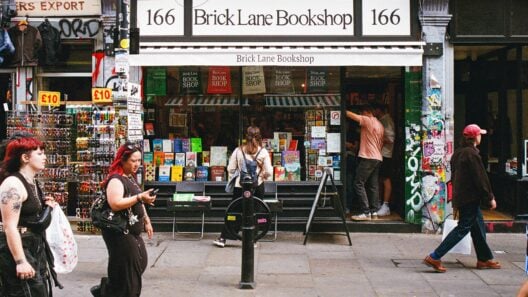
The markets in the yards are the part most visitors see, and they sit within the wider pull of Brick Lane in 2026, from curry houses and bagel shops to vintage rails and street art. Trade continues midweek too: Dray Walk Gallery is hosting a Joseph Cheaney & Sons sample sale from 17 to 22 November, open 10am to 7pm until Saturday and 11am to 4pm on Sunday 22 November.
Survival on this scale is unusual in the East End. Columbia Market, opened in 1869 and demolished in 1958, was the grander Victorian project and left nothing standing. The brewery buildings stayed because they kept finding commercial tenants.
The owner is now consulting on redevelopment, saying large areas of the site are “failing to meet their full potential”. Whatever is agreed, the entrance yard recorded in the early 1680s is still the way in from Brick Lane.